In a significant stride toward addressing one of the most persistent environmental challenges of the 21st century, scientists at the Helmholtz-Zentrum Dresden-Rossendorf (HZDR) have begun rigorous testing of two pioneering technologies designed to neutralize per- and polyfluoroalkyl substances (PFAS). Known colloquially as "forever chemicals" due to their near-indestructible nature, PFAS have become a global concern, contaminating water supplies and ecosystems across every continent. The HZDR initiative, supported by the Helmholtz Centre for Environmental Research (UFZ), focuses on the systematic destruction of these compounds rather than merely filtering or relocating them, marking a potential paradigm shift in wastewater management.
The Global Crisis of "Forever Chemicals"
PFAS represent a vast family of more than 10,000 synthetic industrial chemicals that have been utilized since the 1940s in a myriad of applications, from non-stick cookware and grease-resistant food packaging to waterproof clothing and aqueous film-forming foams (AFFF) used in firefighting. Their utility stems from the carbon-fluorine bond, which is among the strongest and most stable in organic chemistry. However, this same stability ensures that they do not break down under natural conditions, leading to their bioaccumulation in the environment and the human body.
The health implications are increasingly alarming. Extensive research suggests that certain PFAS compounds are linked to developmental delays in children, decreased fertility in women, hormonal interference, increased cholesterol levels, and a heightened risk of several types of cancer, including kidney and testicular cancer. Despite these risks, the sheer volume of these chemicals in the global supply chain makes their eradication a monumental task.
In Germany, the urgency of this research is underscored by recent findings in the Elbe River. High concentrations of PFAS have been detected in the waterway, posing a direct threat to aquatic life, agricultural productivity, and the safety of drinking water for millions. This environmental reality has placed the HZDR’s work at the heart of Germany’s "National Water Strategy," a federal framework aimed at securing the country’s water future by 2050.
Breaking the Unbreakable: The Hydrodynamic Cavitation Approach
The first of the two technologies under investigation at HZDR is hydrodynamic cavitation. Led by postdoctoral researcher Dr. Ysabel Huaccallo-Aguilar and overseen by Dr. Sebastian Reinecke, head of the Department of Water and Environmental Technologies, this method leverages the physics of fluid dynamics to create localized, extreme conditions capable of tearing apart PFAS molecules.
The process involves forcing PFAS-contaminated water through a physical constriction, such as a nozzle or a venturi tube. As the water accelerates through the narrow passage, its pressure drops below its vapor pressure, causing the formation of millions of microscopic vapor bubbles. When the water exits the constriction and pressure returns to normal, these bubbles collapse—or "implode"—violently.
"When the bubbles burst under the rising ambient pressure downstream of the constriction, the PFAS that are attached to the bubbles are exposed to local temperature spikes of several thousand degrees Celsius," Dr. Reinecke explains. This "micro-furnace" effect provides the thermal energy required to snap the carbon-fluorine bonds.
Furthermore, the cavitation process generates highly reactive hydroxyl radicals. These short-lived molecules act as aggressive oxidants, attacking the intermediate products formed during the initial stages of PFAS degradation. In preliminary tests involving perfluorooctane sulfonate (PFOS)—one of the most difficult PFAS variants to destroy—the team achieved a 37 percent degradation rate. While this is a promising start, the HZDR researchers are currently optimizing the process to exceed an 80 percent degradation rate and achieve 50 percent mineralization of fluorine, converting the harmful chemical into harmless fluoride salts.
Cold Atmospheric Plasma: High-Energy Molecular Assault
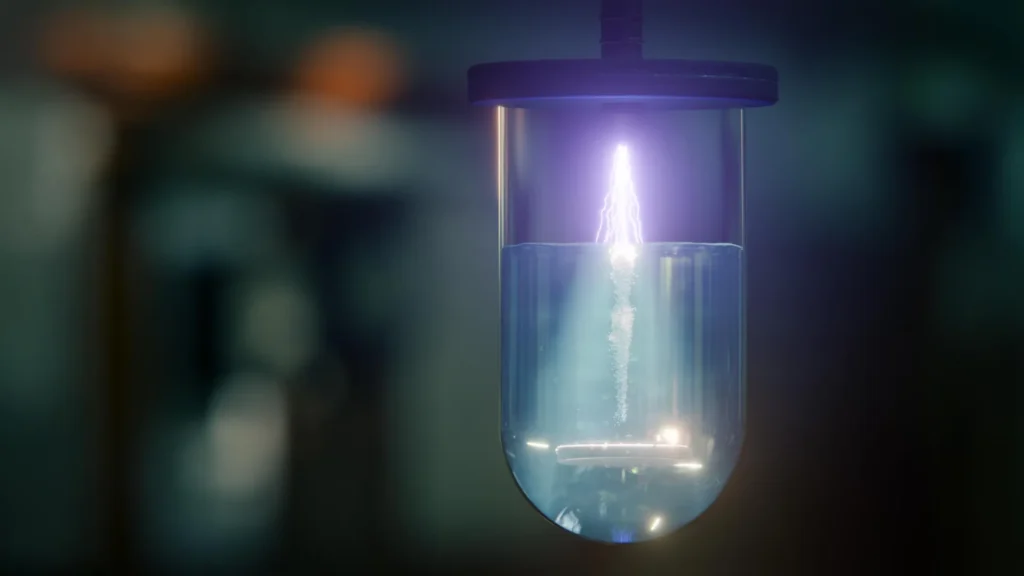
The second technology, developed by environmental engineer Dr. Amit Kumar, utilizes cold atmospheric plasma combined with gas dispersion. Unlike thermal plasma, which requires extreme heat, cold atmospheric plasma operates at room temperature and normal atmospheric pressure, making it a more versatile option for large-scale water treatment.
In this setup, plasma—a fourth state of matter consisting of ionized gas—is generated at the surface of the water. Simultaneously, gas is bubbled through the contaminated liquid. Because PFAS molecules are surface-active (surfactants), they naturally migrate to the interface of the gas bubbles. As the bubbles rise to the surface, they "carry" the PFAS directly into the plasma zone.
The results of the plasma treatment have been striking. The method demonstrated the ability to almost completely degrade both long-chain and short-chain PFAS variants. It also successfully released approximately 35 percent of the bound fluorine atoms, converting them into fluoride.
However, the plasma approach is not without its hurdles. Dr. Reinecke notes that while the reaction kinetics are significantly faster than cavitation, the energy consumption is substantially higher. "In addition, the process generates numerous transformation products that we have not yet been able to investigate in detail," Reinecke warns. These include potential gaseous compounds that may form during the reaction, necessitating further study to ensure that the "cure" does not create new environmental hazards.
A Chronology of Innovation and Collaboration
The HZDR’s journey into PFAS destruction began in earnest in 2022 with a preliminary study focused on the viability of cavitation. This initial phase was designed to prove that the mechanical energy of collapsing bubbles could indeed mineralize organically bound fluorine.
Following the success of the 2022 trials, the project expanded into its current multi-pathway approach. The specialized analyses required to confirm molecular degradation were conducted by the Helmholtz Centre for Environmental Research (UFZ). Using advanced mass spectrometry and ion chromatography, UFZ specialists verified that the treatment was not simply hiding the PFAS, but actually breaking the chemical bonds and releasing fluoride ions.
The research is currently entering a scale-up phase. The team is adapting the plasma system to handle larger volumes of water, moving from laboratory-scale 50-milliliter samples to five-liter experimental reactors. This involves the integration of multiple electrodes and sophisticated technical gas injectors to maintain efficiency at higher volumes.
Strategic Funding and Official Support
The significance of this research is reflected in its robust funding structure. The work is supported by the Helmholtz Association’s Impulse and Networking Fund through the Clean Water Technology Lab (CLEWATEC). CLEWATEC serves as a "Helmholtz Innovation Lab," a bridge between fundamental research and industrial application.
Furthermore, the specific projects "HyKaPro SAB-EFRE" and "Plasma4PFAS SAB-EFRE" are co-financed by the European Union and the Free State of Saxony. This financial backing highlights the strategic importance of the research to the Saxon Parliament and the broader European goal of achieving a "Zero Pollution" environment.
While official statements from the Saxon State Ministry for Energy, Climate Protection, Environment, and Agriculture have generally praised the initiative, there is an underlying expectation for these technologies to be commercialized rapidly. As the European Chemicals Agency (ECHA) considers a near-total ban on the production and use of PFAS, industries are under immense pressure to find viable wastewater treatment solutions.
Analysis of Implications: A Future Hybrid System
The ultimate goal for the HZDR researchers is not to choose one technology over the other, but to synthesize them into a hybrid system. By combining the mechanical efficiency and radical production of hydrodynamic cavitation with the rapid reaction kinetics of cold atmospheric plasma, the team believes they can create a highly efficient, cost-effective industrial solution.
"I believe we’ll achieve high degradation rates by combining the highly reactive species from the plasma with the effects of cavitation," says Dr. Reinecke.
If successful, this hybrid technology would offer several advantages:
- Energy Efficiency: Using cavitation to handle the bulk of the degradation and plasma for the "polishing" stage could optimize energy use.
- Comprehensive Treatment: The system could address both long-chain and short-chain PFAS, which often require different treatment intensities.
- On-Site Application: The technology is being designed for integration into existing industrial wastewater streams, allowing factories to treat their effluent before it ever reaches municipal systems or natural water bodies.
The Road Ahead
As the HZDR team continues its follow-up experiments, the global scientific community is watching closely. The transition from "removing" PFAS (which usually involves activated carbon filters that then must be incinerated at extremely high temperatures) to "destroying" them in situ is the "holy grail" of environmental engineering.
The broader impact of this research extends beyond the Elbe River. If these technologies can be scaled effectively, they could be deployed in PFAS "hotspots" worldwide, including former military bases, industrial parks, and airports. By breaking the "forever" cycle of these chemicals, HZDR and its partners are providing a blueprint for how advanced physics and chemistry can be harnessed to undo decades of environmental damage.
The path to 2050 and the fulfillment of the National Water Strategy remains long, but the progress made in the laboratories of Dresden-Rossendorf suggests that the era of "forever chemicals" may finally have an expiration date. Through the diligent application of hydrodynamic cavitation and cold plasma, science is proving that even the strongest bonds in nature can be broken when met with human ingenuity.