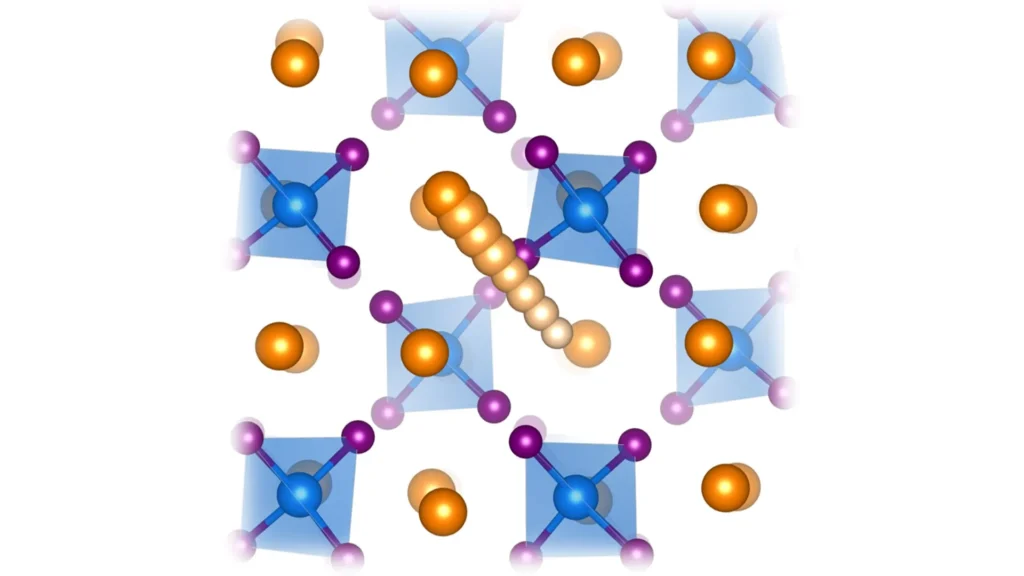
The quest for safer, more energy-dense power sources has propelled all-solid-state batteries (ASSBs) to the forefront of energy storage research. These next-generation batteries promise to overcome the inherent safety risks and performance limitations of traditional lithium-ion batteries, which rely on flammable liquid electrolytes. However, realizing the full potential of ASSBs hinges critically on the development of solid electrolytes capable of rapid ion transport. Identifying such materials has historically been a protracted and resource-intensive endeavor, often involving laborious synthesis, extensive experimental characterization, and computationally demanding simulations that frequently falter in accurately modeling the complex, disordered behavior of ions, particularly at the elevated temperatures necessary for practical operation.
The Promise and Peril of All-Solid-State Batteries
All-solid-state batteries represent a paradigm shift in battery technology. By replacing flammable liquid electrolytes with solid counterparts, ASSBs offer enhanced safety, eliminating the risk of thermal runaway and fires that plague conventional lithium-ion cells. Beyond safety, they hold the potential for higher energy densities, longer cycle lives, and simplified packaging, paving the way for revolutionary advancements in electric vehicles, portable electronics, and grid-scale energy storage. The theoretical energy density of some solid-state chemistries could surpass 500 Wh/kg, significantly outperforming current lithium-ion technology, which typically ranges from 150-250 Wh/kg. Companies like Toyota, Solid Power, and QuantumScape are investing heavily in this space, with prototypes already demonstrating impressive performance metrics, albeit still facing scalability challenges.
Despite their immense promise, ASSBs face significant hurdles. One of the most critical is the limited ionic conductivity of solid electrolytes compared to their liquid counterparts. For an ASSB to be competitive, its solid electrolyte must exhibit ionic conductivity on the order of 10⁻³ to 10⁻² S/cm at room temperature, comparable to or exceeding that of liquid electrolytes. Achieving this level of conductivity in a solid material, which by nature restricts atomic movement, is a formidable scientific and engineering challenge. Furthermore, issues such as high interfacial resistance between the solid electrolyte and electrodes, mechanical stability, and manufacturability at scale continue to be active areas of research.
The Bottleneck: Traditional Discovery Methods and Computational Hurdles
Traditionally, the search for novel solid electrolyte materials has been a laborious, trial-and-error process. Scientists would synthesize new compounds, often in small batches, and then subject them to a battery of experimental tests, including impedance spectroscopy, X-ray diffraction, and scanning electron microscopy, to characterize their properties. This iterative cycle of synthesis and characterization is time-consuming and expensive, limiting the number of materials that can be explored.
Complementing experimental efforts, computational materials science plays a crucial role. Techniques such as Density Functional Theory (DFT) and Molecular Dynamics (MD) simulations can predict material properties from first principles, offering insights into atomic structures and dynamic processes. However, these methods, while powerful, encounter significant limitations when applied to the complex, disordered systems characteristic of fast-ion conductors. Accurately modeling the behavior of ions at high temperatures, where thermal fluctuations lead to significant atomic disorder, pushes the boundaries of conventional computational power.
A particularly vexing challenge lies in detecting and predicting what researchers term "liquid-like" ion motion within a solid crystal lattice. In superionic conductors, ions effectively "melt" and move freely through a rigid sublattice of other ions, akin to how ions move in a liquid electrolyte, even though the material remains structurally solid. Standard computational techniques designed to calculate the properties of such dynamically disordered systems demand exceptionally high computing power. Simulating these complex dynamics accurately over meaningful timescales and system sizes often renders large-scale, systematic studies impractical, effectively creating a bottleneck in the discovery pipeline for advanced battery materials.
Machine Learning Revolutionizes Material Characterization
To surmount these long-standing challenges, a team of researchers has pioneered an innovative machine learning (ML) accelerated workflow. This groundbreaking approach synergistically combines ML force fields with advanced tensorial ML models to accurately simulate Raman spectra, providing unprecedented insights into ionic behavior within solid materials. This represents a significant leap forward in computational materials science, leveraging the predictive power of artificial intelligence to expedite scientific discovery.
Machine learning has rapidly emerged as a transformative tool across various scientific disciplines, and materials science is no exception. ML algorithms can identify intricate patterns and correlations within vast datasets that might elude human intuition or conventional analytical methods. In this context, ML force fields are trained on high-fidelity ab initio calculations (like those from DFT) to learn the complex potential energy surfaces governing atomic interactions. Once trained, these ML force fields can predict atomic forces and energies with near ab initio accuracy but at a computational cost several orders of magnitude lower. This drastic reduction in computational expense enables molecular dynamics simulations of much larger systems and over much longer timescales than previously feasible, allowing researchers to explore the dynamic behavior of materials under realistic conditions.
The integration of tensorial ML models further enhances this workflow. Tensorial properties, such as the Raman scattering tensor, are directional and describe how a material responds to external stimuli. By employing ML models specifically designed to handle such complex, multi-dimensional data, the researchers could accurately predict the Raman spectra of materials, directly linking atomic-level dynamics to observable spectroscopic signals. This innovative combination provides a powerful computational microscope, allowing scientists to "see" and interpret the subtle atomic movements indicative of fast ion transport.
Raman Spectroscopy: Unveiling Atomic Secrets
Raman spectroscopy is a non-destructive optical technique widely used for material characterization. It measures the inelastic scattering of monochromatic light, typically from a laser, as it interacts with a material. When light interacts with molecules or crystal lattices, it can gain or lose energy, resulting in a shift in the wavelength of the scattered light. These "Raman shifts" correspond to the vibrational modes of the material, providing a unique spectroscopic fingerprint that reveals information about its chemical composition, crystal structure, and molecular interactions.
In crystalline solids, the vibrational modes are governed by strict "Raman selection rules," which dictate which vibrations are Raman-active (i.e., produce a signal) based on the crystal’s symmetry. These rules typically lead to sharp, well-defined peaks in the Raman spectrum, corresponding to specific phonon modes. However, the researchers’ findings reveal a critical insight: when ions move through a crystal lattice in a fluid-like, highly disordered manner, their motion temporarily perturbs the local lattice symmetry. This dynamic disturbance relaxes the usual Raman selection rules, leading to the emergence of distinctive low-frequency Raman scattering.
This low-frequency intensity, often appearing as a broad feature near the zero-frequency shift, is not associated with typical phonon modes but rather with the collective, diffusive motion of ions. These spectral signals can be directly and reliably connected to high ionic mobility, acting as a clear spectroscopic indicator of liquid-like ionic conduction. The ability to link these subtle spectroscopic features to the underlying atomic dynamics provides an invaluable tool for identifying and characterizing superionic materials.
Decoding "Liquid-Like" Ion Motion through Raman Signatures
The core breakthrough lies in the revelation that strong low-frequency Raman intensity serves as an unequivocal spectroscopic indicator of liquid-like ionic conduction. This phenomenon arises because the fluid-like movement of ions within the crystal lattice momentarily disrupts the local symmetry of the atomic arrangement. This symmetry breaking, even if transient, effectively "relaxes" the stringent Raman selection rules that typically govern which vibrational modes are observable. The result is the appearance of distinctive low-frequency Raman scattering features that would otherwise be absent or extremely weak in a perfectly ordered crystal with only conventional phonon modes. These unique spectral signals are not merely incidental; they are directly correlated with and indicative of high ionic mobility, essentially acting as a "smoking gun" for fast-ion transport.
The new ML-accelerated approach empowers scientists to simulate the vibrational spectra of complex and disordered materials at realistic operating temperatures with near ab initio accuracy, all while dramatically reducing the computational cost. This efficiency gain, potentially orders of magnitude faster than traditional methods, makes it feasible to screen a far greater number of candidate materials.
To validate their method, the researchers applied it to known sodium-ion conducting materials, specifically Na₃SbS₄. This material belongs to a class of sulfide solid electrolytes that have shown promise for sodium-ion batteries, which are gaining interest as a sustainable alternative to lithium-ion due to the abundance of sodium. The application of the ML workflow to Na₃SbS₄ successfully revealed pronounced low-frequency Raman features. Crucially, these signals were directly attributable to the symmetry breaking caused by the rapid, liquid-like transport of sodium ions within the solid structure, thus providing a reliable and robust indicator of fast ionic conduction. Furthermore, these results offer a compelling explanation for earlier, sometimes puzzling, experimental observations in superionic materials, providing a theoretical framework to interpret previously ambiguous spectroscopic data. This breakthrough not only confirms the validity of the ML approach but also opens the door to high-throughput screening, a methodology that can rapidly evaluate thousands of materials, for new superionic materials.
Validation and Application: The Case of Sodium-Ion Conductors
To further substantiate the method’s efficacy, the research team rigorously tested the workflow using additional sodium-ion conducting systems. The results were consistent and compelling: the ML-accelerated pipeline successfully identified characteristic Raman signatures unequivocally linked to liquid-like ion motion. Materials that exhibited strong low-frequency Raman features also consistently demonstrated high ionic diffusivity—a measure of how quickly ions can move through a material—and displayed dynamic relaxation of the host lattice, confirming the fluid-like behavior of the mobile ions within the solid framework. For instance, in materials like Na₃SbS₄, the ionic conductivity can reach values exceeding 10⁻⁴ S/cm at room temperature, a level that is now clearly correlated with these specific Raman signatures.
By contrast, materials where ion transport primarily occurs through a "hopping" mechanism—where ions jump between fixed interstitial positions within a rigid lattice—did not produce these distinctive low-frequency Raman signatures. In hopping transport, the lattice largely retains its symmetry, and the ion movement is less collective and disruptive. This stark distinction underscores the power of the Raman signals in revealing the fundamental, underlying transport mechanism within a material. This capability is paramount, as understanding the exact nature of ion movement is critical for rational material design and optimization. For example, some oxide solid electrolytes like Li-stuffed garnets (e.g., Li₇La₃Zr₂O₁₂) primarily rely on a hopping mechanism, and while they can achieve high conductivities, their Raman spectra would differ significantly from sulfide superionics exhibiting liquid-like motion. The ability to differentiate these mechanisms spectroscopically provides an unprecedented diagnostic tool for materials scientists.
Accelerating the Pipeline for Advanced Battery Materials
The significance of this study extends beyond the specific example of sodium-ion conductors. By broadening the interpretation of the breakdown of Raman selection rules beyond conventionally defined superionic systems, the research establishes a more generalized framework for understanding and interpreting diffusive Raman scattering across a diverse array of material classes. This expanded understanding has profound implications for the discovery of novel materials.
The ML-accelerated Raman pipeline seamlessly connects atomistic simulations, which provide fundamental insights into material behavior at the atomic scale, with experimental measurements, which yield observable properties. This integrated approach allows scientists to evaluate candidate materials for solid-state batteries with unprecedented efficiency and accuracy. Instead of synthesizing and testing hundreds of materials empirically, researchers can now computationally pre-screen potential candidates, identify promising leads based on their predicted Raman signatures, and then focus experimental efforts on the most viable options. This drastically reduces the time and resources required for materials discovery, which has traditionally been a major bottleneck in battery development.
This strategy introduces a powerful new route for data-driven discovery in energy storage research. By empowering researchers to quickly identify fast-ion conductors, the method could dramatically accelerate the development cycle for high-performance solid-state battery technologies. This has significant economic implications, potentially shortening the time-to-market for new battery products and reducing research and development costs. From an environmental perspective, faster discovery of safer, more efficient batteries contributes directly to the global transition towards sustainable energy systems.
Broader Implications and the Road Ahead
The implications of this research are far-reaching. Beyond solid-state batteries, the methodology could be adapted to accelerate the discovery of materials for other electrochemical applications, such as fuel cells, sensors, and catalysts, where rapid ion transport is also a critical performance determinant. The ability to accurately predict and interpret spectroscopic signals from complex, disordered systems opens new avenues for fundamental scientific inquiry into the nature of atomic and ionic motion in solids.
Future research directions will likely involve applying this ML-accelerated workflow to a wider range of material chemistries, including lithium-ion, potassium-ion, and even multivalent-ion conductors. Further refinement of the ML models, potentially incorporating more complex descriptors or advanced architectural designs, could enhance predictive accuracy and expand the scope of applicability. Experimental validation campaigns, where the predicted Raman signatures are rigorously tested against real-world measurements, will be crucial for solidifying the impact of this computational breakthrough. The integration of this tool into broader materials design platforms could enable fully autonomous materials discovery, where AI agents design, simulate, and even suggest synthesis pathways for novel high-performance materials.
A New Era for Energy Storage Research
In conclusion, the development of this machine learning-accelerated workflow represents a pivotal advancement in the field of energy storage. By providing a reliable, efficient, and accurate method for identifying fast-ion conductors through their distinct low-frequency Raman signatures, researchers have gained a powerful new tool to overcome one of the most significant challenges in solid-state battery development. This breakthrough is poised to accelerate the pace of materials discovery, paving the way for the next generation of safer, more efficient, and sustainable energy storage solutions that are critical for a decarbonized future.
The seminal findings of this research were recently published in the online edition of AI for Science, an international journal dedicated to fostering interdisciplinary artificial intelligence research across scientific domains.