From the frozen, wind-swept plains of the Antarctic plateau, where temperatures routinely plunge below minus 100 degrees Fahrenheit and the sun vanishes for months at a time, a small group of researchers is looking back toward the beginning of time. John Della Costa, a researcher dedicated to the Background Imaging of Cosmic Extragalactic Polarization (BICEP) project, spends his days maintaining sophisticated radio telescopes designed to capture the oldest light in the universe. Yet, during his downtime, Della Costa transitions from a professional observer of the cosmos to an avid student of its history. Alongside his colleagues at the Amundsen–Scott South Pole Station, he participates in "Fysics Fridays," a weekly seminar series centered around the MIT Open Learning course STS.042/8.225, titled Einstein, Oppenheimer, Feynman: Physics in the 20th Century.
The initiative represents a unique intersection of high-level academic pedagogy and extreme-environment field research. While MIT Professor David Kaiser, who teaches the course, is accustomed to the global reach of MIT OpenCourseWare (OCW), the news that his lectures were serving as a cornerstone for community building at the literal end of the Earth provided a profound reminder of the impact of open-access education. The connection between the theoretical frameworks discussed in Kaiser’s lectures and the empirical data being gathered by the BICEP telescopes creates a feedback loop of learning that spans thousands of miles and over a century of scientific thought.
The Science of the Early Universe: BICEP and Cosmic Inflation
The BICEP collaboration is one of the most ambitious experimental efforts in modern cosmology. Operating from the Dark Sector Lab at the South Pole, the project utilizes a series of increasingly sensitive radio telescopes to scan the Cosmic Microwave Background (CMB). The CMB is essentially the "afterglow" of the Big Bang, consisting of light that was first able to travel freely through space approximately 380,000 years after the universe’s inception.
The primary objective for Della Costa and his team is to identify "B-mode" polarization patterns within this ancient light. These patterns are believed to be the "smoking gun" evidence for primordial gravitational waves—ripples in the fabric of spacetime created during the first trillionth of a trillionth of a trillionth of a second. If detected, these waves would provide definitive proof for the theory of cosmic inflation, a concept pioneered by MIT Professor Alan Guth. Inflation theory suggests that the universe underwent an exponential expansion in its earliest moments, smoothing out the distribution of matter and energy and setting the stage for the formation of galaxies.
"Inflation is really important in making sense of our observations of our universe," Della Costa explains. "We have yet to discover the evidence for inflation that definitively proves that it did happen, and BICEP’s main role here at the South Pole is to discover gravitational waves from the very early universe."
The South Pole provides a nearly peerless environment for this work. Because the air is exceptionally cold and dry, there is very little atmospheric water vapor to interfere with the delicate millimeter-wave signals the telescopes are designed to detect. However, the same conditions that make the site ideal for astronomy make it one of the most grueling places on Earth for human inhabitants.
Chronology of a Winter-Over: From San Diego to the Pole
John Della Costa’s journey to the South Pole began far from the ice, during the global disruptions of the COVID-19 pandemic. While a graduate student at San Diego State University, the shift to remote learning and the resulting change in his schedule allowed him the time to pursue independent study beyond his core curriculum. Seeking a deeper understanding of nuclear physics to complement his astrophysics studies, he discovered MIT’s OpenCourseWare platform.
His first foray into the MIT catalog was Course 22.01, Introduction to Nuclear Engineering and Ionizing Radiation, taught by Professor Michael Short. The experience was transformative. "I found the course so interesting, and I’ve been exploring OpenCourseWare ever since then," Della Costa says.
When he was selected for a year-long "winter-over" assignment at the South Pole—spanning from November 2025 to December 2026—he knew that physical and digital isolation would be his greatest challenges. The Amundsen–Scott Station is essentially a closed system for much of the year. Between mid-February and late October, the cold is so intense that aircraft fuel would freeze, making flights impossible. The station "closes" in February, leaving the small crew of roughly 40 to 50 people entirely on their own until the spring thaw.
Recognizing that internet bandwidth would be severely limited and unreliable, Della Costa planned ahead. He downloaded several full MIT courses to a hard drive before departing for the ice. His digital library included foundational physics courses like Physics II: Electricity and Magnetism (8.02) and Physics III: Vibrations and Waves (8.03), as well as Alan Guth’s own course, The Early Universe (8.286). Crucial to his community-building plans was STS.042/8.225, the course that would eventually become the centerpiece of "Fysics Fridays."
Educational Innovation Born of Necessity
The course STS.042/8.225 has its own history of adaptation. Professor David Kaiser, a renowned physicist and historian of science, had traditionally taught the class in person. However, the 2020 pandemic forced a pivot to a fully remote, digital format. Kaiser redesigned the curriculum to be effective via Zoom, incorporating extensive slides and readings that bridged the gap between the technicalities of physics and the social history of the 20th century.
The digital version of the course, which officially launched on OpenCourseWare in August 2022, is unique because it treats the "Big Three"—Einstein, Oppenheimer, and Feynman—not just as scientific icons, but as individuals navigating a world of political upheaval, ethical dilemmas, and philosophical shifts. Unlike standard physics courses that focus purely on equations, Kaiser’s curriculum includes perspectives from historians and sociologists, making it accessible to a broader audience.
"In this course, we get to talk about some really amazing ideas from modern physics," says Kaiser. "We start in the middle of the 19th century… and we rapidly go through things like relativity, quantum theory, nuclear physics, and particle physics. We end up with some of my favorite material about cosmology and the Big Bang—the kinds of things that John and his team are actively working on right now."
Fysics Fridays: Mental Health and Community in the Dark
The psychological toll of a South Pole winter is well-documented in polar literature. The combination of "the long night"—six months of total darkness—and confinement to a small indoor space can lead to "winter-over syndrome," characterized by irritability, depression, and cognitive fatigue. Maintaining a sense of community and intellectual engagement is vital for the well-being of the crew.
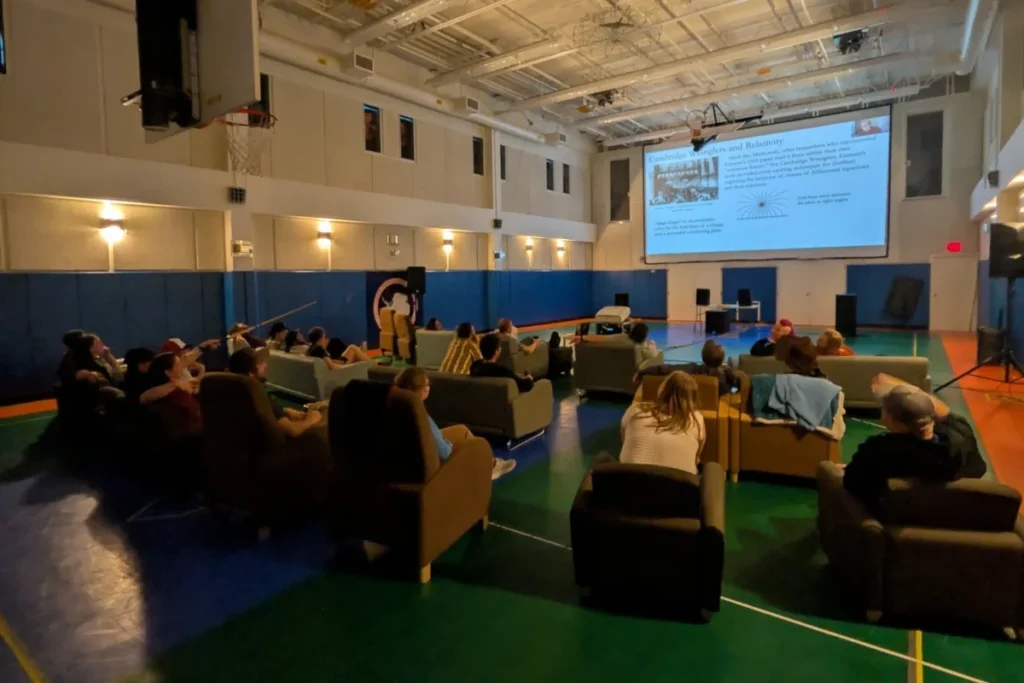
Della Costa launched "Fysics Fridays" as a way to foster this social cohesion. The 45-person community at the station includes not only physicists but also mechanics, cooks, electricians, and administrators. By choosing STS.042/8.225, Della Costa selected a series that was "meaty" enough for the scientists but accessible enough for the non-physicists.
The group does more than just watch lectures. They have turned the station into a makeshift laboratory to bring the concepts to life. "We’ve done the double-slit experiment and plan to also make a cloud chamber to see cosmic rays going through it," Della Costa reports. These hands-on demonstrations provide a tangible connection to the abstract theories of quantum mechanics and particle physics discussed in the videos.
The series began with a documentary on the development of the atomic bomb, which resonated deeply with the crew. The historical context provided by Kaiser’s course helps the researchers see themselves as part of a long lineage of scientists who have worked in isolation or under extreme pressure to unlock the secrets of the natural world.
Broader Impact and Global Implications
The story of "Fysics Fridays" at the South Pole is a powerful testament to the democratization of knowledge. MIT OpenCourseWare, which began as a bold experiment in 2001, now hosts materials from over 2,500 courses and has reached hundreds of millions of learners worldwide. However, its use in Antarctica highlights a specific value: the ability of open education to support specialized research communities in the most remote corners of the globe.
Professor Kaiser’s reaction to Della Costa’s email underscores the human element of open learning. "Hearing that John and his team are spending a part of their time with this course was just the best message to receive," Kaiser says. In a gesture of academic solidarity, Kaiser has arranged to conduct a special Zoom colloquium for the South Pole crew, providing a rare live interaction between the Cambridge campus and the Antarctic station.
From a broader perspective, this collaboration illustrates the essential link between theoretical education and experimental practice. The BICEP researchers are at the "cutting edge" of physics, yet they find value in revisiting the foundational history of their field. As they search for gravitational waves that could confirm the inflationary model of the universe, they are simultaneously participating in a global educational network that transcends geographical and environmental barriers.
The success of the "Fysics Fridays" series suggests that for remote missions—whether in the polar regions or, eventually, in deep space—intellectual stimulation and structured learning are as critical as physical supplies. By providing high-quality, free resources, institutions like MIT are not just educating students; they are sustaining the spirits and minds of those who push the boundaries of human knowledge in the harshest environments on Earth.