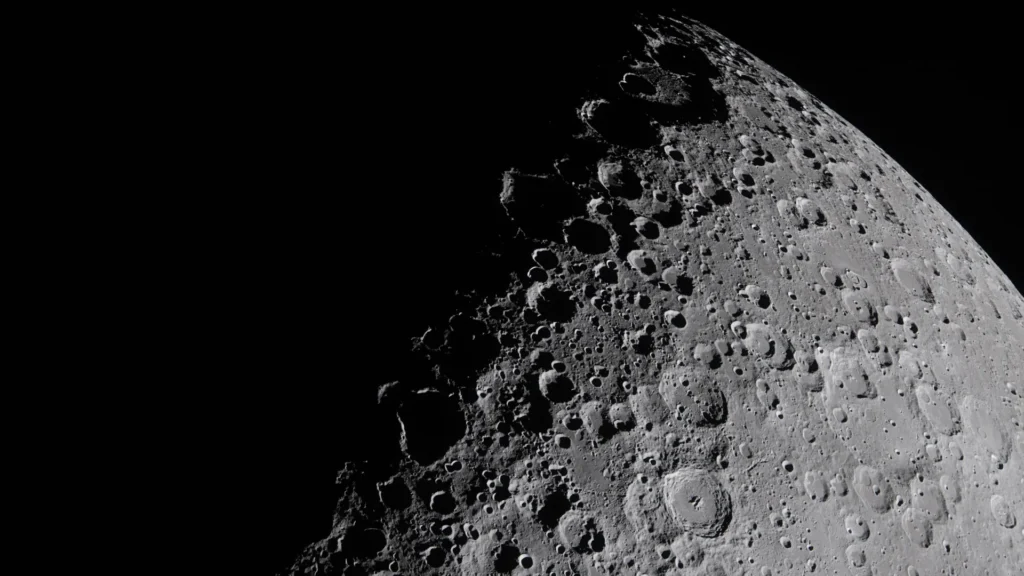
Water buried beneath the moon may be detectable by listening to how vibrations move through the lunar ground. Researchers from the University of Maryland, Lawrence Berkeley National Laboratory, and the University of Hawaii have discovered that seismic waves, the same type of vibrations scientists measure during earthquakes, could be instrumental in locating and mapping ice hidden below the moon’s surface. This groundbreaking research, published in the esteemed journal Science Advances on July 31, 2026, arrives at a pivotal moment as space agencies worldwide gear up for an ambitious new chapter in lunar exploration. NASA’s flagship Artemis program, for instance, is targeting crewed missions to the moon’s south polar region by 2028, an area where permanently shadowed craters are strongly suspected to harbor significant deposits of water ice.
The Critical Role of Lunar Ice for Sustained Human Presence
The potential availability of water ice on the Moon is not merely an academic curiosity; it represents a fundamental enabler for long-term human presence beyond Earth. For future astronauts, this frozen resource could fulfill multiple vital functions. Once extracted, melted, and purified, it could provide a readily accessible source of drinking water. Furthermore, through electrolysis, water can be separated into its constituent elements: oxygen, crucial for breathable air, and hydrogen, a potent propellant for rockets. A reliable in-situ supply of these resources would drastically reduce the logistical burden and expense associated with transporting vast quantities of material from Earth for each mission.
Nicholas Schmerr, an associate professor in the University of Maryland’s Department of Geological, Environmental, and Planetary Sciences and a co-author of the study, underscored the strategic importance of identifying usable materials on the lunar surface. "It’s crucial to identify any materials on the moon that an astronaut can make use of while they’re up there," Schmerr stated. "Since they will be limited by the few resources they brought from Earth, anything they find on the moon will help them basically live off the land, especially for longer-term missions or outposts." This philosophy of lunar self-sufficiency is a cornerstone of ambitious future exploration plans.
The Limitations of Surface Observations
Despite growing interest and several successful lunar missions, a precise understanding of the Moon’s ice reserves remains elusive. Scientists are still grappling with the exact quantities of ice present and their precise locations. Current orbital reconnaissance missions, while invaluable for mapping the lunar surface, are largely limited in their ability to probe deeply beneath the regolith. Their instruments primarily detect materials within the uppermost layers of lunar soil, leaving potential subsurface ice deposits largely invisible.
The new study posits that seismic measurements offer a powerful complementary technique, capable of revealing ice deposits that remain inaccessible to orbital observation. The physical properties of frozen and dry lunar soil differ significantly when subjected to seismic waves. The presence of ice acts to stiffen the surrounding material, allowing seismic vibrations to propagate at speeds that are two to three times faster than they would through dry soil.
Beyond increased velocity, ice-rich regions can also exhibit a distinct behavior in how they interact with seismic energy. Instead of allowing vibrations to pass through unimpeded, these areas can reflect seismic energy, creating an effect analogous to an echo where sound bounces off a solid surface. According to Schmerr, a seismometer strategically placed on the lunar surface would be capable of detecting both of these seismic signatures – the altered wave speeds and the reflected energy. "We can use seismic waves to not just see whether ice is present but also roughly how much of it there is," he explained, highlighting the quantitative potential of this seismic approach.
Rigorous Testing of the Seismic Signature
The research team employed a multi-faceted approach to validate their hypothesis regarding the seismic detectability of lunar ice. This involved three distinct yet complementary avenues of investigation.
Harrison Lisabeth, the lead author of the study, a rock physicist at Lawrence Berkeley National Laboratory and an alumnus of the University of Maryland (Ph.D. ’16, geology), conducted laboratory experiments using volcanic rock sourced from Arizona. This particular type of rock, when crushed, closely mimics the physical characteristics of lunar dust. Lisabeth meticulously froze samples of this pulverized rock, then utilized X-ray imaging to meticulously observe the formation and distribution of ice within the microscopic interstitial spaces between the individual mineral grains. This experimental setup allowed for a controlled environment to study the impact of ice on the rock’s seismic response.
Complementing the laboratory work, Matthew Siegler of the University of Hawaii contributed by developing highly detailed thermal models of the Moon’s south polar region. These sophisticated temperature maps were crucial in identifying specific craters that have maintained consistently frigid conditions, cold enough to have potentially preserved water ice for billions of years, creating environments conducive to long-term ice storage.
At the University of Maryland, Professor Schmerr leveraged advanced computer simulations to model the propagation of seismic waves, specifically simulating the passage of small moonquakes through hypothetical underground deposits of lunar ice. Across all three investigative methods – laboratory experimentation, thermal modeling, and computational simulation – the consistent presence of ice invariably produced distinct and measurable alterations in the seismic data. These consistent findings across diverse methodologies lend significant credence to the study’s conclusions.
Lunar Ice: A Window to the Early Solar System
The significance of lunar ice extends far beyond its utility for supporting human astronauts. These ancient ice deposits may also hold invaluable clues about the early history of our solar system. The permanently shadowed craters at the lunar poles, shielded from direct sunlight for eons, are exceptionally effective at trapping volatile materials, including water and other compounds. The surrounding lunar rocks, dating back approximately four billion years, provide a geological context that suggests the ice preserved within these craters could offer direct insights into the processes that governed the movement of water through the young solar system.
"The moon witnessed some of the most critical parts of the early solar system, including how water was delivered," Schmerr elaborated. "Studying the ice deposited there could reveal how water spread and ultimately how Earth’s oceans formed." This geological archive, frozen in time, could unlock fundamental questions about the origins of water on Earth and the potential for life elsewhere in the solar system.
Future Missions Poised to Test the Seismic Predictions
The scientific community is eagerly anticipating upcoming lunar missions that could provide the first real-world validation of these seismic predictions. China’s Chang’e-7 mission, scheduled for a landing near Shackleton Crater in late 2026, is equipped with a seismometer and is targeting an area where several suspected ice deposits are located. This mission presents a prime opportunity to deploy the seismic detection method in a scientifically relevant environment.
Furthermore, NASA’s Artemis astronauts are slated to deploy the Lunar Environmental Monitoring Station (LEMS) in 2028. Professor Schmerr himself was involved in the development of this instrument, which is specifically designed for seismic exploration of the lunar subsurface. The deployment of LEMS in a region with potential ice deposits will offer another critical testbed for the research team’s findings.
"Our findings are laying the groundwork for an observation we’ll get in the next couple of years," Schmerr remarked, expressing optimism about the forthcoming empirical data. "No one has physically measured the ice on the moon yet, but we now have a prediction for what to look out for. That’s an important first step." The confluence of theoretical modeling, laboratory validation, and planned in-situ measurements marks a significant stride towards understanding and potentially utilizing one of the Moon’s most precious resources.
Broader Implications and Future Prospects
The implications of this research are profound, extending across multiple domains of space exploration and planetary science. For the practicalities of lunar habitation, the ability to accurately map subsurface water ice using seismic methods would revolutionize mission planning. It would enable the precise identification of optimal sites for future lunar bases, ensuring access to essential resources and significantly reducing the cost and complexity of establishing a sustainable human presence on the Moon. This could accelerate the timeline for establishing permanent lunar outposts, transforming them from science fiction into tangible realities.
From a scientific perspective, the potential to study ancient ice deposits offers an unparalleled opportunity to reconstruct the history of the early solar system. The composition of this ice could reveal details about the sources of water delivered to the inner planets, the processes of planetary formation, and the environmental conditions that prevailed billions of years ago. Understanding how water arrived on Earth, for instance, could shed light on the conditions necessary for the emergence of life.
The development of seismic techniques for subsurface exploration also has broader applications for understanding other celestial bodies. Similar methods could be employed to search for water ice or other subsurface resources on Mars, the icy moons of Jupiter and Saturn, and potentially even on asteroids. This research, therefore, not only advances our understanding of the Moon but also contributes to the broader quest for exploring and potentially colonizing other worlds.
The timeline for these developments is accelerating. With missions like Chang’e-7 and Artemis poised to gather data in the coming years, the scientific community is on the cusp of a new era of lunar discovery. The transition from theoretical prediction to observational confirmation will be a critical juncture, solidifying the value of seismic techniques in lunar exploration and paving the way for more ambitious and resource-informed missions to the Moon and beyond. The successful detection and characterization of lunar ice could be a pivotal moment, marking a significant step towards humanity’s sustained presence in the cosmos.
This research was supported by grants from the U.S. Department of Energy Office of Science and NASA.