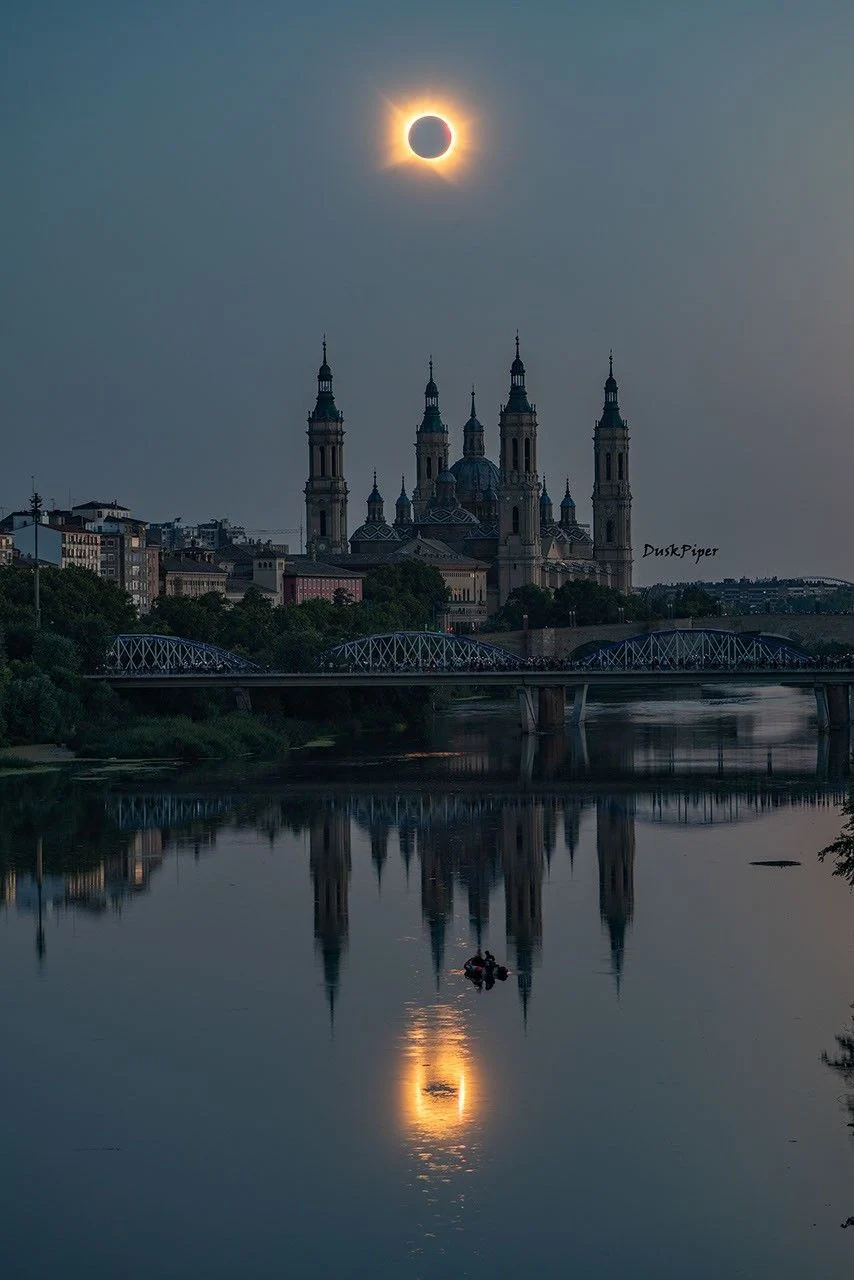
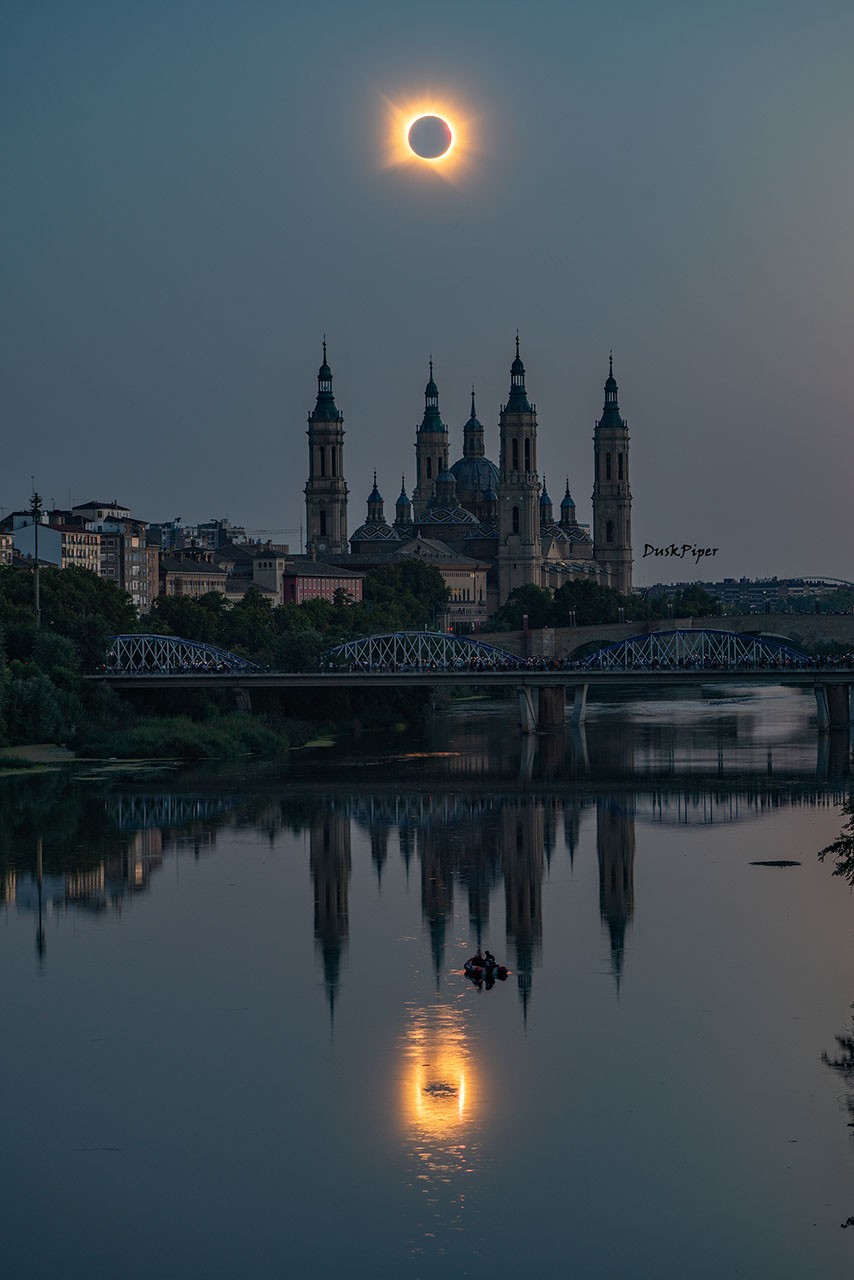
On August 12, 2026, a rare and breathtaking celestial event unfolded as the Moon completely obscured the Sun, casting a shadow across a vast swathe of the Northern Hemisphere, with Spain and Portugal experiencing a particularly dramatic view of totality. This total solar eclipse, a phenomenon that has captivated humanity for millennia, provided a few precious moments of darkness in the middle of the day, revealing the Sun’s ethereal corona and offering scientists an invaluable opportunity to study our star. The event was prominently captured in a striking image from Zaragoza, Spain, showcasing the majestic alignment of the Moon and Sun above an ornate church, with its reflection rippling across the Ebro River.
A Shadow Across Continents
The path of totality for the August 12, 2026, total solar eclipse stretched across Siberia, Greenland, Iceland, and then made a significant passage over the Iberian Peninsula, including Spain and Portugal. For the approximately 30 million people situated within the path of totality, the experience was profound. As the Moon began its transit across the Sun, daylight gradually dimmed, birds fell silent, and insects ceased their chirping, creating an eerie yet magical atmosphere. The climax of the event was the brief period of totality, where the Sun’s brilliant disk was entirely hidden, allowing its delicate outer atmosphere, the corona, to become visible as a shimmering halo of light.
This particular eclipse held special significance for Spain, as it marked the country’s first major total solar eclipse since 1905. The anticipation leading up to the event was palpable, with astronomical societies, scientific institutions, and the public eagerly preparing to witness this once-in-a-century spectacle. The image released by NASA’s Astronomy Picture of the Day (APOD) perfectly encapsulates the grandeur of the moment, juxtaposing the cosmic event with the enduring architecture of a Spanish landmark and the reflective surface of a river.
The Science of the Corona
Total solar eclipses are not just visually stunning; they are critical scientific opportunities. The Sun’s corona, the outermost layer of its atmosphere, is incredibly hot, with temperatures reaching millions of degrees Celsius. However, it is also extremely faint, making it difficult to study under normal circumstances. During a total solar eclipse, when the Sun’s bright disk is blocked, the corona becomes readily observable.
Scientists utilize these events to gain crucial insights into the Sun’s behavior, including the processes that heat the corona to such extreme temperatures and the mechanisms that drive solar flares and coronal mass ejections. These phenomena can have significant impacts on Earth, affecting satellite communications, power grids, and even astronaut safety. Studying the corona during eclipses helps researchers refine their understanding of space weather, enabling better prediction and mitigation of its effects.
The APOD explanation highlights this scientific imperative, stating that eclipses "help scientists understand why the corona is millions of degrees hotter than the Sun’s surface." This enduring mystery is a key driver for solar physics research, and events like the 2026 eclipse provide invaluable observational data.
A Chronology of the Celestial Dance
The journey of the Moon across the Sun’s face is a precisely orchestrated cosmic ballet, observable over several hours.
- Initial Contact: The eclipse begins when the Moon’s edge first touches the Sun’s disk, a moment known as first contact. This marks the start of the partial phase, where a progressively larger portion of the Sun is covered.
- Totality Approaches: As the eclipse progresses, the Moon’s shadow, known as the umbra, races towards the Earth. Observers in the path of totality witness the Sun becoming increasingly crescent-shaped.
- Second Contact and Totality: The moment of totality arrives with second contact, when the Moon completely covers the Sun. This is the period of maximum eclipse, characterized by the visibility of the corona and a significant drop in ambient light. The duration of totality varies depending on the observer’s location within the path of the umbra. For the August 12, 2026, eclipse, the maximum duration of totality was approximately 2 minutes and 17 seconds.
- Emergence: Following totality, the Sun begins to reappear as the Moon moves off its disk. This is known as third contact, marking the end of totality and the beginning of the egress, or the reappearance phase.
- Final Contact: The eclipse concludes with fourth contact, when the Moon has entirely moved past the Sun’s disk, ending the partial phase.
For those in Zaragoza, Spain, the eclipse timeline was meticulously planned. The partial phase began shortly before 11:00 AM local time, with totality occurring around 12:00 PM. The brief, awe-inspiring period of totality lasted for nearly two minutes before the Sun began to re-emerge, and the full eclipse concluded a little after 1:00 PM.
Supporting Data and Astronomical Context
The August 12, 2026, total solar eclipse was part of Saros cycle 143, a series of eclipses that occur approximately every 18 years, 11 days, and 8 hours. This particular cycle began on June 15, 1906, and is predicted to continue until September 27, 2154. The eclipses in a Saros series share many common geometric circumstances, leading to a succession of similar eclipses. The eclipse of 1905, mentioned as the last major total solar eclipse in Spain, was also part of Saros cycle 143, underscoring the cyclical nature of these celestial events.
The apparent size of the Moon in the sky relative to the Sun is crucial for total solar eclipses. The Moon’s orbit around the Earth is elliptical, meaning its distance from Earth varies. When the Moon is closer to Earth (at perigee), it appears larger in the sky, increasing the likelihood of a total eclipse. Conversely, when it is farther away (at apogee), it appears smaller, and if an eclipse occurs at apogee, it can result in an annular eclipse, where a ring of the Sun remains visible. The eclipse of August 12, 2026, occurred at a favorable point in the Moon’s orbit, allowing for a substantial duration of totality.
Citizen Science and Broader Impact
The participation of the public in astronomical observation is increasingly vital, and total solar eclipses offer a unique avenue for citizen science. As the APOD explanation notes, "Enthusiastic citizens can contribute to these studies by recording how wildlife responds, imaging the corona, and monitoring air temperature and clouds." These observations, when collected systematically, can provide valuable data on the localized environmental effects of an eclipse and complement the findings of professional astronomers.
The shared experience of witnessing a total solar eclipse can also foster a sense of global community and inspire a deeper appreciation for the universe. The image from Zaragoza, with its juxtaposition of natural wonder and human creation, serves as a reminder of our place within a grander cosmic narrative. The awe and wonder experienced by those who witnessed totality are not merely emotional responses but can also ignite a lifelong curiosity about science and exploration.
The implications of studying solar phenomena extend beyond pure scientific understanding. A more robust comprehension of space weather can lead to the development of technologies and strategies to protect our increasingly interconnected world from solar disturbances. This includes safeguarding satellites, ensuring the reliability of power grids, and protecting astronauts on future space missions.
Looking Ahead
The August 12, 2026, total solar eclipse was a spectacular event that provided both a breathtaking visual spectacle and significant scientific opportunities. As scientists continue to analyze the data gathered, the understanding of our Sun and its profound influence on our solar system will undoubtedly deepen. The memory of the corona shining brightly in the darkened sky above Spain will undoubtedly linger, a testament to the enduring power of celestial phenomena to inspire and inform. The APOD program, by consistently showcasing these incredible cosmic events, plays a crucial role in making the wonders of the universe accessible to all, fostering a continuous dialogue between the cosmos and humanity.