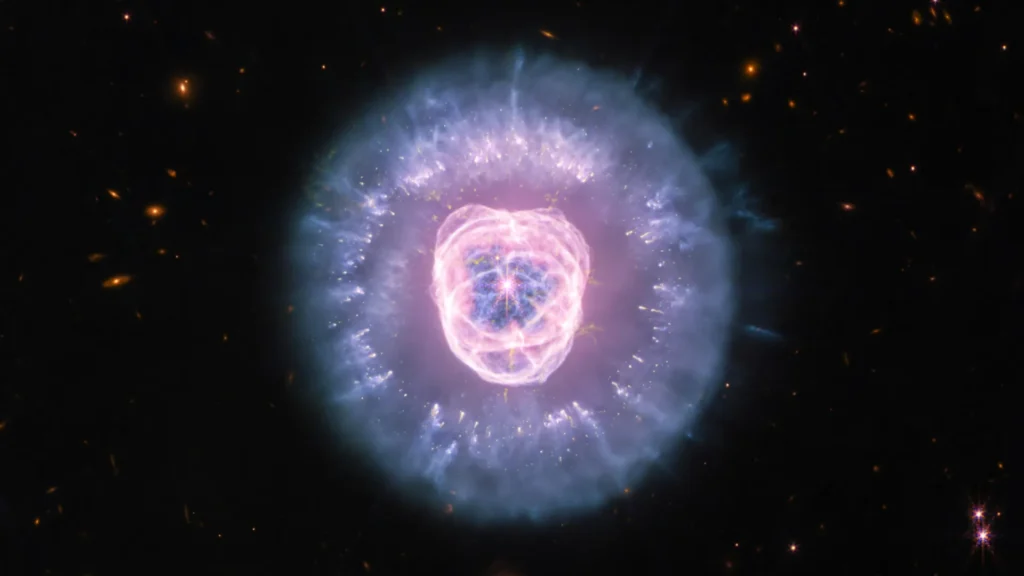
The James Webb Space Telescope (JWST) has delivered a breathtaking new perspective on NGC 2392, a vibrant planetary nebula colloquially known as the Lion Nebula. These recently captured images, rendered in striking infrared detail, offer an unparalleled glimpse into the intricate processes occurring within this celestial object, building upon decades of astronomical observation and expanding our understanding of stellar evolution. The revelations from JWST promise to refine existing models of how stars like our Sun meet their demise, illuminating the complex cosmic ballet that transforms dying stars into spectacular nebulae.
A Legacy of Observation: From Hubble’s Gaze to Webb’s Insight
The Lion Nebula has long captivated astronomers, with its distinctive "lion face" appearance first vividly captured by the Hubble Space Telescope in 2000. In visible light, Hubble’s observations highlighted the nebula’s characteristic visage, complete with a prominent "mane" composed of ethereal structures reminiscent of comet tails. These earlier images provided crucial insights into the general morphology of the nebula, establishing its iconic silhouette. However, the inherent limitations of visible light meant that many subtler features, particularly those involving dense gas and dust, remained obscured.
Now, JWST, with its advanced infrared capabilities and superior resolution, has revisited NGC 2392. While the overall structure of the Lion Nebula appears broadly consistent between the Hubble and Webb observations, JWST’s instruments, specifically the Near-Infrared Camera (NIRCam) and the Mid-Infrared Instrument (MIRI), have peeled back layers of cosmic veiling. This infrared vantage point excels at penetrating the dust and gas that often obscure hotter, more energetic phenomena in visible light. As a result, Webb’s images reveal previously unseen concentrations of dense dust and vast, hazy regions of ionized gas, offering a far more nuanced and detailed portrait of this dying stellar system.
The Engine of Creation: A Dying Star’s Influence on the Cosmic Lion
At the heart of the Lion Nebula lies the remnant of a star that has reached the end of its main-sequence life. This stellar core, though appearing as a diminutive "button nose" within the nebula’s facial features, is the potent engine driving the spectacular display of gas and dust surrounding it. The radiation and energy emanating from this remnant are the primary forces sculpting the nebula’s complex and intricate structures.
Planetary nebulae, contrary to their name, are not related to planet formation. Instead, they represent a crucial phase in the life cycle of low-to-intermediate mass stars, a category that includes our own Sun. Unlike their more massive counterparts, which meet their end in cataclysmic supernova explosions, stars like the one that formed the Lion Nebula undergo a more gradual and less violent demise.
The process begins when a star exhausts the hydrogen fuel in its core, leading to an imbalance in the forces governing its existence. As nuclear fusion in the core wanes, gravity begins to assert dominance, causing the star to contract. This contraction, in turn, heats the core, igniting helium fusion and causing the star to expand dramatically, becoming a red giant. During this phase, the star becomes unstable, exhibiting pulsations that lead to the expulsion of its outer layers into space. These expelled envelopes of gas and dust, energized by the star’s internal processes, gradually expand outward, forming the vast, luminous shells we observe as planetary nebulae. It is during this stellar shedding phase that stars contribute significantly to the chemical enrichment of the interstellar medium, seeding the cosmos with heavier elements that will eventually form new stars and planets.
At the center of this expanding cosmic cloud lies the exposed, extremely hot core of the former star. This remnant, stripped of its outer layers, becomes a white dwarf – a dense, Earth-sized object composed primarily of carbon and oxygen. The intense ultraviolet radiation emitted by this white dwarf then ionizes the surrounding gas, causing it to glow and illuminating the intricate structures of the nebula. In the case of NGC 2392, the oxygen-rich central star’s white dwarf is effectively "cooking" the nebula from within, generating the bubble of ionized gas that defines the lion’s recognizable face.
Unraveling the Complexity: Webb’s Infrared Lens on Dust and Gas Dynamics
Webb’s ability to detect infrared light is instrumental in dissecting the intricate interplay between the white dwarf’s radiation and the surrounding nebular material. The infrared spectrum allows astronomers to peer through the obscuring veil of dust, revealing its distribution and density with unprecedented clarity. This is particularly important for understanding the formation of the complex rings and shells that characterize many planetary nebulae, including the Lion Nebula.
The "mane" of the Lion Nebula, for instance, has been revealed by Webb to be an inner region of a dust shell illuminated by the central white dwarf. Within this region, astronomers observe structures resembling tufts of hair or comet-like tails. These are not random formations but rather compact clumps of dust that have managed to withstand the relentless radiation from the stellar core. These dense clumps play a critical role in the nebula’s evolution; by blocking some of the ionizing radiation, they create shadowed regions that shield material located behind them, allowing for the preservation of complex molecular structures and potentially influencing the subsequent evolution of the nebula.
The gas and dust that constitute the Lion Nebula have been in a state of dynamic evolution for several thousand years, and this process continues even today. Webb’s observations provide a snapshot in time, freezing the nebula’s appearance at a particular moment in its long cosmic journey. However, the consequences of the star’s death are ongoing. The outward-bound flow of gas and dust from the central stellar remnant will continue to shape and alter the nebula’s appearance over vast timescales.
A Cosmic Clock: The Transient Beauty of Planetary Nebulae
Astronomers estimate that the Lion Nebula, like other planetary nebulae, is a relatively ephemeral phenomenon on astronomical scales. It is projected to disperse into the interstellar medium over approximately 10,000 years. This timeframe, while immense from a human perspective, is a mere blink of an eye in the grand cosmic narrative. The eventual dissipation of the nebula signifies the complete redistribution of the star’s processed material, contributing to the chemical richness of the galaxy and providing the raw ingredients for future generations of stars and planetary systems.
The ongoing research into NGC 2392 by JWST is part of a broader effort to understand the diverse pathways of stellar evolution and the processes that enrich the universe with the elements necessary for life. By studying these stellar remnants, astronomers gain invaluable insights into the fate of stars similar to our own Sun, helping to contextualize our place in the cosmos and the long-term evolution of our solar system.
The Power of Webb: A Collaborative Endeavor in Space Exploration
The groundbreaking observations of the Lion Nebula are a testament to the capabilities of the James Webb Space Telescope, the largest and most powerful observatory ever launched into space. Webb represents a monumental achievement in international scientific collaboration, a partnership between NASA, the European Space Agency (ESA), and the Canadian Space Agency (CSA).
ESA’s contribution to the Webb mission is significant. The agency provided the telescope’s launch service, utilizing the Ariane 5 launch vehicle. This involved extensive development and qualification of Ariane 5 adaptations specifically for the Webb mission, procured through Arianespace. Furthermore, ESA played a crucial role in the development of key scientific instruments, contributing the Near-Infrared Spectrograph (NIRSpec) and 50% of the Mid-Infrared Instrument (MIRI). MIRI itself was a product of a consortium of nationally funded European institutes working in partnership with NASA’s Jet Propulsion Laboratory (JPL) and the University of Arizona.
The synergy of these international contributions has enabled JWST to push the boundaries of astronomical discovery, providing an infrared window into the universe that was previously unimaginable. The detailed imagery of the Lion Nebula is just one example of the profound scientific returns expected from this revolutionary telescope, promising to rewrite textbooks and deepen humanity’s understanding of the cosmos for decades to come. The ongoing analysis of Webb’s data from NGC 2392 will undoubtedly yield further revelations about the complex physics governing stellar death and the intricate processes that sculpt the nebulae we observe across the vast expanse of space.