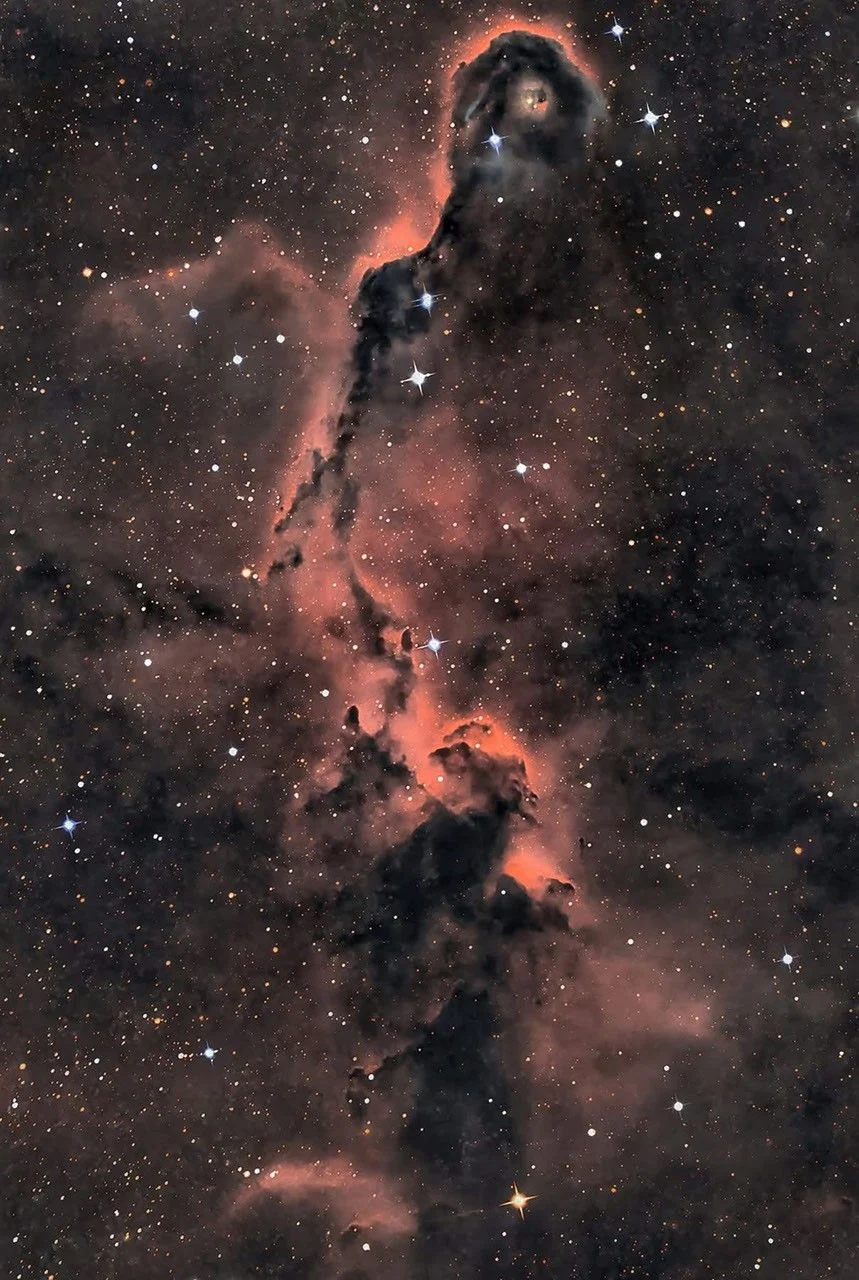
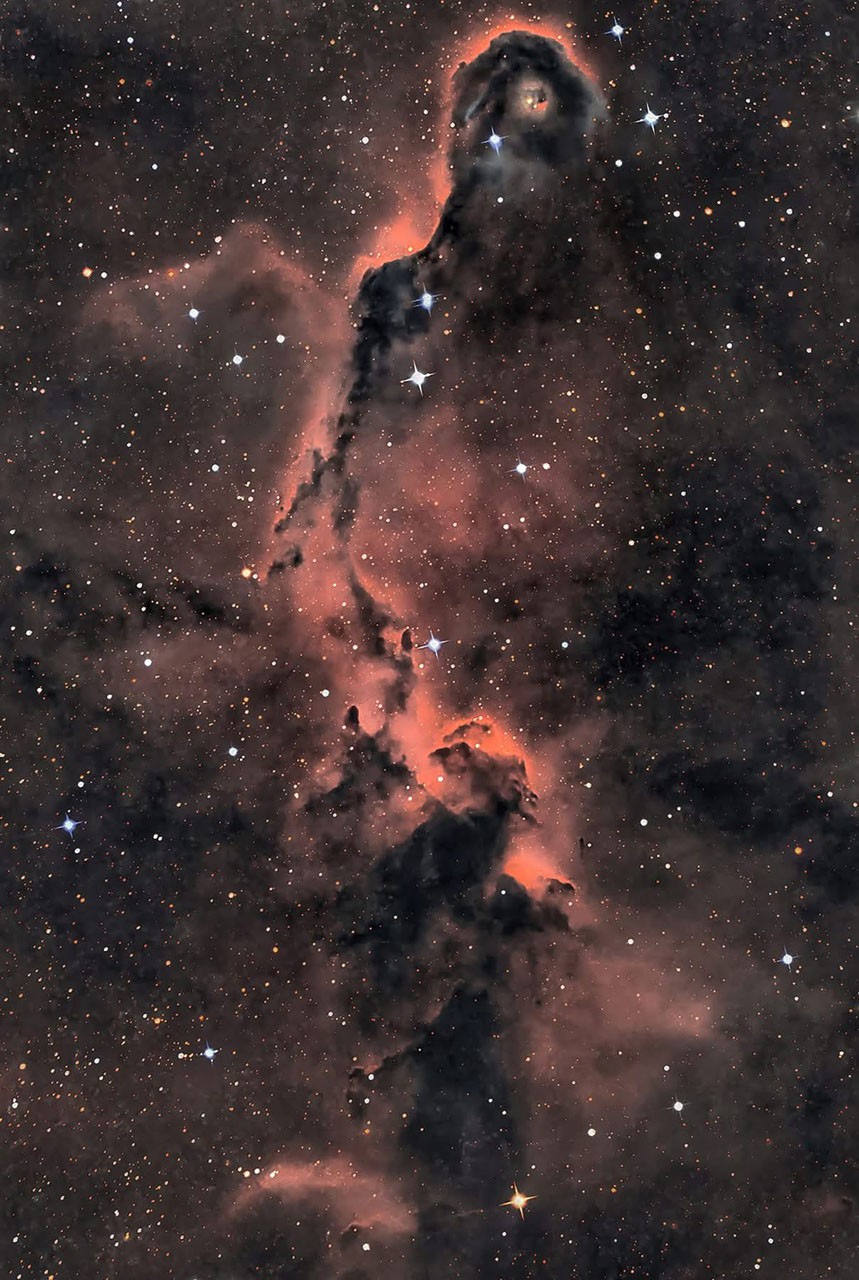
An awe-inspiring image from NASA’s Astronomy Picture of the Day (APOD) showcases the Elephant’s Trunk Nebula, a dramatic and evocative interstellar cloud within the IC 1396 complex, located in the high and far-off constellation of Cepheus. This detailed telescopic view, also known as vdB 142, reveals a cosmic spectacle stretching over 20 light-years in length, resembling a trunk-like formation. The image, captured by Eddie Sgarbossa, highlights the intricate interplay of light and shadow, with bright, swept-back ridges of emission juxtaposed against pockets of cool interstellar dust and gas.
Unveiling the Cosmic Elephant’s Trunk
The Elephant’s Trunk Nebula is not merely a visually striking celestial object; it is a dynamic region of intense astrophysical activity. The dark, tendril-shaped clouds are the very cradles of new stellar birth. Within these dense formations, the raw materials for stars – primarily hydrogen and helium gas, along with trace amounts of heavier elements and dust – are accumulating under the influence of gravity. As these clouds collapse, their density and temperature increase, eventually reaching a critical point where nuclear fusion ignites in their cores, marking the genesis of a new star.
The APOD image meticulously captures these processes. The bright, luminous areas are typically emission nebulae, where ionized gas glows due to the ultraviolet radiation from nearby hot, young stars. These stars, often massive and short-lived, are the energetic engines driving the visible beauty of the nebula. Conversely, the dark, opaque regions are dense concentrations of interstellar dust. This dust, though microscopic in size, is incredibly effective at scattering and absorbing light, effectively obscuring the background starlight and revealing the intricate, shadowy tendrils that give the nebula its distinctive shape.
A Stellar Nursery in Cepheus
The IC 1396 complex, of which the Elephant’s Trunk Nebula is a part, is a vast star-forming region situated approximately 3,000 light-years from Earth. Its immense size, spanning over 5 degrees in the sky, means it occupies a significant portion of the celestial sphere. To put this into perspective, the angular size of the Elephant’s Trunk Nebula itself, from top to bottom, is roughly equivalent to the diameter of two full moons. This vastness underscores the sheer scale of cosmic processes at play within our galaxy.
The constellation of Cepheus, where IC 1396 resides, is a circumpolar constellation for many observers in the Northern Hemisphere, meaning it never sets below the horizon. Its distinctive house-like shape, with a prominent central "roof," makes it a recognizable feature in the night sky. Historically, Cepheus has been a focal point for astronomical observation and mythology, with its stars often associated with the king in Greek mythology. The inclusion of the Elephant’s Trunk Nebula within this constellation further enriches its astronomical significance, drawing attention to the dynamic processes occurring within its boundaries.
The Science of Star Formation: A Deeper Look
The formation of stars within nebulae like IC 1396 is a complex and multi-stage process that has been a cornerstone of astrophysical research for decades. The journey from a diffuse cloud of gas and dust to a fully-fledged star is governed by fundamental physical laws, including gravity, thermodynamics, and electromagnetism.
- Gravitational Collapse: The initial stage involves the gravitational collapse of a dense region within a giant molecular cloud. This collapse can be triggered by various events, such as the shockwave from a nearby supernova explosion or the gravitational perturbation from a passing star.
- Fragmentation: As the cloud collapses, it often fragments into smaller clumps. Each of these clumps can potentially evolve into an individual star or a star system.
- Protostar Formation: Within each fragment, gravity continues to pull material inward, causing the core to heat up. This dense, collapsing core is known as a protostar. While not yet a true star, it is luminous due to the energy released by gravitational contraction.
- Accretion Disk and Jets: As material continues to fall onto the protostar, it often forms an accretion disk around it. This disk plays a crucial role in feeding the protostar and can also launch powerful bipolar jets of gas and plasma from the poles of the protostar. These jets can sculpt the surrounding nebula, as seen in the intricate structures of the Elephant’s Trunk.
- Nuclear Fusion: When the core of the protostar becomes sufficiently hot and dense (around 10 million Kelvin), nuclear fusion begins. Hydrogen nuclei fuse to form helium, releasing a tremendous amount of energy. This marks the birth of a true star, which will then enter the main sequence phase of its life.
The Elephant’s Trunk Nebula provides a tangible, visual representation of these fundamental processes. The "dark, tendril-shaped clouds" mentioned in the APOD explanation are precisely these regions of dense gas and dust where protostars are actively forming and accreting material. The "swept-back ridges" are likely shaped by the stellar winds and radiation pressure from the young, massive stars that have already emerged from the nebula.
Chronology of Discovery and Observation
While the specific date of the initial discovery of the Elephant’s Trunk Nebula is not provided in the source material, its inclusion in the IC 1396 complex means its study is tied to the broader exploration of this star-forming region. The IC 1396 complex has been a subject of astronomical interest for many years, with early cataloging and observation dating back to the 20th century.
- Early Cataloging: Nebulae and star clusters are systematically cataloged by astronomers to organize and study the cosmos. The designation "vdB 142" suggests it was included in a catalog compiled by astronomers van den Bergh. Such catalogs are crucial for tracking and referencing celestial objects.
- Telescopic Observations: The detailed view presented in the APOD image is the result of advanced telescopic observations. Modern telescopes, both ground-based and space-based, equipped with sophisticated imaging technology, are capable of capturing the intricate details of nebulae that were once only hinted at by earlier instruments. The specific mention of "detailed telescopic view" implies observations made with instruments sensitive to specific wavelengths of light, allowing astronomers to discern the different components of the nebula.
- Space-Based Missions: Missions like the Hubble Space Telescope and the Spitzer Space Telescope have revolutionized our understanding of star-forming regions. Spitzer, in particular, with its infrared capabilities, can peer through the dust that obscures visible light, revealing the hidden protostars and the complex structures within nebulae. While the exact instrument used for this specific image is not stated, it is highly probable that it was captured by a modern observatory with advanced imaging capabilities, possibly in conjunction with data from multiple telescopes.
- APOD’s Role: The Astronomy Picture of the Day initiative, established by NASA, plays a vital role in disseminating astronomical discoveries and stunning imagery to the public. By featuring such images with expert explanations, APOD educates and inspires millions worldwide, fostering a greater appreciation for space science. The image of the Elephant’s Trunk Nebula, as part of APOD, serves as a testament to ongoing astronomical research and the power of visual storytelling in science.
Supporting Data and Context
- Distance: Approximately 3,000 light-years from Earth. This distance places the nebula within our own Milky Way galaxy.
- Size: The IC 1396 complex spans over 5 degrees in the sky. The Elephant’s Trunk Nebula itself is over 20 light-years long. For context, one light-year is the distance light travels in one year, approximately 9.46 trillion kilometers (5.88 trillion miles).
- Angular Size Comparison: The Elephant’s Trunk Nebula’s width is approximately 1 degree, which is about the angular size of two full moons side-by-side.
- Composition: Interstellar dust and gas, primarily hydrogen and helium, along with trace amounts of heavier elements.
- Associated Phenomena: Young star clusters, emission nebulae, dark nebulae, protostars, stellar winds, and radiation pressure.
Official Responses and Scientific Community Reactions
While there are no direct "statements or reactions" from specific individuals or organizations in the provided text, the very act of featuring this image on NASA’s APOD website represents an official endorsement and dissemination of scientific findings. The APOD team, comprising professional astronomers, selects images that are not only visually captivating but also scientifically significant.
The inclusion of the Elephant’s Trunk Nebula on APOD would typically be met with enthusiasm from the astronomical community. Such images serve as valuable teaching tools, inspire new research avenues, and spark public interest in astrophysics. Astronomers specializing in star formation would likely analyze the details within the image to refine their models of nebula evolution, protostellar jets, and the impact of massive stars on their surroundings.
The brief explanation accompanying the image, written by a professional astronomer, indicates a consensus within the scientific community about the nature and significance of the Elephant’s Trunk Nebula as a star-forming region. The links provided within the explanation further demonstrate the depth of research and analysis that underpins such astronomical observations, pointing to academic papers and specialized astronomical databases.
Broader Impact and Implications
The study of nebulae like the Elephant’s Trunk has profound implications for our understanding of the universe and our place within it.
- Understanding Stellar Evolution: By observing regions of active star formation, astronomers gain critical insights into how stars are born, how they evolve, and how they eventually die. This knowledge is fundamental to understanding the life cycle of galaxies and the distribution of elements in the cosmos.
- Origin of Planetary Systems: The dust and gas within nebulae are not only the building blocks of stars but also of planets. The processes of accretion disk formation and the subsequent aggregation of dust grains into planetesimals are directly observed in star-forming regions. Studying these environments helps us understand how planetary systems, including our own solar system, came into being.
- Cosmic Recycling: Stars forge heavier elements in their cores and release them into space through stellar winds and supernova explosions. These elements then become incorporated into new generations of stars and planets. Nebulae like the Elephant’s Trunk are thus part of a continuous cosmic recycling process that enriches the universe with the raw materials necessary for life.
- Astrobiology: The discovery of exoplanets orbiting other stars has fueled the field of astrobiology, the study of life in the universe. Understanding the conditions under which stars and planets form is crucial for identifying potentially habitable exoplanets and for contemplating the prevalence of life beyond Earth.
The image of the Elephant’s Trunk Nebula, with its evocative portrayal of cosmic creation, serves as a powerful reminder of the dynamic and ever-evolving nature of the universe. It underscores the ongoing quest of humanity to unravel the mysteries of the cosmos, from the birth of stars to the potential for life elsewhere. The continuous stream of breathtaking images and scientific discoveries, facilitated by initiatives like APOD, ensures that the public remains connected to the forefront of astronomical exploration.