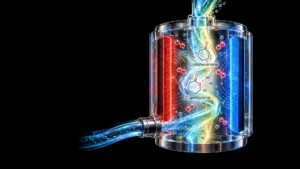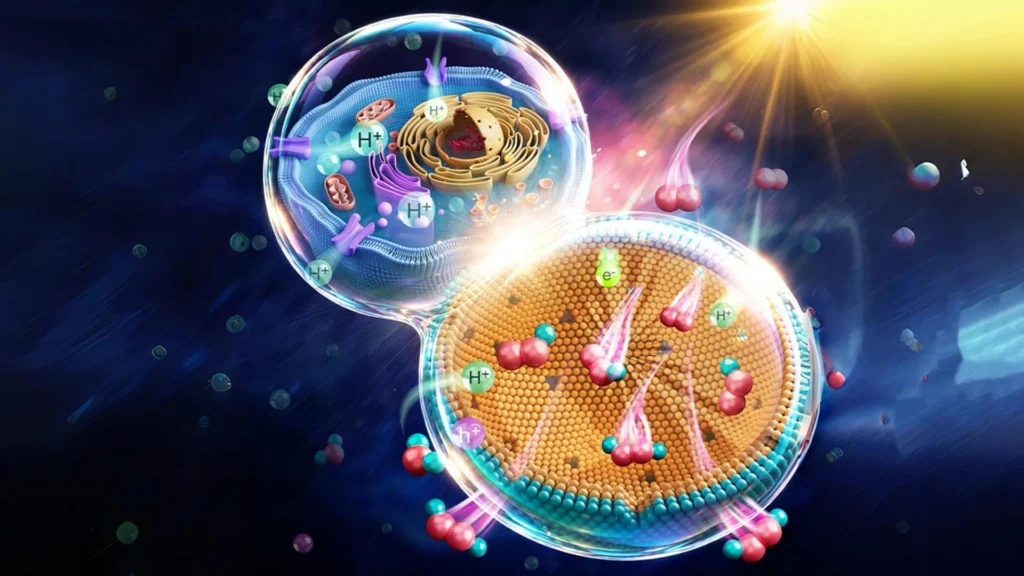
In a landmark study that bridges the gap between biological systems and synthetic materials science, a team of international researchers has successfully engineered a hollow CdS@polydopamine nanoreactor capable of mimicking the sophisticated chemical functions of living cells. This development, which integrates structural compartmentalization with dynamic chemical relays, marks a significant leap forward in the field of artificial photosynthesis. By replicating the way natural cells manage energy and matter, the researchers have achieved a breakthrough in the efficient production of hydrogen peroxide (H2O2) using only sunlight, water, and oxygen.
The research was spearheaded by Professor LI Can and his team at the Dalian Institute of Chemical Physics (DICP) of the Chinese Academy of Sciences (CAS), in a strategic collaboration with Professor Jian Liu’s group at Inner Mongolia University. Their findings, recently published in the prestigious Journal of the American Chemical Society, describe a system that not only mimics the physical form of a cell but also reproduces its intricate internal kinetic mechanisms.
The Evolution of Nanocell Engineering
For decades, scientists have looked to the biological cell as the ultimate blueprint for chemical efficiency. Natural cells are marvels of engineering; they perform thousands of simultaneous reactions within microscopic volumes without interference. This is achieved through two primary methods: compartmentalization and regulated transport. By separating different reaction stages into specific organelles and using molecular "pumps" or "relays" to move protons and electrons, cells overcome the thermodynamic and kinetic barriers that often plague synthetic chemical processes.
The emerging field of nanocell engineering seeks to translate these biological principles into engineered nanomaterials. Traditional photocatalysts often suffer from low efficiency because the electrons and "holes" generated by light tend to recombine before they can drive a chemical reaction. Furthermore, the two halves of a chemical reaction—oxidation and reduction—often occur at vastly different speeds, creating a bottleneck. The DICP team sought to solve these issues by creating a "nanoreactor" that functions as a synthetic organelle, providing a controlled environment for light-driven chemistry.
Architectural Innovation: The Hollow CdS@Polydopamine Design
The core of this new technology is the CdS@polydopamine (PDA) nanoreactor. The structure consists of a cadmium sulfide (CdS) core—a well-known semiconductor capable of absorbing visible light—encapsulated within a porous, hollow shell of polydopamine. This specific architecture was chosen to address the primary limitations of conventional photocatalysis.
The first major feature of this design is the hollow cavity. At the nanoscale, a hollow interior creates a confined environment that serves several purposes. First, it acts as a light trap; incoming photons bounce within the cavity, increasing the probability of absorption by the semiconductor material. Second, it creates a high local concentration of reactants. Molecules of oxygen and water are drawn into the cavity, where they are held in close proximity to the catalytic surfaces, significantly increasing the reaction frequency compared to an open, bulk solution.
The second, and perhaps more revolutionary, feature is the use of polydopamine not just as a structural shell, but as a functional "proton relay." Polydopamine contains a dynamic catechol/o-benzoquinone redox pair. In biological systems, similar chemical pairs are used to move protons across membranes. In this synthetic nanoreactor, this pair facilitates Proton-Coupled Electron Transfer (PCET). By acting as an intermediary that accepts and releases protons in sync with electron movement, the PDA shell accelerates the otherwise sluggish kinetics of water oxidation and oxygen reduction.
Chronology of the Research and Development
The development of the CdS@polydopamine nanoreactor followed a rigorous multi-year timeline of conceptualization, synthesis, and validation:
- Conceptual Phase (2020-2021): The research team began by analyzing the kinetic bottlenecks in hydrogen peroxide photosynthesis. They identified that the slow transfer of protons was the primary reason for low solar-to-chemical conversion rates. Inspired by the proton pumps in mitochondria, they began searching for a synthetic equivalent.
- Material Synthesis (2021-2022): The team experimented with various "mussel-inspired" polymers, eventually settling on polydopamine due to its biocompatibility and the presence of the catechol group. They developed a template-assisted method to create the hollow spheres, ensuring the CdS nanoparticles were correctly positioned to interact with the PDA shell.
- Experimental Testing (Late 2022): Initial laboratory tests were conducted under controlled visible-light conditions. The team measured the production of H2O2 in aqueous solutions, refining the thickness of the PDA shell to balance proton relay efficiency with light penetration.
- Mechanistic Validation (2023): To understand exactly how the protons were moving, the researchers employed in situ spectroscopy and finite element simulations. This allowed them to "see" the chemical changes in the catechol groups in real-time as the reaction progressed.
- Final Integration (Early 2024): The researchers moved from powdered catalysts to a practical, macroscopic form by embedding the nanoreactors into a sodium alginate hydrogel, testing its durability under natural sunlight.
Performance Metrics and Supporting Data
The performance of the CdS@polydopamine nanoreactor has set a new benchmark for biomimetic artificial photosynthesis. In standard laboratory tests using visible-light illumination, the system achieved a hydrogen peroxide photosynthesis rate of 3.24 mmol per gram of catalyst per hour (mmol gcat.-1 h-1).
More importantly, the researchers reported a solar-to-chemical conversion (SCC) efficiency of 1.2%. While 1.2% may sound modest in comparison to commercial solar panels (which convert light to electricity), it is a significant figure for chemical conversion. For context, natural photosynthesis in most plants operates at an overall efficiency of less than 1% when considering the total energy stored in biomass. Surpassing the 1% threshold is widely considered the "entry point" for making artificial photosynthesis commercially and industrially viable.
The team’s use of a Z-scheme heterojunction was critical to these results. In this mechanism, the electrons move in a path resembling the letter "Z," which helps maintain the high energy levels needed for the two separate half-reactions: the oxidation of water to produce oxygen and protons, and the reduction of oxygen to produce hydrogen peroxide. The PDA shell ensures that these two processes remain synchronized, preventing the accumulation of intermediate products that could stall the reaction.
Industrial and Environmental Implications
The potential applications for this technology are vast, particularly in the realm of "green" chemistry. Hydrogen peroxide is one of the world’s most essential chemicals, used extensively in water treatment, paper bleaching, and as a disinfectant. However, current industrial production of H2O2 relies on the anthraquinone process, which is energy-intensive, requires complex organic solvents, and generates significant waste.
The DICP nanoreactor offers a pathway to decentralized, on-site H2O2 production. Because the system only requires sunlight and water, it could be used in remote areas for water purification without the need for chemical supply chains.
To address the practical challenges of using nanoparticles in the environment—such as the difficulty of recovering them from water—the researchers embedded the nanoreactors into a sodium alginate hydrogel. This seaweed-derived matrix is environmentally benign and keeps the nanoreactors in a stable, solid form. The resulting "photocatalytic gel" can be placed in a body of water, exposed to sunlight to produce H2O2, and then easily removed and reused. Tests showed that the hydrogel-embedded system maintained stable performance over multiple cycles, proving its potential for long-term industrial use.
Expert Analysis and Official Responses
Professor LI Can, the lead researcher, emphasized that this study is about more than just producing a single chemical; it is about a new philosophy of design. "Our study provides a new strategy for engineering biomimetic nanoreactors that increasingly replicate the sophisticated functions of living cells," Li stated. "This opening of new opportunities in artificial photosynthesis, energy catalysis, and synthetic chemistry suggests that we are moving toward a future where synthetic materials are no longer passive, but active participants in complex chemical logic."
Collaborators from Inner Mongolia University noted that the success of the project was due to the interdisciplinary approach, combining advanced materials science with biological insights and theoretical physics. Independent observers in the field of photocatalysis have highlighted the importance of the proton relay mechanism, noting that managing proton movement has long been the "missing link" in artificial photosynthesis.
Future Outlook
While the 1.2% efficiency rate is a milestone, the researchers are already looking toward the next phase of development. Future work will focus on optimizing the PDA shell to further increase the rate of proton transfer and exploring the use of other semiconductor cores that can capture a broader spectrum of sunlight, including infrared light.
Furthermore, the "nanoreactor" concept is being explored for other complex reactions, such as the reduction of carbon dioxide into liquid fuels. By mimicking the compartmentalized nature of the cell, scientists hope to create synthetic systems that can turn CO2 from an environmental pollutant into a valuable resource.
The success of the CdS@polydopamine nanoreactor serves as a powerful proof of concept. It demonstrates that by looking to the natural world—not just for inspiration in form, but for guidance in function—science can develop cleaner, more efficient, and more sustainable ways to power the modern world. As the global community seeks to transition away from fossil fuels and toward "circular" chemical economies, biomimetic technologies like those developed at DICP will likely play a central role in the industrial landscape of the 21st century.