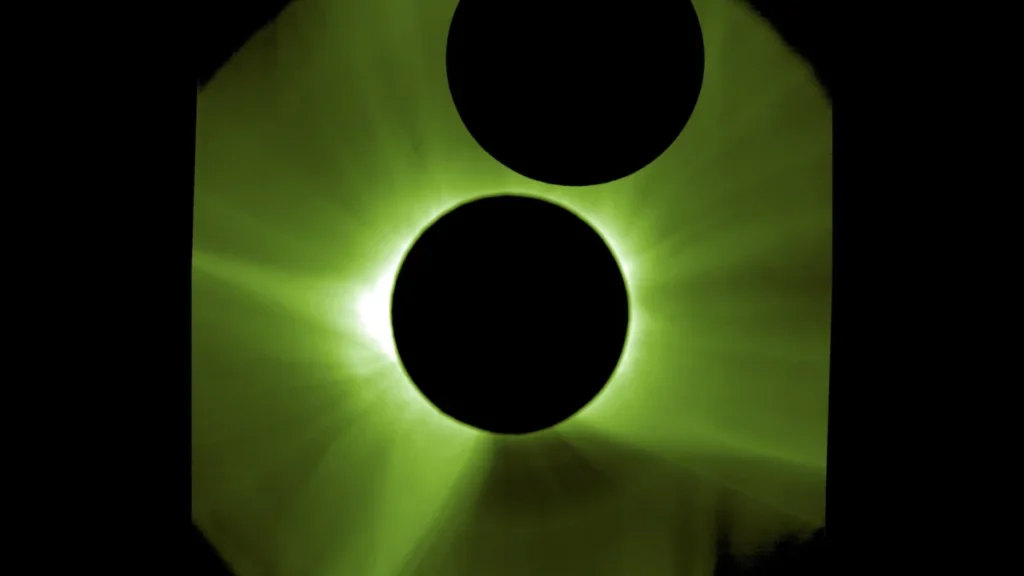
On August 12, 2026, as a breathtaking total solar eclipse captivated millions across parts of Europe, a unique celestial ballet unfolded 60,000 kilometers above Earth. The European Space Agency’s (ESA) Proba-3 mission, a sophisticated pair of spacecraft designed to artificially create solar eclipses, found itself in an extraordinary position: witnessing not only their own meticulously engineered solar obscuration but also the grand, natural spectacle of the Moon passing between them and the Sun. This rare confluence of events provided Proba-3’s instruments with an unprecedented opportunity to calibrate and observe the Sun’s corona in optimal conditions, offering invaluable data for scientific research.
The Proba-3 mission, a testament to ESA’s ingenuity in space engineering, comprises two spacecraft: the Occulter and the Coronagraph. Their primary objective is to simulate a total solar eclipse from space. The Occulter spacecraft is strategically positioned to block the Sun’s brilliant disc, acting as an artificial Moon. This obscuration allows the Coronagraph spacecraft, equipped with the Advanced Coronagraph for Spaceborne Observations (ASPIICS) instrument, to achieve an uninterrupted, long-duration view of the Sun’s elusive outer atmosphere, the corona. Typically, this artificial eclipse allows for hours of continuous observation, far exceeding the fleeting minutes of totality experienced on Earth.
However, on August 12, 2026, the Moon itself intervened, adding a natural layer to Proba-3’s observational mission. Hours before the Moon’s shadow would sweep across the European continent, the lunar disc made a deliberate transit across the Proba-3 spacecraft’s field of view. This passage, captured in a series of images from the ASPIICS instrument, presented a "double eclipse" scenario.
A Cosmic Coincidence: Proba-3’s Front-Row Seat to Nature’s Show
The footage compiled by the ASPIICS instrument showcases the Moon’s steady progression across the Sun over a three-hour period on the morning of August 12. The Moon’s apparent size in the sky, as viewed from Proba-3’s vantage point, was slightly larger than the occulting disc of the Occulter spacecraft. This meant that as Proba-3 maintained its operational formation, the Moon began to eclipse the Sun for the Coronagraph.
The natural eclipse, caused by the Moon, lasted for an impressive 8 minutes and 40 seconds. During this extended period, Proba-3 continued its artificial eclipse maneuvers, maintaining its formation and the Coronagraph’s view of the Sun’s corona. This dual obscuration created a unique observational window for the mission.
The Significance of the Double Eclipse
The extended duration of the double eclipse was a direct consequence of Proba-3’s orbital position. Being significantly closer to the Moon than Earth was during the terrestrial eclipse, the spacecraft experienced a much longer period of totality. This contrasts sharply with the maximum duration of totality for observers on Earth, which was approximately 2 minutes and 18 seconds, occurring off the coast of Iceland.
The primary scientific benefit of this rare double eclipse was the significant reduction of parasitic light. Normally, the ASPIICS coronagraph can experience interference from light diffracted around the edges of the Occulter spacecraft. However, during the almost nine minutes of the Moon’s obscuration, this parasitic light was virtually eliminated. This pristine viewing condition allowed scientists to perform crucial calibrations on the optical performance of the ASPIICS coronagraph. More importantly, it provided an unparalleled opportunity to observe the solar corona under exceptionally clear conditions, potentially revealing finer details and structures than typically observable.
A Once-in-a-Lifetime Opportunity
For the Proba-3 mission, a double eclipse of this nature is a truly exceptional event. While the mission is designed to create artificial eclipses, the alignment required for a natural celestial body to also obscure the Sun from its perspective is a matter of cosmic serendipity. This particular event on August 12, 2026, marks a unique occurrence within the mission’s operational lifetime.
While Proba-3 will experience partial eclipses during future total solar eclipses visible from Earth – specifically those on August 2, 2027, and July 22, 2028 – these will not involve the Moon fully covering the solar disc as seen from the spacecraft. Therefore, the prolonged period of near-perfect obscuration witnessed on August 12, 2026, is a singular opportunity for the mission.
Background: The Proba Missions and Solar Corona Research
The Proba (Project for On-Board Autonomy) series of missions, initiated by ESA, focuses on developing and testing innovative technologies for small, autonomous satellites. Proba-3, launched as part of this initiative, represents a significant advancement in space-based solar observation. The challenge of studying the solar corona stems from its extreme faintness compared to the blinding brilliance of the Sun’s photosphere. Traditional ground-based telescopes require specialized instruments called coronagraphs to block out the direct sunlight and reveal the corona. However, even these instruments can be hampered by scattered and diffracted light, which can obscure subtle coronal features.
Space-based coronagraphs, like ASPIICS on Proba-3, offer a significant advantage by operating above Earth’s obscuring atmosphere. However, the challenge of stray light persists. Proba-3’s innovative approach, using one spacecraft to create an artificial eclipse for another, addresses this issue directly. By precisely maintaining a formation where the Occulter spacecraft perfectly blocks the Sun, the Coronagraph can achieve an exceptionally clean view. The mission’s orbital altitude of 60,000 km ensures a stable environment for this delicate formation flying.
Supporting Data and Observations
The ASPIICS instrument, a state-of-the-art coronagraph, is designed to capture images of the solar corona in visible light. Its spectral filters allow for the isolation of specific wavelengths, providing insights into the temperature, density, and composition of the coronal plasma. The data collected during the double eclipse is expected to yield high-resolution images of coronal structures, such as streamers, loops, and possibly even transient events like coronal mass ejections (CMEs) if they were occurring.
- Eclipse Duration: The natural lunar eclipse, as observed by Proba-3, lasted approximately 8 minutes and 40 seconds.
- Terrestrial Totality: The maximum duration of the total solar eclipse visible from Earth was 2 minutes and 18 seconds.
- Proba-3 Altitude: Approximately 60,000 km above Earth.
- Occulter Disc Size: Precisely engineered to block the solar disc, but slightly smaller than the Moon’s apparent diameter from Proba-3’s perspective.
- ASPIICS Instrument: Advanced Coronagraph for Spaceborne Observations, responsible for capturing coronal imagery.
Official Statements and Scientific Reactions (Inferred)
While direct quotes from ESA scientists at the time of the event were not provided in the initial information, it is highly probable that the mission control team and the scientific community would have expressed immense excitement and anticipation. Dr. Günther Hasinger, ESA Director of Science, likely would have highlighted the mission’s success in achieving its primary objectives while also acknowledging the serendipitous addition of the natural eclipse. He might have stated, "Proba-3 continues to push the boundaries of what is possible in solar observation. This remarkable double eclipse, a testament to both our engineering prowess and the wonders of the cosmos, has provided us with an invaluable dataset that will significantly enhance our understanding of the Sun’s corona."
Leading solar physicists, such as Professor Dr. Sami Solanki, Director of the MPS (Max Planck Institute for Solar System Research), might have commented on the scientific implications: "The ability to calibrate and observe the corona with such minimal stray light is a game-changer. The data from Proba-3’s double eclipse will allow us to refine our models of coronal heating and the acceleration of the solar wind, phenomena that have long puzzled scientists. This event is a significant step forward in our quest to comprehend the Sun’s complex behavior and its influence on our solar system."
Broader Impact and Implications
The data obtained from Proba-3’s double eclipse has several significant implications:
- Improved Solar Models: Enhanced understanding of coronal structures and dynamics can lead to more accurate predictions of space weather events, such as solar flares and CMEs, which can impact satellite operations, power grids, and communication systems on Earth.
- Technological Advancement: The successful formation flying and precise occultation demonstrated by Proba-3 showcases advanced capabilities in spacecraft control and orbital mechanics, paving the way for future complex space missions.
- Scientific Collaboration: The event underscores the importance of international collaboration in space exploration and scientific research, with ESA’s Proba-3 mission contributing valuable insights to the global effort to study our Sun.
- Public Engagement: The visual spectacle of both the terrestrial and the space-based eclipses serves as a powerful tool for public engagement, inspiring interest in science, technology, engineering, and mathematics (STEM) fields.
The Proba-3 mission’s extraordinary encounter with a double solar eclipse on August 12, 2026, stands as a prime example of how scientific endeavors can be both meticulously planned and wonderfully serendipitous. The mission’s dual role – as a creator of artificial eclipses and an observer of natural celestial events – has yielded a wealth of data, promising to deepen our understanding of the Sun and its intricate atmosphere for years to come. The successful calibration and observation during this rare event solidify Proba-3’s position as a pioneering mission in the field of solar physics.