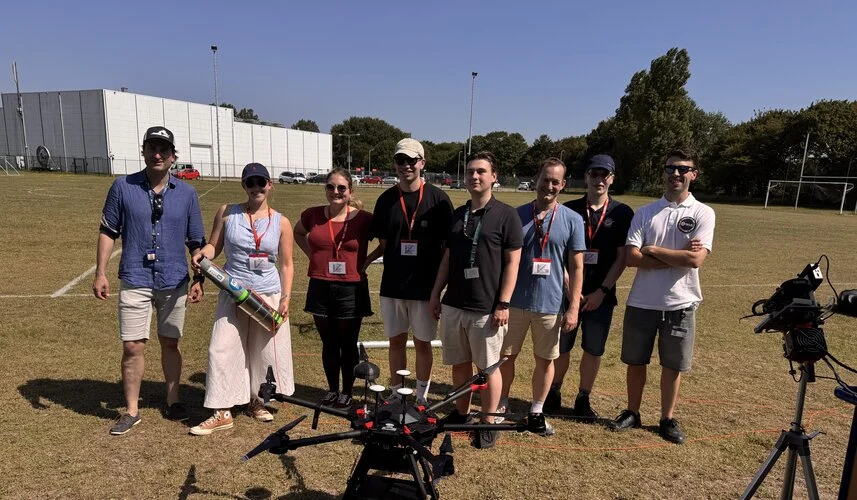
A groundbreaking test flight involving a drone carrying a novel student-developed radar retroreflector technology has successfully taken place over the European Space Agency’s (ESA) technical centre, ESTEC, in the Netherlands. This pivotal event marks a significant milestone in the advancement of passive radar enhancement systems, demonstrating their potential for improving the detectability of small airborne vehicles and sounding rockets. The successful demonstration paves the way for future launches, including a sounding rocket test scheduled for later this summer.
A Leap Forward in Radar Visibility
The test, conducted on a clear, warm day, saw a powerful drone lift a unique payload to an altitude of 120 meters above ESTEC’s grounds. Suspended by a five-meter rope, a 50 cm long plastic tube, simulating a sounding rocket, swung gently. The payload itself housed a 28 cm long metal tube, meticulously designed and constructed by a student team from Ruhr University Bochum, Germany. This device, the radar retroreflector, is engineered to reflect radar signals directly back to their source with exceptional efficiency. The primary objective of this test was to validate the retroreflector’s ability to significantly enhance the radar signature of objects that might otherwise be difficult to track, particularly at specific angles or distances.
ESA engineer Giovanni Serafini skillfully maneuvered the drone, executing a rapid descent to within three meters of the ground, followed by a series of controlled horizontal movements across the field. These maneuvers were crucial for simulating various flight paths and angles of approach that a sounding rocket or other small aerial vehicle might experience during a mission. The data collected from these tests will be instrumental in refining the retroreflector’s design and performance characteristics.

The Ingenuity of Student Innovation
The retroreflector technology is the brainchild of a student team from Ruhr University Bochum, who developed it for a competition organized by the Institute of Electrical and Electronics Engineers (IEEE). Daria Tsukanova, a member of the university team, explained the fundamental principle behind their invention: "A retroreflector is a passive structure, in this case a 28 cm long metal tube covered with cavities, designed to reflect signals back towards their source. This makes an object easier to detect and track without requiring active electronics or transmitters onboard."
This passive nature is a key advantage. Unlike active radar transponders that require their own power source and emit signals, a retroreflector simply bounces incoming radar waves back. This simplicity translates to lower cost, reduced complexity, and higher reliability, especially for small, expendable platforms like sounding rockets or even small satellites where mass and power are at a premium.
Addressing the Challenges of Radar Detection
Traditional radar systems often rely on the inherent metallic composition of objects, such as rockets, to provide a detectable signal. However, the reflectivity of these objects can vary significantly depending on their orientation relative to the radar source. This can lead to temporary or even complete loss of signal, creating gaps in tracking data. The student-developed retroreflector aims to mitigate this issue by providing a consistent and strong return signal across a wide range of angles.
"Radars currently rely on the fact that rockets are made out of metal, and so are relatively reflective by nature," Tsukanova elaborated. "However, even those rockets become no longer detectable at certain viewing angles. The advantage of the student team’s reflector is that it can extend these limits, keeping rockets or other objects visible to the radar for much longer."

Cost-Effectiveness and Accessibility
A significant aspect of this innovation is its affordability and accessibility. Stephan Hauptmeier, another member of the Ruhr University Bochum team, highlighted the economic advantages: "What’s unique about this technology is that it’s very cheap. The reflector itself is passive, made by 3D printing and laser cutting." The use of additive manufacturing and precise laser fabrication techniques allows for rapid prototyping and cost-effective production, making this technology potentially viable for a wide range of applications.
Furthermore, the retroreflector can be detected using radar technology already prevalent in the automotive industry. This existing infrastructure means that specialized, high-cost "space-grade" radar systems are not necessarily required for its detection. "Another advantage is that to detect it, we can use a radar technology well-established in the automotive industry – the same one that is part of driver assistance systems and will, for example, cause a car to break automatically if an obstacle is detected. This means no special ‘space-grade’ radar is needed," Hauptmeier stated.
Leveraging Existing ESA Expertise
The ESTEC test also benefited from ESA’s established expertise and infrastructure in radar technology. Václav Valenta, an ESA microwave engineer, emphasized the synergistic approach: "This has been a unique opportunity to leverage hardware previously developed within ESA’s Technology Development Element programme for planetary and in-orbit missions, based on automotive radar technology. By making one of these prototypes available to students, we enable them to gain practical experience with real radar technology and explore how such systems can be configured and optimised for specific applications."
This collaboration underscores ESA’s commitment to fostering innovation and supporting emerging talent. By providing access to advanced hardware and technical expertise, ESA empowers students to bridge the gap between theoretical knowledge and practical application, accelerating the development of new space technologies.

From Competition to Launch Pad
The successful ESTEC demonstration is not an endpoint but a crucial stepping stone. The team is now preparing for the next phase: a flight aboard a sounding rocket. This launch is scheduled to take place later this summer in Brno, Czech Republic, where the retroreflector will be propelled up to one kilometer above the ground. This higher-altitude test will provide invaluable data on the retroreflector’s performance in a more realistic atmospheric and trajectory scenario.
Karol Masztalerz, an ESA Graduate Trainee, commented on the broader significance of the project: "This project is a great example of how student initiatives can evolve beyond the competition environment. What began as a university-led challenge has grown into an international collaboration between ESA, two European universities – the Ruhr University Bochum in Germany and Imperial College London in the UK – industry partners and the Czech Rocket Society, who are providing their new Sherpa rocket for the next round of testing."
This expanding network of collaborators highlights the project’s growing momentum and its potential impact across multiple sectors. The involvement of institutions like Imperial College London, where engineer Václav Pavlíček was instrumental in adapting the radar system for terrestrial use cases, further strengthens the research and development efforts.
A Testament to International Collaboration
The project’s journey from a university competition to an ESA-backed launch is a testament to the power of international collaboration and the IEEE’s role in fostering such initiatives. The International Microwave Symposium (IMS) competition, organized by IEEE, served as the initial catalyst, identifying this project as a winner. The ongoing management of the project involves a collaborative effort between Václav Valenta at ESA and Markus Gardill from the Brandenburg University of Technology Cottbus-Senftenberg, who was instrumental in organizing the competition as co-chair of IEEE’s Microwave Theory and Techniques Society’s technical committee for Microwave Aerospace Systems (TC-29).

This structured approach ensures that student innovations are nurtured and supported through rigorous testing and validation processes, increasing their likelihood of successful real-world application. The involvement of industry partners and organizations like the Czech Rocket Society, which is providing its Sherpa rocket, further solidifies the pathway from concept to flight-ready technology.
Future Implications and Broader Impact
The success of this student-developed radar retroreflector technology has significant implications beyond the immediate context of sounding rocket launches. Improved radar visibility is crucial for a range of applications, including:
- Space Debris Monitoring: Enhancing the tracking of smaller debris could improve collision avoidance strategies for operational satellites.
- Small Satellite Tracking: As the number of small satellites (CubeSats, smallsats) continues to grow, robust tracking capabilities become increasingly important for orbital management and operational efficiency.
- Atmospheric Research: Sounding rockets are vital tools for atmospheric science. More reliable tracking ensures better data acquisition and mission success.
- Unmanned Aerial Vehicle (UAV) Operations: Enhanced detectability can contribute to safer airspace integration for drones, particularly in complex or crowded environments.
- Search and Rescue Operations: Quickly locating downed aircraft or vessels, especially in challenging terrain or conditions, could be significantly improved with enhanced radar visibility.
The cost-effectiveness and reliance on existing automotive radar technology suggest a rapid adoption potential. This could democratize advanced radar tracking capabilities, making them accessible to a wider array of research institutions, smaller space agencies, and even commercial entities. The project serves as a powerful model for how academic ingenuity, coupled with institutional support and international cooperation, can drive significant advancements in space technology and beyond. The upcoming sounding rocket launch will undoubtedly be a key indicator of the technology’s readiness for broader implementation.