Researchers at the University of Cambridge have pioneered a groundbreaking chemical technique that harnesses light instead of conventional toxic chemicals to precisely modify complex drug molecules. This innovative approach promises to dramatically accelerate the drug development timeline, making the design and refinement of new medicines significantly more efficient and sustainable. Published on March 12 in the esteemed journal Nature Synthesis, the study introduces what the research team has termed an "anti-Friedel-Crafts" reaction, a departure from traditional synthetic methods that have long been a cornerstone of organic chemistry.
Challenging Decades of Traditional Synthesis
For decades, the pharmaceutical industry has relied on established chemical reactions to build the intricate molecular structures that form the basis of therapeutic drugs. Among these, Friedel-Crafts chemistry has been indispensable for forming robust carbon-carbon bonds, which constitute the very backbone of countless organic compounds, including pharmaceuticals, polymers, and fuels. However, traditional Friedel-Crafts reactions come with inherent limitations: they typically demand potent chemical reagents, often expensive metal catalysts, and harsh laboratory conditions such as elevated temperatures and pressures. These requirements necessitate that such reactions occur early in the drug manufacturing process, often followed by numerous additional, time-consuming chemical steps to yield the final, desired medicinal compound.
The new methodology developed by the Cambridge team fundamentally reverses this paradigm. By allowing chemists to introduce precise modifications to drug molecules much later in their developmental journey, the "anti-Friedel-Crafts" reaction bypasses many of the logistical and chemical hurdles associated with early-stage interventions. This late-stage functionalization is a highly coveted capability in medicinal chemistry, as it enables rapid fine-tuning of molecular properties without the laborious and costly process of deconstructing and rebuilding entire molecular scaffolds.
LED-Activated Precision: A Greener Path to Key Chemical Bonds
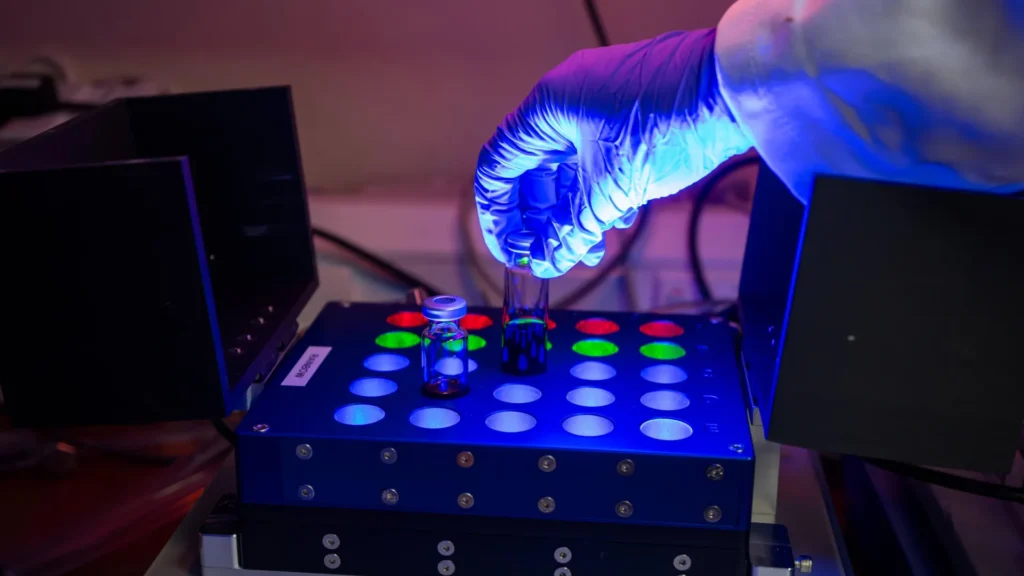
At the heart of this breakthrough is the utilization of an ordinary LED lamp to activate the chemical reaction, a stark contrast to the heavy metal catalysts and extreme conditions of yesteryear. Operating at ambient temperature, the light energy initiates a self-sustaining chain reaction that facilitates the formation of crucial carbon-carbon bonds under remarkably mild conditions. Crucially, this process does not require toxic or prohibitively expensive reagents, significantly reducing both the environmental footprint and the economic cost associated with drug synthesis.
In practical terms, this light-activated approach liberates chemists from the arduous task of dismantling complex molecules and painstakingly rebuilding them piece by piece to test minor structural variations. This conventional process can consume months of laboratory time and resources. David Vahey, first author of the study and a PhD researcher at St John’s College, Cambridge, underscored the significance: "We’ve found a new way to make precise changes to complex drug molecules, particularly ones that have been exceptionally difficult to modify in the past. Scientists can spend months rebuilding large parts of a molecule just to test one small change. Now, instead of doing a multistep process for hundreds of molecules, scientists can start with their hit and make small modifications later on." He further elaborated, "This reaction lets scientists make precise adjustments much later in the process, under mild conditions and without relying on toxic or expensive reagents. That opens chemical space that has been hard to access before and gives medicinal chemists a cleaner, more efficient tool for exploring new versions of a drug."
Accelerating the Pace of Drug Discovery and Development
The implications for the pharmaceutical industry are profound. Drug discovery and development is notoriously lengthy and expensive, with an average timeline of 10-15 years and costs often exceeding $1-2 billion for a single new medicine to reach the market. A significant portion of this time and expense is attributed to synthetic chemistry, particularly the iterative process of modifying and testing candidate molecules.
By reducing the number of synthesis steps, the Cambridge method inherently lowers chemical consumption, cuts energy expenditure, and shrinks the overall environmental footprint of drug development. This efficiency translates directly into valuable time savings for researchers, potentially shaving months or even years off the development cycle. In a competitive global market where speed to market can dictate success, such an advantage is invaluable. Moreover, the pharmaceutical industry, estimated to be worth over $1.5 trillion globally, continuously seeks innovations that can streamline its R&D pipeline. This new technique offers a tangible pathway to achieving that goal, fostering innovation and potentially bringing life-saving treatments to patients faster.
The reaction’s high selectivity is another critical attribute. It allows chemists to target and modify one specific part of a molecule without inadvertently disturbing other sensitive functional groups. This precision is paramount because even subtle structural alterations can profoundly influence a medicine’s efficacy, its biological behavior within the human body, or its propensity to produce undesirable side effects. This "high functional-group tolerance" makes the reaction particularly useful for late-stage optimization, a crucial phase in drug discovery where scientists fine-tune molecules to enhance their performance, bioavailability, and safety profiles.
A Pillar of Green Chemistry: Environmental and Economic Benefits
The pharmaceutical sector, like many industrial giants, faces increasing pressure to adopt more sustainable practices. The avoidance of heavy metals, harsh reaction conditions, and lengthy synthesis pathways inherent in the new Cambridge approach directly addresses these concerns. It promises to reduce the generation of toxic waste and significantly lower energy consumption in pharmaceutical manufacturing, aligning with the growing global movement towards green chemistry principles. This shift is not merely an environmental imperative but also an economic one, as regulations tighten and consumer demand for sustainably produced goods grows.
Professor Erwin Reisner, Professor of Energy and Sustainability in the Yusuf Hamied Department of Chemistry and lead author of the study, emphasized this dual impact. Reisner’s research group is renowned for its work on chemical systems inspired by photosynthesis, exploring sustainable methods to convert waste materials, water, and carbon dioxide into useful chemicals and fuels. "Transitioning the chemical industry to a sustainable industry is arguably one of the most difficult parts of the whole energy transition," Reisner explained, highlighting the broader context of this discovery. He added, "This is a new way to make a fundamental carbon-carbon bond and that’s why the potential impact is so great. It also means chemists can avoid an undesirable and inefficient drug modification process." The research team further validated the technique’s industrial applicability through collaboration with AstraZeneca, a global pharmaceutical leader, evaluating its potential to meet the practical and environmental demands of large-scale pharmaceutical manufacturing, including its adaptability for continuous flow systems commonly used in industrial chemical production.
From Serendipity to Breakthrough: The Accidental Discovery
Like many transformative scientific discoveries throughout history, from X-rays and penicillin to Viagra and modern weight loss medications, the "anti-Friedel-Crafts" reaction emerged from an unexpected laboratory result. David Vahey recounts the serendipitous origin: "Failure after failure, then we found something we weren’t expecting in the mess — a real diamond in the rough. And it is all thanks to a failed control experiment."
Vahey had been testing a photocatalyst when, during a control experiment designed to isolate variables, he removed the catalyst. To his astonishment, the reaction worked just as effectively, and in some instances, even better without it. Initially, the unusual product appeared to be an error or a mistake. However, instead of dismissing it, the researchers chose to investigate further – a critical decision that underscores the nature of scientific progress. Professor Reisner stressed the importance of this moment: "Recognizing the value in the unexpected is probably one of the key characteristics of a successful scientist." Vahey’s decision to probe the anomaly rather than discard it as a failed outcome was the pivotal moment where discovery happened.
Augmenting Human Ingenuity with Artificial Intelligence
Following the initial accidental discovery and the elucidation of the underlying chemistry, the Cambridge team collaborated with Trinity College Dublin to integrate machine learning models into their research. These AI systems were then trained to predict where the newly discovered reaction would occur on entirely novel molecules that had never been tested in the laboratory. By learning intricate patterns from known chemical reactions, the AI system can simulate possible outcomes and identify promising molecular candidates with unprecedented speed and accuracy, drastically reducing the amount of laborious trial-and-error experimentation traditionally required.
This integration of AI represents a powerful synergy between human insight and computational power. While AI excels at analyzing vast datasets and identifying patterns, it still requires human intuition to recognize truly novel phenomena that lie outside its programmed rules. "We generate enormous amounts of data, and increasingly we use artificial intelligence to help analyze it," Reisner explained. "We have an algorithm that can predict reactivity. AI helps because we don’t need chemists to do endless trial and error, but an algorithm will only follow the rules it has been given. It still takes a human being to look at something that appears wrong and ask whether it might actually be something new." In this instance, Vahey’s human curiosity and investigative spirit laid the groundwork, which AI then amplified, accelerating the subsequent exploration and validation of the technique.
Future Impact and Broader Implications
The potential impact of this light-powered chemical reaction extends far beyond the confines of academic laboratories. By providing medicinal chemists with a cleaner, more efficient, and more precise tool, it opens up previously inaccessible "chemical space," enabling the exploration of new molecular structures with therapeutic potential. This could lead to the discovery of novel drug candidates for diseases that currently lack effective treatments or to the development of safer and more potent versions of existing medications.
For Vahey, the true measure of the discovery lies in its future application. "What industry and other researchers do with it next – that’s where the future impact lies," he remarked. Professor Reisner echoed this sentiment, emphasizing the nature of scientific endeavor: "As a chemist, you only need one or two good days a year – and those can come from a failed experiment."
This breakthrough contributes significantly to the broader landscape of pharmaceutical innovation, which also includes advancements in computational chemistry, high-throughput screening, and the development of biologics. It represents a tangible step towards a future where drug discovery is not only faster and more cost-effective but also fundamentally more sustainable. As global healthcare demands continue to rise, and the imperative for environmental responsibility grows, pioneering technologies like the "anti-Friedel-Crafts" reaction will be crucial in shaping the next generation of medicines and ensuring a healthier planet.