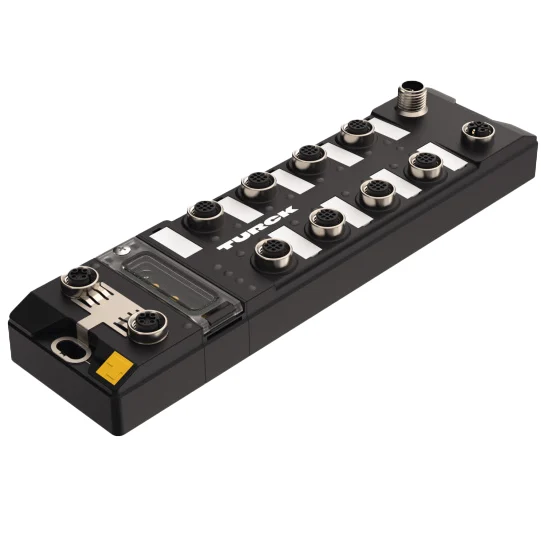
TURCK, a prominent global leader in industrial automation, has announced a significant advancement in material handling and intralogistics solutions with the preview of its TBEN-LLH-4RMC, a compact multiprotocol Ethernet I/O module specifically engineered for the control and seamless integration of conveyor roller motors. This innovative module is poised to redefine efficiency and flexibility in automated systems, with its official launch in the U.S. market anticipated in Q2 2026. The TBEN-LLH-4RMC represents a strategic move towards decentralized automation, addressing the evolving demands of modern manufacturing, packaging, and logistics environments where robust motor control, system adaptability, and operational longevity are paramount.
The core function of the TBEN-LLH-4RMC is to provide a sophisticated, yet user-friendly, solution for managing conveyor systems that are increasingly critical to global supply chains and e-commerce fulfillment. Designed to operate effectively in demanding industrial settings, it combines onboard logic, comprehensive I/O functions, and a ruggedized housing to deliver field-level control capabilities. This integration aims to significantly reduce the traditional reliance on centralized Programmable Logic Controllers (PLCs) and simplify complex wiring architectures, thereby enabling manufacturers and system integrators to streamline installation processes, minimize maintenance requirements, and ultimately achieve greater operational agility.
Understanding the TBEN-LLH-4RMC: A Deep Dive into Innovation
The TBEN-LLH-4RMC is not merely another I/O module; it embodies a paradigm shift in how conveyor systems are controlled. Its "multiprotocol Ethernet" capability is a cornerstone feature, meaning it can communicate seamlessly across various industrial Ethernet networks, including EtherNet/IP, PROFINET, and Modbus TCP. This flexibility is critical in today’s diverse industrial landscapes, where different manufacturers and facilities often employ distinct communication protocols. By supporting multiple protocols, the TBEN-LLH-4RMC ensures broad compatibility and simplifies integration into existing and future automation infrastructures, eliminating the need for protocol converters or specialized hardware, which traditionally add complexity and cost.
Central to its design is the principle of decentralized automation. Unlike conventional systems where a central PLC manages every motor, the TBEN-LLH-4RMC brings intelligence directly to the field level, situated closer to the motors it controls. This architecture includes onboard logic, allowing the module to execute local control sequences and diagnostics without constant communication back to a central controller. This capability is invaluable for several reasons: it reduces network traffic, decreases latency in motor response times, and enhances system resilience by preventing a single point of failure from crippling an entire conveyor line. Should a central PLC experience issues, localized control can often maintain partial or full operation, thereby increasing uptime.
The I/O functions integrated within the module are specifically tailored for conveyor roller motors. This typically includes inputs for sensors (e.g., photoeyes for package detection, limit switches for positioning) and outputs for motor control (e.g., start/stop, speed adjustment, direction). The compact form factor of the TBEN-LLH-4RMC is also a significant advantage, allowing for installation in tight spaces often found along conveyor lines, further reducing the physical footprint and complexity of the system. While specific technical specifications such as IP ratings (e.g., IP67 for dust and water resistance), operating temperature ranges, and vibration resistance are yet to be fully detailed, the emphasis on a "rugged housing" strongly suggests that the module is built to withstand the harsh conditions prevalent in industrial environments, ensuring reliability and a long operational lifespan. Features often expected in such advanced modules include integrated diagnostics for proactive maintenance, power over Ethernet (PoE) capabilities for simplified power distribution, and daisy-chaining options for scalable network architectures.
Strategic Implications for Intralogistics and Material Handling

The unveiling of the TBEN-LLH-4RMC comes at a pivotal moment for the intralogistics and material handling sector. Driven by the explosive growth of e-commerce, increasing consumer expectations for rapid delivery, and persistent labor shortages, industries are investing heavily in automation. The global material handling equipment market size, valued at hundreds of billions of dollars, continues to expand, with projections indicating sustained growth as companies strive for greater efficiency and resilience in their supply chains. Conveyor systems are the backbone of these operations, moving billions of packages and products daily within warehouses, distribution centers, and manufacturing plants.
However, traditional conveyor control systems, often reliant on large, centralized PLCs, present several challenges:
- Complex Wiring: Extensive cabling from the central PLC to each motor and sensor is labor-intensive, costly, and prone to errors during installation and troubleshooting.
- Scalability Issues: Expanding or reconfiguring conveyor lines can be a daunting task, requiring significant re-engineering and downtime.
- Single Point of Failure: A malfunction in the central PLC can bring an entire system to a halt, leading to costly operational disruptions.
- Higher Installation Costs: The sheer volume of wiring and the complexity of programming central PLCs contribute to substantial upfront investment.
- Lengthy Commissioning Times: Debugging and optimizing complex, centralized systems can extend project timelines significantly.
The TBEN-LLH-4RMC directly addresses these pain points. By enabling decentralized automation, it offers:
- Reduced Installation Costs: Significantly fewer cables are required, as control intelligence resides closer to the motors. This translates to less material cost, reduced labor for wiring, and faster installation times.
- Simplified Maintenance and Troubleshooting: With localized intelligence and diagnostics, issues can often be identified and resolved at the segment level, rather than requiring a system-wide investigation. This leads to quicker repairs and reduced downtime.
- Enhanced Flexibility and Scalability: Conveyor segments can be added, removed, or reconfigured with greater ease, allowing businesses to adapt quickly to changing production demands or facility layouts. This modularity is crucial for agile operations.
- Improved System Uptime: Decentralized control reduces the impact of localized failures, as other segments of the conveyor system can continue to operate independently.
- Potential for Energy Efficiency: More granular control over individual roller motors can lead to optimized energy consumption, as motors can be precisely controlled based on demand, reducing unnecessary operation.
The Rise of Decentralized Automation and Industry 4.0
The shift towards decentralized automation is a fundamental trend underpinning Industry 4.0 and the Industrial Internet of Things (IIoT). Traditionally, industrial control systems were hierarchical, with a central brain (PLC) making all decisions. However, as factories become more interconnected and data-driven, the limitations of this model become apparent. Decentralized systems offer several advantages:
- Faster Response Times: Decisions are made closer to the point of action, reducing communication delays and improving real-time control.
- Increased Modularity: Systems can be built from independent, intelligent modules, making them easier to design, implement, and maintain.
- Simplified System Design: Complex, large-scale systems can be broken down into smaller, manageable units.
- Edge Computing Integration: Decentralized modules are ideal platforms for edge computing, where data processing and analysis occur at the network’s edge, close to the data source. This reduces the need to send all raw data to the cloud, enhancing security, reducing bandwidth requirements, and enabling faster insights.
The TBEN-LLH-4RMC is a prime example of an IIoT-ready device. By providing intelligent control at the edge, it can gather critical operational data from individual roller motors—such as run time, current draw, and error codes. This data, when aggregated and analyzed, can support predictive maintenance strategies, allowing operators to identify potential motor failures before they occur, schedule maintenance proactively, and avoid costly unscheduled downtime. This integration of operational technology (OT) with information technology (IT) is central to the promise of smart factories.
TURCK’s Position and Market Rollout
TURCK has long been recognized as a global leader in industrial automation, boasting a comprehensive portfolio that includes sensors, fieldbus technology, connectivity solutions, and interface products. The introduction of the TBEN-LLH-4RMC aligns perfectly with TURCK’s strategic vision to provide integrated, high-performance solutions that simplify automation challenges for its customers. This module enhances TURCK’s existing connectivity offerings and expands its footprint in intelligent motor control, a critical area for modern logistics and manufacturing.

The competitive landscape for industrial I/O and motor control is dynamic, with numerous established players offering various solutions. However, TURCK’s emphasis on a compact, multiprotocol, and decentralized approach with integrated logic positions the TBEN-LLH-4RMC as a highly competitive offering, particularly for complex, large-scale conveyor systems where ease of integration and operational efficiency are paramount.
While the exact "preview" event was not specified, such announcements typically occur at major industry trade shows like Hannover Messe in Germany or SPS IPC Drives, providing a platform for companies to showcase upcoming innovations. The scheduled U.S. launch in Q2 2026 suggests that TURCK is currently in the advanced stages of product development, testing, and certification, ensuring the module meets all necessary industry standards and regulations. Following a successful U.S. launch, it is highly probable that TURCK will pursue broader global availability, catering to its international customer base.
Inferred Industry Reactions and Broader Impact
The announcement of the TBEN-LLH-4RMC is expected to be met with significant interest from various stakeholders across the industrial automation ecosystem.
- System Integrators are likely to welcome the module enthusiastically. A leading system integrator might comment, "This is precisely the kind of innovation we need to tackle the increasing complexity of modern intralogistics projects. The TBEN-LLH-4RMC promises to dramatically cut down on wiring time and simplify commissioning, allowing us to deliver more robust and flexible conveyor systems to our clients faster and more cost-effectively."
- Facility Managers and Operations Directors of warehouses, distribution centers, and manufacturing plants will recognize the potential for improved operational efficiency and reduced total cost of ownership. An operations director could state, "Minimizing downtime and simplifying maintenance are top priorities. A decentralized approach with integrated diagnostics offers a clear path to higher availability and easier troubleshooting, which directly impacts our bottom line and customer satisfaction."
- From TURCK’s perspective, the module represents a culmination of expertise and foresight. A TURCK spokesperson might articulate, "The TBEN-LLH-4RMC represents a significant leap forward in intelligent motor control for material handling. By embedding advanced logic and robust I/O capabilities directly at the field level, we are empowering businesses to achieve unprecedented levels of efficiency, flexibility, and uptime in their conveyor systems. It’s designed to simplify complex installations and reduce long-term operational costs, aligning perfectly with the demands of modern Industry 4.0 environments and supporting the ongoing automation revolution."
The broader impact of technologies like the TBEN-LLH-4RMC extends beyond immediate cost savings and efficiency gains. It fosters a more sustainable approach to industrial operations. By optimizing conveyor movements, reducing energy waste through precise control, and extending the lifespan of equipment through predictive maintenance, such modules contribute to greener manufacturing and logistics. They enable factories and warehouses to be more adaptable, capable of rapid reconfiguration to meet fluctuating market demands, and more resilient in the face of disruptions. This modular, intelligent approach is foundational to building the agile, smart factories and distribution centers of the future.
In conclusion, TURCK’s preview of the TBEN-LLH-4RMC signals a strategic enhancement in the industrial automation landscape. By offering a compact, multiprotocol Ethernet I/O module with integrated logic for conveyor roller motors, TURCK is addressing critical challenges in material handling and intralogistics. Its decentralized design promises to deliver substantial benefits in terms of reduced installation and maintenance requirements, enhanced flexibility, and improved system uptime. As industries continue their rapid adoption of automation and Industry 4.0 principles, solutions like the TBEN-LLH-4RMC will be instrumental in driving efficiency, resilience, and intelligent control across global supply chains. The Q2 2026 U.S. launch will mark a significant milestone for TURCK and the broader industrial automation sector.