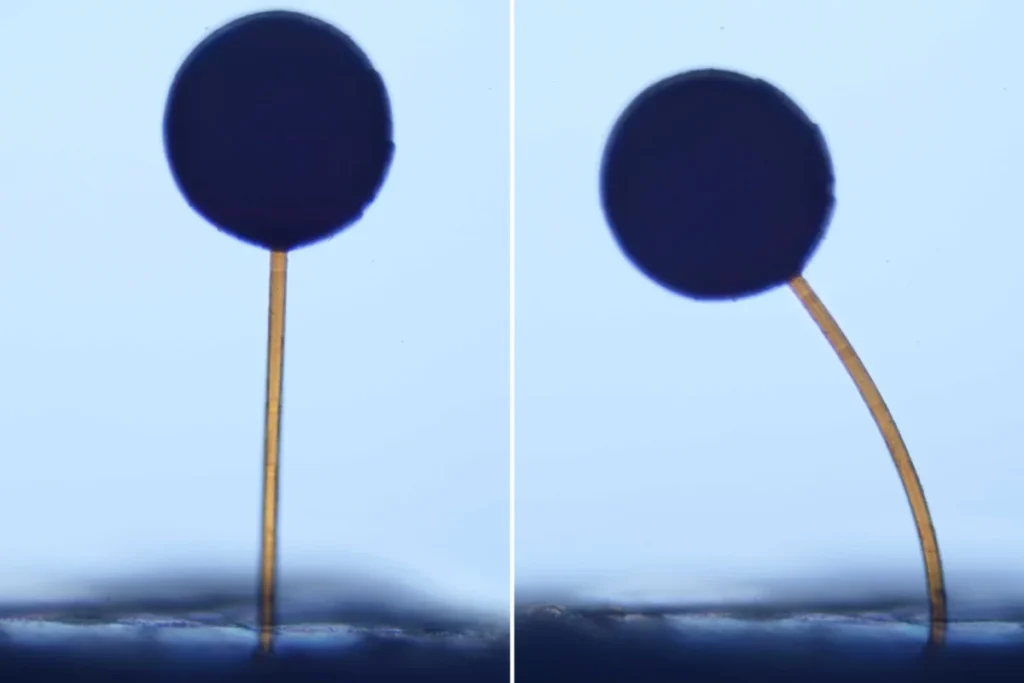
Under the magnified gaze of a microscope, a delicate array of lollipop-shaped structures, each a mere fraction of a grain of sand, swayed gently within a petri dish. Suddenly, with an almost imperceptible snap, these previously inert entities coalesced, mirroring the swift closure of a Venus flytrap. This remarkable transformation from passive elements to an active robotic gripper was triggered by the proximity of a small magnet, manipulated by a scientist. This innovative "lollipop gripper" is a tangible demonstration of a groundbreaking new class of soft magnetic hydrogels, meticulously developed by a collaborative team of engineers from the Massachusetts Institute of Technology (MIT), the École Polytechnique Fédérale de Lausanne (EPFL) in Switzerland, and the University of Cincinnati.
The findings of this pioneering research, published today in the prestigious journal Matter, detail a novel fabrication method enabling the creation of complex, three-dimensional structures that respond dynamically to magnetic fields. This advancement holds significant promise for the development of soft, microscopic, and magnetically responsive robots and materials, with potential applications spanning diverse fields, most notably in medicine. Imagine microscopic "magno-bots" capable of precisely delivering drugs to targeted sites within the body or expertly acquiring tissue samples for biopsies, all guided and controlled by external magnetic forces.
While the principle of using magnets to induce movement is well-established, particularly at the macroscopic scale—evidenced by the familiar phenomenon of paper clips trailing a refrigerator magnet—its application at the microscale has presented unique challenges. Scientists have previously engineered magnetic "micro-swimmers," components smaller than a millimeter, which can be remotely steered by magnets to navigate confined spaces. However, these existing designs typically involve dispersing magnetic particles within a printable resin and relying on the external magnet to pull the entire structure.
The MIT team’s novel material offers a significant departure from these conventional approaches. It allows for the fabrication of structures with far greater complexity and deformability, all with micron-scale precision. This enhanced capability could empower magnetic "millibots"—robots operating at the millimeter scale—to manipulate individual components and execute more sophisticated maneuvers than previously conceivable.
"We can now construct intricate, soft three-dimensional architectures with components that possess the ability to move and deform in complex ways within the same microscopic structure," explained Carlos Portela, the Robert N. Noyce Career Development Associate Professor of Mechanical Engineering at MIT and a senior author on the study. "For the field of soft microscopic robotics, or stimuli-responsive matter, this represents a potentially game-changing capability."
The collaborative effort also included contributions from MIT graduate students Rachel Sun and Andrew Chen, along with Yiming Ji and Daryl Yee from EPFL, and Eric Stewart from the University of Cincinnati.
An Instantaneous Response: The Power of Magnetic Metamaterials
At MIT, Professor Portela’s research group has established a reputation for developing novel metamaterials—engineered materials possessing microscopic architectures that bestow them with properties exceeding those of their constituent components. His prior work has yielded a diverse range of metamaterials, including exceptionally tough and stretchable structures, as well as designs capable of manipulating sound waves and withstanding extreme impacts.
More recently, Portela has expanded his research focus to "programmable" materials, which are designed to alter their properties in response to specific external stimuli, such as certain chemicals, light, or electric and magnetic fields. From the research team’s perspective, magnetic stimuli offer a particularly attractive avenue for material control.
"With a magnetically responsive material, we achieve control at a distance, and the response is virtually instantaneous," stated co-lead author Andrew Chen. "We bypass the need for slow chemical reactions or physical processes, and we can manipulate the material without any direct physical contact."
The objective for the new study was to engineer a magnetically responsive metamaterial capable of being formed into structures smaller than a millimeter. The established method for fabricating such microstructures is two-photon lithography, a high-resolution 3D printing technique. This process involves directing a laser beam into a small volume of resin, which solidifies in response to the laser’s flashes. By precisely tracing a microscopic pattern, layer by layer, a three-dimensional structure is gradually built.
However, applying this 3D resin printing technique to magnetic structures has historically presented considerable difficulties. Researchers have attempted to integrate magnetic nanoparticles directly into the resin before printing. Yet, these metallic particles often interfere with the printing process by scattering light, clumping together, or settling unintentionally. The presence of magnetic particles can diminish the laser’s power at the focal point, weakening the resulting structure or even preventing its formation altogether.
"Directly 3D printing deformable micron-scale structures with a significant concentration of magnetic particles is exceptionally challenging, often resulting in a compromise between magnetic functionality and structural integrity," noted Sun, another co-lead author on the research.
A Novel Fabrication Process: The "Double-Dip" Method
To overcome these limitations, the researchers devised an innovative fabrication approach that combines conventional 3D resin printing with a subsequent two-step immersion process. Initially, they employed standard resin printing to create a microstructure using a conventional polymer gel, devoid of any magnetic additives. Following this, the printed gel structure was immersed in a solution containing iron ions, which the gel readily absorbs. Subsequently, the iron-infused structure underwent a second immersion in a solution containing hydroxide ions. This reaction causes the iron ions within the gel to bond with the hydroxide ions, forming iron-oxide nanoparticles, which are inherently magnetic.
This novel "double-dip" method allows for the intricate 3D printing of structures at scales smaller than a millimeter, with magnetic properties being imparted after the initial printing. Crucially, the researchers discovered that they could precisely control the magnetic properties of individual features within a structure. By adjusting the laser’s power during the printing of specific regions, they could influence the degree of cross-linking, or "tightness," of the polymer gel. A more tightly cross-linked gel can accommodate fewer magnetic particles, enabling the researchers to fine-tune the magnetic responsiveness of each microscopic component.
"This offers an unprecedented level of design freedom for creating multifunctional structures and materials at the microscale," emphasized Sun.
As a compelling demonstration of their technique, the team fabricated structures resembling miniature lollipops, measuring less than a millimeter in height, with the spherical "candy" portions smaller than a grain of sand. These lollipops were printed from polymer gel, and the researchers intentionally infused each "ball" with varying concentrations of magnetic particles, thereby bestowing them with distinct degrees of magnetism. When observed under a microscope, and subjected to the field of an ordinary refrigerator magnet, the lollipops exhibited varied attractive forces towards the magnet, aligning in a configuration that mimicked the coordinated action of gripping fingers.
"One can envision a magnetic architecture like this functioning as a minuscule robot that could be guided through the human body by an external magnet, capable of latching onto specific targets, for instance, to collect a biopsy sample," Portela elaborated. "This is a vision that can be further explored and realized by others building upon this work."
Beyond Grippers: Bistable Switches and Future Prospects
The researchers also engineered a magnetically responsive, "bistable" switch. This design involved printing a small, millimeter-long rectangle of polymer gel and attaching four tiny, oar-like magnetic structures to each side. Each "oar" measured approximately 8 microns in thickness—comparable in size to a red blood cell. When a magnet was applied to one end of the rectangular structure, the oars on that side pivoted towards the magnet, drawing the rectangle along and locking it into that position. Reversing the magnet’s position caused the oars to flip again, effectively switching the rectangle’s orientation to the opposite side, much like a miniature lever or switch.
"We believe this represents a novel bistable mechanism that could be utilized, for example, in microfluidic devices as a magnetic valve to control the flow of fluids, either opening or shutting off passage," Portela suggested. "For now, we have successfully demonstrated the ability to fabricate complex magnetic architectures at the microscale and to spatially tune their properties. This breakthrough opens up a multitude of exciting possibilities for the future development of soft miniature robots."
The development of these advanced magnetically responsive hydrogels and their intricate fabrication methods marks a significant leap forward in the field of micro-robotics and smart materials. The ability to precisely control the magnetic behavior of microscopic structures at will, without direct physical intervention, unlocks a vast array of potential applications.
In the medical domain, the implications are particularly profound. Beyond drug delivery and biopsy, these micro-robots could be employed for minimally invasive surgical procedures, clearing blockages in blood vessels, or performing targeted diagnostics within the intricate landscape of the human body. The precision and remote control offered by magnetic actuation make them ideal candidates for navigating delicate biological environments where traditional robotic instruments might be too cumbersome or invasive.
The educational and industrial sectors also stand to benefit. The development of sophisticated micro-scale manipulators could revolutionize micro-assembly processes, enabling the creation of increasingly complex and miniaturized electronic components and devices. In research laboratories, these materials could serve as versatile tools for manipulating cells, particles, or other microscopic entities with unprecedented accuracy.
The timeline for widespread adoption of these technologies will, of course, depend on further research, development, and rigorous testing. However, the fundamental breakthrough achieved by the MIT-led team provides a robust foundation. The research was supported in part by grants from the National Science Foundation and a seed grant program from MathWorks, underscoring the critical role of public and private funding in driving such cutting-edge scientific endeavors. Crucially, the work was also facilitated by access to state-of-the-art facilities at MIT.nano, highlighting the importance of specialized infrastructure for advanced materials science research.
As the scientific community digests these findings, the potential for these tiny, magnetically animated structures to reshape industries and improve human health is becoming increasingly clear, heralding a new era of microscopic engineering.