August 23, 2026 – In a week marked by a return to its primary mission objectives, NASA’s Mars Science Laboratory (MSL) rover, Curiosity, is steadily progressing towards its scientific targets as it continues its ambitious ascent of Mount Sharp. After a brief but scientifically valuable detour to investigate a unique erosional surface, the rover has now reoriented itself on a course to higher elevations of the Martian mountain. This period coincides with the transition into autumn in Gale Crater, a season that typically sees a decrease in ambient temperatures and a reduced probability of widespread dust storms. However, Curiosity remains vigilant, equipped to detect and analyze any lingering local or regional dust storm activity, a crucial aspect of understanding Martian atmospheric dynamics.
Resuming the Climb: A Glimpse at Unique Geology
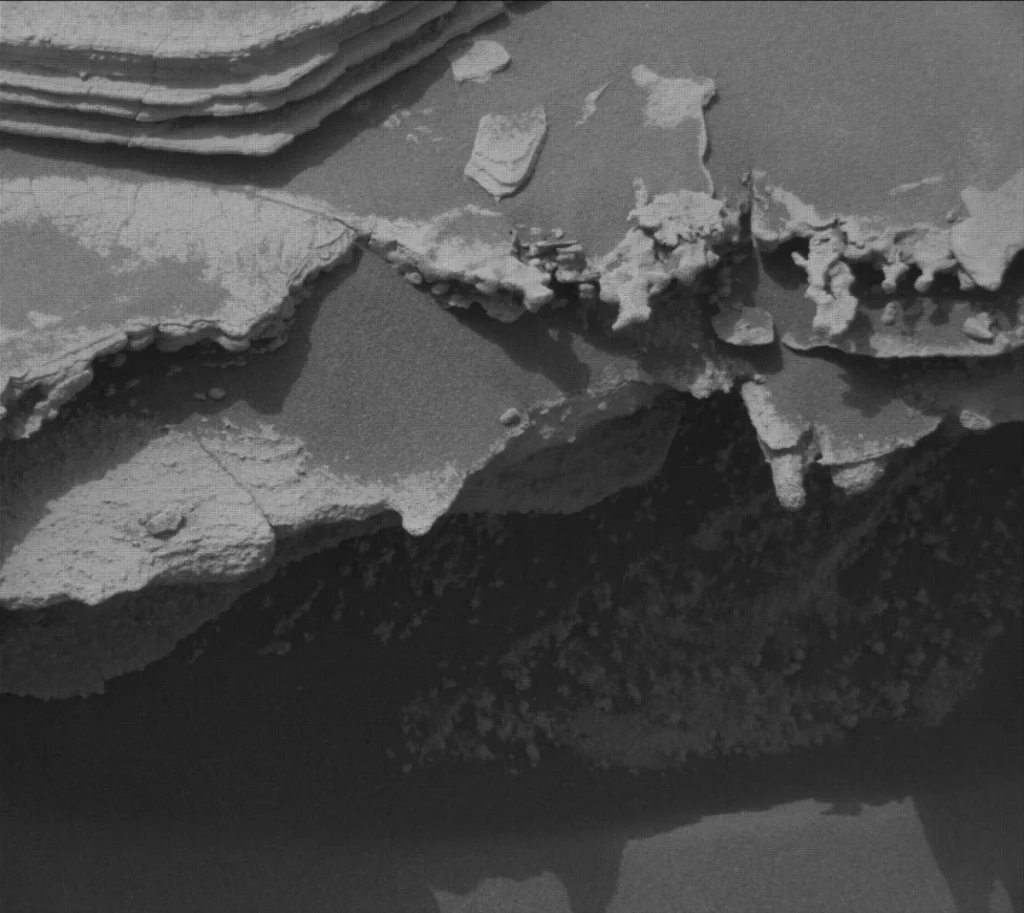
The operational plan for Sols 4982 to 4985 saw Curiosity positioned directly in front of a fascinating geological formation situated just above a distinct erosional contact. This location, which the science team had the opportunity to study extensively over two previous planning cycles, offered a unique vantage point. As highlighted in previous mission updates, the rover’s instruments were deployed to capture detailed imagery and chemical analyses of this intriguing feature.
The Mars Hand Lens Imager (MAHLI) was utilized to reacquire high-resolution images of a specific target designated "Tres Morros." This meticulous imaging effort aims to provide the science team with an exceptionally detailed and focused view of the underside of this geological structure, potentially revealing insights into its formation processes and the history of erosion in the region.
Complementing the visual data, the Alpha Particle X-ray Spectrometer (APXS) was employed to conduct in-situ elemental analysis of bedrock targets. "El Motacusal," a brushed bedrock target, was subjected to APXS measurements, providing crucial data on its chemical composition. Following this, APXS was directed to an "as is" bedrock target named "Alto de Carmen" for a second measurement. Both of these APXS targets were thoroughly documented with high-resolution images captured by MAHLI, ensuring a comprehensive dataset for subsequent analysis.
The ChemCam instrument suite played a vital role in the remote sensing campaign. Its Laser-Induced Breakdown Spectroscopy (LIBS) capability was used to analyze the elemental composition of two bedrock targets, "Lagunas Bravas" and "Parququcha." Additionally, ChemCam’s Remote Micro-Imager (RMI) captured detailed close-up images of a target known as "Mishe Mokwa," offering a microscopic perspective on the Martian surface.
During this period, the Mastcam instrument, operated by Allison Dries-Padilla, Missions Operations Specialist at Malin Space Science Systems, provided extensive visual documentation. A near-field mosaic of the erosional ridge, affectionately nicknamed "Los Toldos," was captured, offering a detailed panorama of the immediate surroundings. Further afield, a mosaic was acquired of a bedrock exposure situated above the erosional surface, designated "Los Ladrillos." Mastcam also provided essential color documentation for previous ChemCam RMI observations on a target named "Cordillera" and for the ChemCam LIBS activities conducted during this plan, ensuring a multi-spectral understanding of the studied areas.
Strategic Maneuvers and New Scientific Opportunities
Following its detailed investigation of the erosional surface, Curiosity executed a precisely planned drive of approximately 100 feet (30 meters) to reach a new location, which became the focus of the operational plan for Sols 4985 to 4987. While this new area presented ample amounts of flat and scientifically promising bedrock, the rover’s positioning posed a slight challenge for the deployment of the robotic arm. The rover’s left-front wheel was perched precariously on a small rock, necessitating careful consideration to ensure the safety of the arm’s movements and prevent any potential slippage.
Despite these positional constraints, the science team was still able to conduct valuable contact science. MAHLI and APXS safely performed their analyses on two bedrock targets, "Mamorecillo" and "Aguas Claras." MAHLI also completed an additional housekeeping activity, capturing images of the rover’s calibration target, a standard procedure for ensuring instrument accuracy.
The ChemCam instrument was slated to utilize its laser spectrometer to gather geochemical data on three targets within this vicinity, followed by comprehensive documentation by Mastcam. The ChemCam LIBS targets for this plan included "Yura Kasa," a dark-toned, resistant layer within the bedrock, offering a potential contrast to previously analyzed materials. Mastcam was also scheduled to acquire a series of mosaics to continue mapping and documenting the stratigraphy of the geological unit situated above the erosional contact, a key objective in understanding the layered history of Mount Sharp.
Vigilance Against Martian Weather
A significant component of Curiosity’s operational plan during this period was dedicated to comprehensive environmental monitoring, specifically aimed at detecting and tracking potential dust storms. The Martian atmosphere, especially during seasonal transitions, can be dynamic and prone to significant dust events that can impact rover operations and our understanding of the planet’s climate.
Mastcam played a crucial role in this effort, executing a series of dust-imaging observations. These observations are designed to measure the optical depth, or "tau," of the atmosphere. A higher tau value is a direct indicator of an increased amount of dust suspended in the atmosphere. Understanding these fluctuations is vital for long-term climate modeling and for predicting the conditions under which dust storms might develop or dissipate.
APXS also contributed to atmospheric monitoring by planning an overnight measurement, likely designed to assess the composition or density of atmospheric particles over an extended period.
The Navcam instrument, with its wider field of view and capabilities, took on a substantial portion of the heavy lifting in dust storm surveillance. Its activities included multiple large dust-devil surveys, which are crucial for identifying and tracking these localized, rotating columns of dust. Zenith observations, which provide a view directly overhead, were also conducted to monitor for general atmospheric haze and dust lofting. In-crater line-of-sight observations were performed to track dust movement within Gale Crater itself, providing a localized perspective on atmospheric conditions. Furthermore, suprahorizon cloud movies were captured, which can offer early indications of atmospheric disturbances and potential dust storm development.
The Road Ahead: Continued Ascent and Scientific Exploration
With its immediate scientific objectives met and its environmental monitoring protocols robustly executed, Curiosity is poised to continue its ascent of Mount Sharp. The planned drive of approximately 150 feet (47 meters) will move the rover southwest of its current position, venturing deeper into the mountain’s geological layers.
This ongoing journey up Mount Sharp is not merely a physical progression but a chronological exploration of Mars’s past. Each layer of rock represents a distinct period in the planet’s history, potentially holding clues about ancient water, atmospheric conditions, and the habitability of Mars billions of years ago. The data collected by Curiosity, from the elemental composition of rocks to the fine details of geological structures and atmospheric phenomena, contributes to a growing scientific narrative of a dynamic and evolving Red Planet.
The mission team will reconvene to plan the next week of operations, which is expected to include further contact science, remote sensing activities, and continued driving. Each sol, or Martian day, presents new opportunities for discovery as Curiosity meticulously works its way across the Martian landscape, inching closer to unlocking the secrets held within Mount Sharp. The insights gained from these ongoing explorations are invaluable, not only for understanding Mars but also for informing future human missions and the search for extraterrestrial life. The sustained operation of Curiosity, now in its fourteenth year on Mars, stands as a testament to human ingenuity and our enduring drive to explore the cosmos.