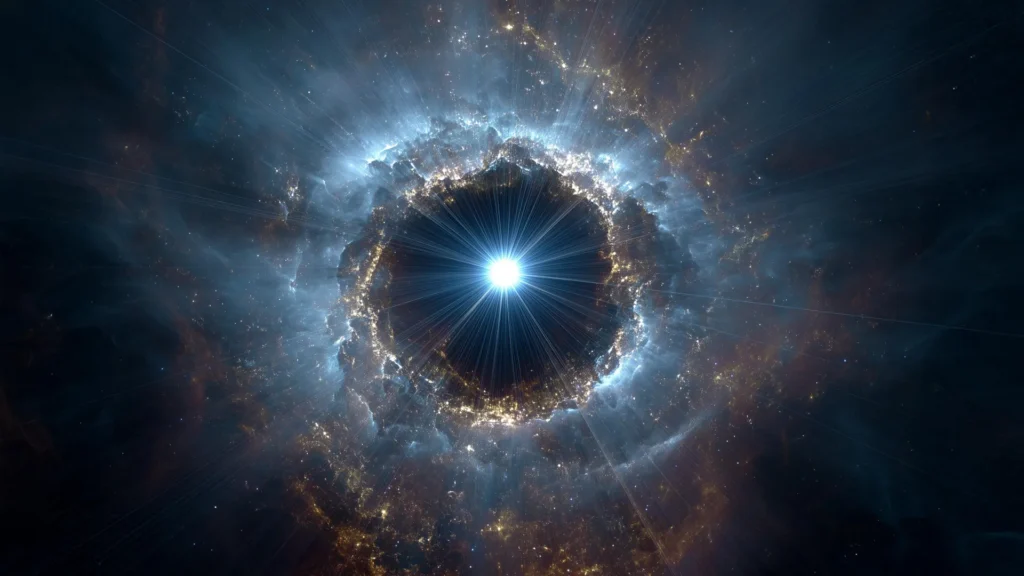
This groundbreaking revelation stems from a recent study by Colgate University researchers Sohan Ghodla and Cosmin Ilie, published as a Letter in Physical Review D. Their investigation delves into the profound question of whether supermassive black holes (SMBHs) that originated in the very early Universe could be the primary progenitors of the gravitational wave background now being meticulously measured by Pulsar Timing Arrays (PTAs). The findings forge an unexpected link between two seemingly disparate frontiers of astronomical inquiry: the rapid formation of colossal black holes in the Universe’s infancy and the ripples in spacetime generated billions of years later by their colossal descendants.
Unveiling the Cosmic Symphony: Gravitational Waves and Pulsar Timing Arrays
The detection of gravitational waves, first directly observed in 2015 by the Laser Interferometer Gravitational-Wave Observatory (LIGO) from merging stellar-mass black holes, marked a new era in astronomy. These high-frequency events, however, represent only one facet of the gravitational wave spectrum. To probe the much lower, nanohertz frequencies, astronomers rely on a different kind of cosmic observatory: Pulsar Timing Arrays.
PTAs leverage the extraordinary precision of rapidly spinning neutron stars, known as pulsars, which emit beams of radio waves at incredibly regular intervals, acting as cosmic clocks with unparalleled accuracy. As gravitational waves – ripples in the fabric of spacetime – propagate through the Universe, they subtly stretch and compress the spacetime between Earth and these distant pulsars. This distortion causes minuscule, yet detectable, alterations in the arrival times of the radio pulses. By meticulously monitoring an array of these pulsars across the galaxy over many years, international collaborations like the North American Nanohertz Observatory for Gravitational Waves (NANOGrav), the European Pulsar Timing Array (EPTA), the Parkes Pulsar Timing Array (PPTA), and the Indian Pulsar Timing Array (InPTA) – collectively forming the International Pulsar Timing Array (IPTA) – have recently gathered compelling evidence for a stochastic gravitational wave background.
This background, akin to a persistent hum pervading the cosmos, is widely theorized to originate from a vast population of supermassive black hole binaries. These are pairs of SMBHs, each residing at the heart of massive galaxies, that are gradually spiraling inward toward an inevitable collision following galactic mergers. The most massive of these systems, those with a combined mass exceeding roughly a billion Suns, are particularly potent generators of gravitational waves in the nanohertz frequency range detectable by PTAs.
The Early Universe Conundrum: The Genesis of Supermassive Black Holes
While the existence of present-day SMBH binaries offers a robust explanation for the observed gravitational wave background, it simultaneously deepens one of cosmology’s most profound mysteries: how did these behemoths come into being? Observations from cutting-edge instruments like the James Webb Space Telescope (JWST) and the Chandra X-ray Observatory have repeatedly uncovered surprisingly massive black holes (ranging from millions to billions of solar masses) existing just a few hundred million years after the Big Bang, during an epoch often referred to as "cosmic dawn" (corresponding to redshifts greater than 10).
This rapid emergence poses a significant challenge to conventional models of black hole growth. The standard pathway suggests that black holes originate from the collapse of massive stars, forming "stellar-mass" black hole seeds (tens to hundreds of solar masses). For these seeds to grow into billion-solar-mass objects in such a short cosmological timescale – a mere fraction of the Universe’s current age of 13.8 billion years – they would need to accrete matter at an astonishing and sustained rate, potentially exceeding theoretical Eddington limits. This "seed problem" has spurred theoretical astrophysicists to explore alternative formation mechanisms capable of producing much larger "massive seeds" very quickly.
Investigating Ancient Seeds: Direct Collapse vs. Dark Stars
Ghodla and Ilie’s study directly addresses this enigma by investigating whether the descendants of such ancient, massive black hole seeds could persist through cosmic time, grow alongside their host galaxies, eventually pair up through galaxy mergers, and ultimately generate the gravitational wave background observed today. The researchers explored two prominent theoretical pathways for producing these massive black hole seeds in the early Universe:
-
Direct Collapse Black Holes (DCBHs): This scenario posits that under specific, rare conditions in the early Universe – such as pristine gas clouds with very low metallicity and inhibited hydrogen cooling – vast amounts of gas could bypass star formation and collapse directly into a black hole. These DCBHs could form with masses ranging from 10,000 to 100,000 solar masses, providing a significant head start for rapid growth.
-
Black Holes Formed Through the Collapse of Supermassive Dark Stars (SMDS): This more exotic hypothesis involves hypothetical primordial stars, known as Dark Stars. Unlike conventional stars that derive their energy primarily from nuclear fusion, Dark Stars are thought to be powered by the annihilation of Weakly Interacting Massive Particles (WIMPs), a leading candidate for dark matter. In the WIMP dark matter scenario considered by Ghodla and Ilie, these stars would accumulate dark matter within their cores, where self-annihilation would generate heat and radiation pressure. This internal heating would prevent the star from collapsing and igniting nuclear fusion, keeping it relatively cool, extended, and allowing it to accrete vast amounts of gas from its surroundings. Under the right conditions, Dark Stars could theoretically grow to immense sizes, potentially reaching a million times the mass of the Sun or more, before eventually collapsing to form massive black holes.
The Dominant Contribution of Dark Star Remnants
To evaluate the contribution of these early black hole seeds to the present-day gravitational wave background, Ghodla and Ilie developed sophisticated models. They meticulously tracked the evolution of the dark matter halos hosting these nascent black holes, estimated the frequency at which these objects would merge as their host galaxies collided, and subsequently calculated the gravitational wave background that these mergers would produce over cosmic history.
Their results revealed a striking distinction between the two seed formation mechanisms. The models indicated that if remnants of supermassive Dark Stars existed at a number density of approximately 10⁻³ Mpc⁻³ (meaning about one Dark Star remnant per 1,000 cubic megaparsecs), their descendants could potentially provide a large, and possibly dominant, share of the gravitational wave signal currently being measured by PTAs. This suggests that the faint hum of gravitational waves detected today could carry a direct echo from the exotic physics of Dark Stars at cosmic dawn.
In contrast, the direct collapse black hole population, while a viable seed mechanism, appears to have been much less common. With characteristic densities near 10⁻⁶ Mpc⁻³ (about one DCBH per million cubic megaparsecs), these objects would contribute substantially less to the observed PTA signal, making them a less likely dominant source for the background.
"Pulsar timing arrays are usually thought of as probes of supermassive black-hole binaries in the relatively recent Universe," explained Cosmin Ilie, highlighting the conventional view. "What our work shows is that the signal may also contain information about how the ancestors of those black holes formed at cosmic dawn. In that sense, gravitational waves observed today could provide a new window onto the birth of the first supermassive black holes."
Gravitational Waves as a Probe of Cosmic Dawn
One of the most profound conclusions of the study is the unexpected power of current PTA measurements to place meaningful limits on how common the earliest seeds of supermassive black holes could have been. The amount of gravitational wave background detected provides a cosmic ledger, tallying the mergers of massive black holes throughout the Universe’s history.
Sohan Ghodla elaborated on this delicate balance: "Produce too many of these massive seeds and you end up over-producing the PTA-detected signal. Produce too few, and you need other sources to efficiently assemble these supermassive black holes later in the life of the universe to match PTA observations."
Within the theoretical framework examined by the researchers, seed densities in the range of 10⁻² to 10⁻¹ Mpc⁻³ (i.e., one seed per 10 to 100 cubic megaparsecs) would begin generating more gravitational wave background than current observations allow. The precise upper limit is intricately tied to the masses of the dark matter halos where these seeds initially formed. This remarkable constraint implies that PTAs, by observing events occurring billions of years later, are effectively probing conditions and populations that existed at extremely high redshifts, greater than 10, when the Universe was less than 500 million years old. This offers an unprecedented, indirect means of studying an epoch otherwise challenging to observe directly.
The calculations further supported an earlier finding that binaries with total black hole masses roughly above 10⁹ solar masses (a billion times the mass of our Sun) dominate the predicted PTA signal. Binary systems containing less massive black holes contribute far less to the nanohertz background, underscoring the critical role of these colossal mergers in shaping the cosmic gravitational wave landscape.
Connecting Dark Matter, Dark Stars, and Black Holes: A Unified Picture
The findings of Ghodla and Ilie’s study weave together several major, unresolved questions in modern cosmology into a coherent narrative. It establishes a new observational link between:
- The fundamental nature of dark matter, which constitutes about 27% of the Universe’s mass but remains elusive.
- The formation of the first luminous objects (stars and galaxies) at cosmic dawn.
- The mysterious origins and rapid growth of supermassive black holes.
- The pervasive background of gravitational waves that permeate the cosmos.
"Dark Stars were originally proposed as objects that might be seen directly at cosmic dawn," said Ilie, referring to earlier proposals for directly observing these hypothetical stars with telescopes like JWST. "This work points to a completely different way of testing their possible role in cosmic history. Their descendants could leave a gravitational-wave imprint that persists all the way to the present-day Universe." This implies that even if Dark Stars themselves are too faint or short-lived for direct observation, their gravitational legacy might be detectable.
Future Prospects and the Dawn of Multi-Messenger Cosmology
The implications of this research are profound, opening new avenues for both theoretical and observational cosmology. As Pulsar Timing Array measurements continue to become more precise – through longer observation times, the inclusion of more pulsars, and advancements in data analysis techniques – astronomers will gain an even sharper picture of the gravitational wave background. This improved sensitivity will enable more stringent constraints on the abundance and properties of early black hole seeds.
Furthermore, the synergy between gravitational wave astronomy and traditional electromagnetic astronomy will become increasingly vital. Future observations from telescopes like the Roman Space Telescope, along with next-generation X-ray missions, will continue to map the distribution and growth of distant black holes and their host galaxies, providing crucial complementary data. By combining these different observational windows, researchers may eventually be able to distinguish more clearly among competing explanations for how the Universe’s first supermassive black holes formed.
The ongoing quest to understand dark matter, its properties, and its role in cosmic evolution also receives a new impetus from this study. If Dark Stars indeed played a significant role in seeding SMBHs, their gravitational wave signature could provide indirect evidence for the existence and characteristics of WIMP dark matter. The Universe’s cosmic symphony, detectable through the subtle timing variations of pulsars, promises to be a powerful tool in unraveling the secrets of its earliest moments, offering a unique opportunity to peer back beyond the first stars to the very genesis of cosmic structures and the mysterious dark components that shaped them.