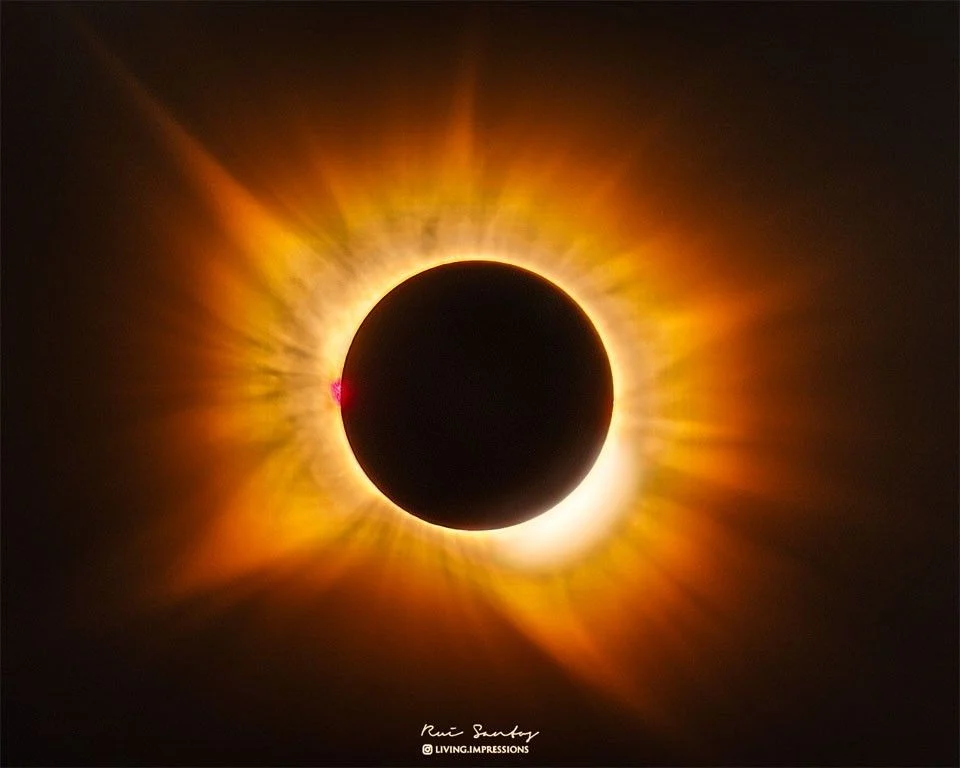
The celestial spectacle of a total solar eclipse, a phenomenon that has captivated humanity for millennia, unfolded over Spain recently, presenting observers with a vision of the Sun’s corona that was not only breathtakingly beautiful but also scientifically intriguing. While typically appearing as a pearlescent white halo, the corona observed during this particular eclipse exhibited a distinct golden hue. This unusual coloration, according to astronomical analysis, can be attributed to a confluence of factors, including the Sun’s low position on the horizon at the time of totality, the scattering of light through Earth’s atmosphere, and the presence of smoke particles from nearby forest fires.
The featured image, a meticulously crafted HDR composite of multiple exposures, captures the Sun’s corona in its full, filamentary glory, radiating outwards in a spectrum of golden tones. This visual testament to the eclipse’s unique atmospheric conditions was captured by photographer Santos from Benavente, Spain, a location that experienced totality as the Sun was nearing the horizon. The delicate interplay of light and atmospheric particles transformed the normally white corona into a scene of ethereal gold, offering a rare glimpse into how terrestrial conditions can influence our perception of cosmic events.
The Science Behind the Golden Glow
The solar corona, the outermost layer of the Sun’s atmosphere, is characterized by its extremely high temperatures, reaching millions of degrees Celsius, yet it is typically only visible during a total solar eclipse when the Moon completely obscures the Sun’s bright disk. Its appearance is usually described as white or pearly due to the scattering of sunlight by free electrons within the plasma. However, the eclipse observed over Spain on August 12, 2026, presented a deviation from this norm, painting the corona in shades of gold.
Two primary terrestrial factors are identified as contributing to this unusual coloration. Firstly, the timing of the eclipse for observers in Spain meant that totality occurred as the Sun was positioned low on the horizon. Sunlight, in its journey from the Sun to Earth, must traverse a significantly larger portion of the atmosphere when the Sun is near the horizon. This extended path through the atmosphere leads to the preferential scattering of shorter, bluer wavelengths of light, a phenomenon that also explains why sunsets and sunrises often appear red or orange.
Secondly, and significantly, the presence of smoke from nearby forest fires played a crucial role as a secondary filter. Forest fires, increasingly prevalent in many regions, release a complex mixture of particles into the atmosphere, including soot and ash. These particles, particularly fine aerosols, are highly effective at scattering light. In this instance, the smoke further filtered the already reddened sunlight, scattering away even more of the remaining blue and green wavelengths, thereby intensifying the golden and reddish tones of the corona. This effect is analogous to how smog can create deeper, more vibrant sunsets.
A Timeline of Observation and Analysis
The total solar eclipse of August 12, 2026, was a highly anticipated astronomical event, with Spain being one of the prime locations for viewing the full spectacle. The path of totality, a narrow band across the Iberian Peninsula, allowed millions of people to witness the Moon’s shadow sweep across the land.
Pre-Eclipse Preparations and Expectations: As the date approached, astronomical organizations and enthusiasts alike prepared for the event. Telescopes were calibrated, viewing locations were scouted, and educational programs were launched to inform the public about the science and safety of eclipse observation. The potential for unusual atmospheric conditions due to seasonal weather patterns and reports of forest fires in some regions were noted, adding an element of scientific curiosity to the already awe-inspiring event.
The Moment of Totality: On August 12, 2026, as the Moon began its transit across the Sun, a palpable sense of anticipation filled the air. For those in the path of totality, the world darkened dramatically as the Sun was gradually obscured. When the Moon perfectly aligned to reveal the solar corona, the golden spectacle unfolded. Observers reported a profound sense of wonder, with many noting the unusual warmth and richness of the corona’s color.
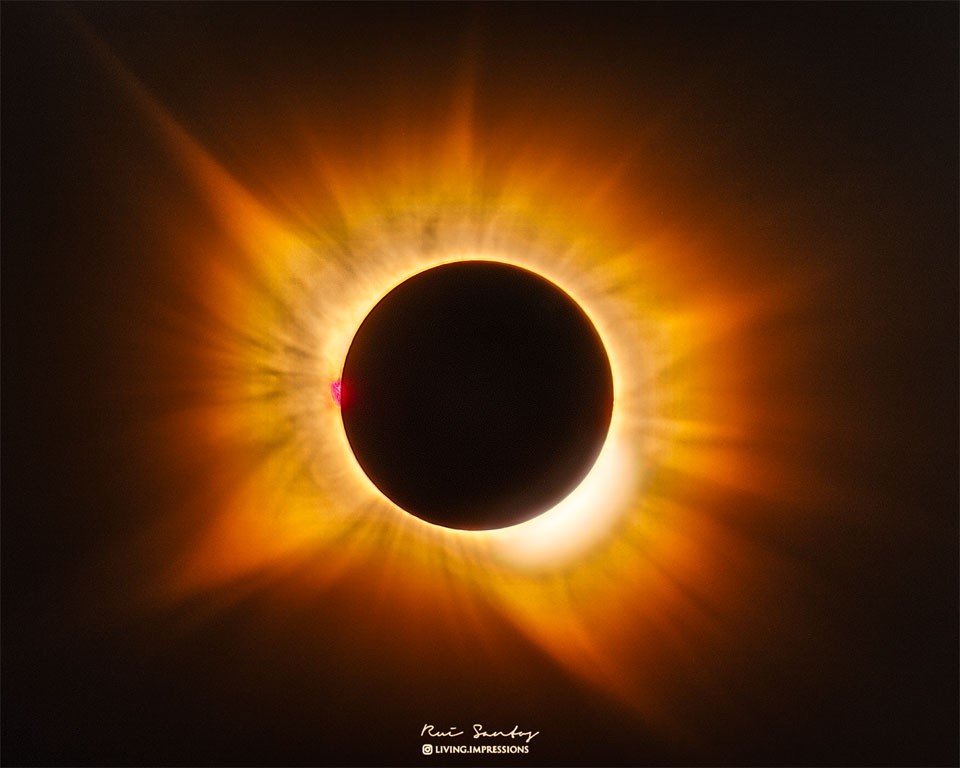
Post-Eclipse Scientific Analysis: Following the eclipse, astronomers and photographers began to analyze the collected data and images. The photograph by Santos, highlighted by NASA’s Astronomy Picture of the Day (APOD), became a key piece of evidence in understanding the unique visual characteristics of the corona. Professional astronomers, referencing historical eclipse records and atmospheric data from the period, were able to correlate the golden hue with the specific environmental conditions present. The analysis confirmed the combined effects of the Sun’s low altitude and the presence of smoke particles from forest fires.
Data Supporting the Analysis:
- Atmospheric Scattering: The scientific principle of Rayleigh scattering explains why the sky is blue and sunsets are red. When the Sun is low on the horizon, light travels through more atmosphere, scattering away blue light and allowing longer wavelengths (red, orange, yellow) to dominate.
- Aerosol Scattering: Smoke particles from forest fires, particularly fine particulate matter (PM2.5), are known to scatter light efficiently. Their size and composition can influence the spectrum of light they scatter. In this case, they acted as an additional filter, enhancing the reddish-yellow hues.
- Forest Fire Activity: Satellite data from agencies like NASA’s FIRMS (Fire Information for Resource Management System) would have indicated active forest fires in regions surrounding Spain during the relevant period, providing quantitative evidence of smoke plumes.
- Observer Reports: Numerous anecdotal reports from observers in Spain corroborated the unusual golden color of the corona, providing a broad base of eyewitness testimony.
Beyond the Visual: Implications for Solar Science
While the golden corona was primarily a visual phenomenon influenced by Earth’s atmosphere, such observations can indirectly contribute to our understanding of the solar corona itself. The detailed imaging and analysis of the corona during eclipses provide valuable data for solar physicists.
Understanding Coronal Structure and Dynamics: Even with atmospheric interference, the fundamental structure and dynamic features of the corona, such as filaments and streamers, are visible. Studying these features helps scientists understand the Sun’s magnetic field, which drives much of its activity, including solar flares and coronal mass ejections.
Solar Prominences: Notably, the image also captured a hydrogen-glowing solar prominence. These immense eruptions of plasma from the Sun’s surface, often appearing bright pink due to the emission of hydrogen-alpha light, remained true to their original color, demonstrating that their emission is intrinsic to the Sun and not significantly altered by the atmospheric conditions that affected the corona’s overall hue. This contrast further highlights the specific nature of the coronal coloration.
High Dynamic Range (HDR) Imaging: The successful capture of such a detailed image was facilitated by HDR processing. This technique combines multiple exposures of varying lengths to capture the full range of brightness within a scene, from the faint outer corona to any brighter features. This advanced photographic technique allows for a more comprehensive scientific record of the event.
Broader Impact and Future Observations
The event serves as a potent reminder of the interconnectedness of Earth and space phenomena. The Sun, a constant source of energy and influence, interacts with our planet’s atmosphere in complex ways, and terrestrial events like wildfires can, in turn, alter our view of the cosmos.
Public Engagement and Education: Astronomy Picture of the Day (APOD) plays a vital role in disseminating astronomical knowledge and inspiring public interest. By featuring such unique celestial events, APOD encourages a broader understanding of science and the wonders of the universe. The gallery of images from the solar eclipse of 2026 August 12, accessible through provided links, offers a rich resource for further exploration.
Future Eclipses: The next featured picture on APOD, promising a look at "fast meteors," signals the ongoing rhythm of astronomical discoveries and daily celestial wonders. As humanity continues to explore the cosmos, each eclipse, each meteor shower, and each newly captured image contributes to our ever-growing knowledge of the universe and our place within it. The golden corona over Spain, a transient beauty shaped by both solar radiance and earthly conditions, will undoubtedly remain a memorable chapter in the ongoing story of our fascination with the Sun and sky.