The city of Hyderabad, often referred to as India’s primary technology hub, served as the backdrop for the second annual Coolest Projects India event on Saturday, September 19, 2025. This prestigious gathering, hosted in Telangana’s state capital, marked a significant milestone in the country’s burgeoning youth technology movement. Organized by the Raspberry Pi Foundation in collaboration with local partners, the event brought together 326 young technology creators who collectively showcased 132 innovative projects. The sheer scale of the event—spanning disciplines from artificial intelligence (AI) and advanced hardware to web development and game design—underscores the rapid growth of the young tech creator community in India.
The event is part of a global initiative designed to provide a platform for young people under the age of 18 to share their digital creations with a wider audience. Unlike traditional competitive science fairs, Coolest Projects emphasizes creativity, problem-solving, and the sharing of knowledge. The 2025 edition in India demonstrated that the next generation of thinkers is not merely consuming technology but is actively reshaping it to address both playful concepts and practical real-world challenges.
Strategic Context: India’s Rising STEM Landscape
The success of Coolest Projects India must be viewed through the lens of the country’s broader commitment to Science, Technology, Engineering, and Mathematics (STEM) education. In recent years, the Indian government’s National Education Policy (NEP) 2020 has placed a renewed emphasis on vocational training and digital literacy, introducing coding and computational thinking as early as the sixth grade. This policy shift has catalyzed a nationwide interest in "maker culture," where students move beyond theoretical learning to hands-on experimentation.
Data from the Raspberry Pi Foundation suggests that participation in India has seen a steady upward trajectory. The transition from the inaugural event to the 2025 showcase saw a marked increase in project complexity. While early iterations of youth tech projects often focused on basic web pages or simple animations, the 2025 cohort displayed a sophisticated understanding of sensor fusion, machine learning, and physical computing. This evolution reflects the increasing accessibility of affordable hardware, such as the Raspberry Pi and various microcontrollers, alongside the proliferation of free online learning resources provided by organizations like Code Club India.
Detailed Chronology of the Event
The journey to the Hyderabad showcase began months prior to the September 19 event. Young creators from across the country spent the summer participating in local workshops, mentorship sessions, and online forums. Many of these students were supported by Code Club India, a network of volunteer-led after-school coding clubs that provide the foundational skills necessary for project development.
On the morning of the event, the venue was transformed into a bustling hub of innovation. The schedule was meticulously structured to allow for maximum interaction:
- Registration and Setup (8:00 AM – 10:00 AM): Participants arrived to assemble their hardware, calibrate sensors, and ensure their software environments were stable. This phase often requires intense troubleshooting, mirroring the real-world challenges faced by professional engineers.
- Public Showcase and Peer Review (10:00 AM – 1:00 PM): The floor opened to visitors, educators, and fellow creators. This period is central to the Coolest Projects ethos, as it encourages students to articulate their design process, explain their code, and receive feedback from their peers.
- Technical Demonstrations (1:00 PM – 3:00 PM): Creators presented their projects to a panel of mentors and industry experts. The focus here was not just on the final product, but on the "journey"—the problems encountered and the creative solutions implemented to overcome them.
- Community Celebration and Closing (3:00 PM – 4:30 PM): The day concluded with a celebration of all participants. Every creator was recognized for their contribution, reinforcing the idea that the value of the event lies in the act of creation and community building.
Featured Innovations: A Deep Dive into Youth-Led Solutions
The 132 projects on display covered a vast spectrum of technology. However, three specific projects stood out for their technical execution and creative application of modern computing principles.
Advanced Programming: Fruit Keys
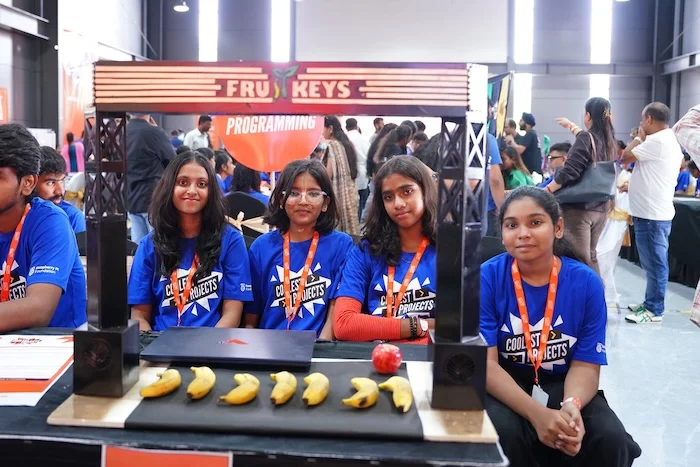
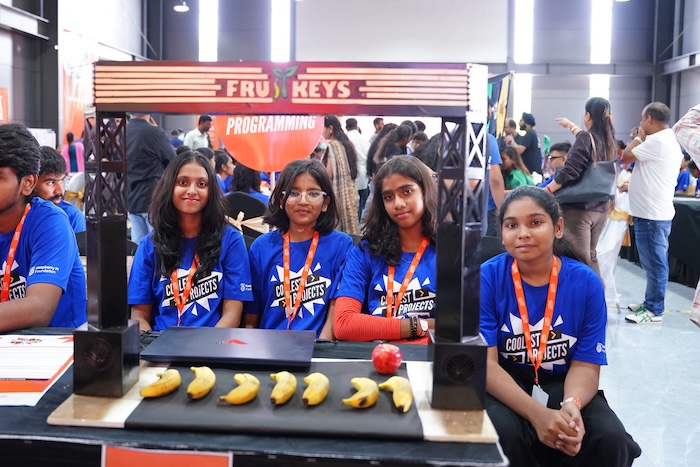
The project titled "Fruit Keys," developed by the team of Vhedhya, Tanvi, Bhavani, and Sameeksha, served as a masterclass in computer vision. Utilizing a Raspberry Pi computer paired with a high-definition camera and the OpenCV (Open Source Computer Vision Library) software, the team transformed ordinary fruit into a functional musical interface.
In this setup, bananas were programmed to act as virtual keys. When a user’s hand interacted with a banana, the system—using real-time image processing—triggered specific musical notes. Furthermore, the team integrated an apple into the system to serve as a toggle, allowing the player to switch between different instrument sounds. This project highlights the potential of touch-free interfaces and demonstrates how complex libraries like OpenCV can be made accessible to young learners to create interactive, gamified experiences.
Healthcare Hardware: Kinetic Care
Addressing the critical field of medical rehabilitation, the team of Kumari, Bhoomika, and Shaurya presented "Kinetic Care." This project is a smart physical therapy system designed for home use, bridging the gap between professional clinical care and self-managed recovery.
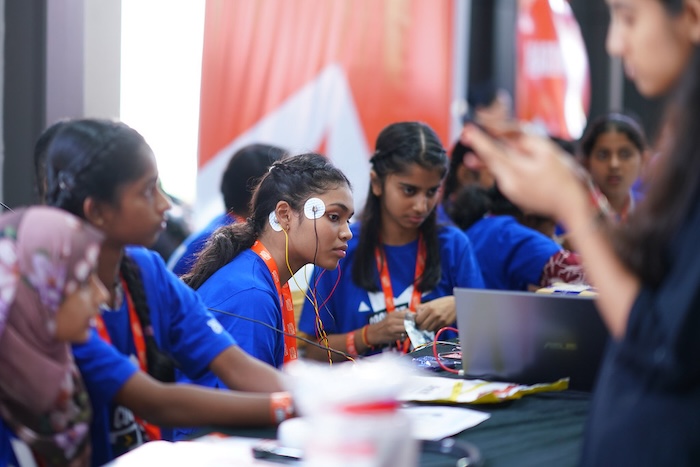
The system employs a camera-based tracking mechanism that monitors a user’s movements during exercise. To increase patient compliance and engagement, the team integrated these movements into a video game interface. Beyond the software, the project included a custom wearable sensor that monitors for sudden or ergonomically unsafe muscle movements. If the sensor detects a potential risk for injury, it triggers an immediate vibration alert (haptic feedback) to the user. Kinetic Care exemplifies how low-cost hardware can be used to create sophisticated "MedTech" solutions that improve the quality of life for those undergoing physical therapy.
Physical Computing and Games: Chrome Dino in Real Life
Srishti and Kimaya took a digital icon—the "Chrome Dino" game—and translated it into the physical world. Their project featured a motorized conveyor belt system with moving physical obstacles. As the difficulty increased, the speed of the conveyor belt adjusted accordingly.
The player interacts with the game using physical buttons to dodge obstacles, while a series of LEDs and sound effects provide an immersive arcade-style experience. The project also included a digital scoreboard that unlocked rewards for high achievers. This project was particularly noted for its integration of mechanical engineering with software logic, requiring the creators to synchronize motor speeds with sensor inputs and user reactions.
Institutional Support and Industry Perspectives
The success of Coolest Projects India 2025 was made possible through a robust ecosystem of partners and sponsors. Code Club India played a pivotal role in the lead-up to the event, providing the pedagogical framework that allowed many of the participants to transition from basic block-based coding to text-based languages like Python and C++.
Financial and logistical support was provided by Qube Research and Technologies. Industry sponsorship is vital for such events, as it ensures that participation remains free for all students, thereby removing economic barriers to entry. Representatives from the sponsoring organizations noted that the level of technical proficiency displayed by the students is a promising indicator of India’s future workforce capabilities.
"Every project represented hours of learning, problem-solving, and imagination," noted organizers from the Raspberry Pi Foundation. "It is a privilege to give these creators a platform to be seen and celebrated. Events like this shine a light on why investing in young people’s digital skills matters so much for India’s future."
The mentors involved in the event—many of whom are professional software developers and engineers—observed that the "soft skills" gained at Coolest Projects are just as important as the technical ones. The ability to present a project to a stranger, explain a complex algorithm in simple terms, and troubleshoot a hardware failure under pressure are all essential traits for the next generation of innovators.
Broader Implications for India’s Digital Future
The 2025 showcase in Hyderabad serves as a micro-study of the "Digital India" initiative. As the country seeks to position itself as a global leader in AI and semiconductor manufacturing, the cultivation of a "maker" mindset in the youth is essential. By encouraging students to experiment with hardware like the Raspberry Pi, these programs are creating a pipeline of talent that is comfortable with both the physical and virtual layers of technology.
Furthermore, the diversity of the projects—ranging from healthcare to entertainment—suggests that young Indians are looking at technology as a tool for social good and personal expression. This holistic approach to technology education is likely to result in more empathetic and versatile problem-solvers in the years to come.
The data from this year’s event also highlights a growing geographic spread of tech talent. While Hyderabad served as the host, participants traveled from various parts of the state and beyond, indicating that the digital divide is slowly being bridged through community-led initiatives and decentralized learning models.
Looking Ahead: The Road to 2027
As the 2025 event concludes, the focus of the Raspberry Pi Foundation and its partners is already shifting toward future iterations. Several partner-run Coolest Projects events are scheduled to take place across the globe in the coming months, providing further opportunities for international collaboration.
The foundation has already begun soliciting interest for the 2026 and 2027 cycles, with plans to expand the reach of the event to even more cities across the Indian subcontinent. For young creators, the message is clear: the tools for innovation are more accessible than ever, and the global community is ready to support their next build. Those interested in participating in future events or staying updated on deadlines are encouraged to engage with the Coolest Projects newsletter and local Code Club chapters.
The 2025 Hyderabad event was more than just a showcase; it was a testament to the resilience, creativity, and ambition of India’s youth. As these 326 creators return to their schools and communities, they carry with them the confidence and skills to tackle the challenges of tomorrow, one line of code at a time.