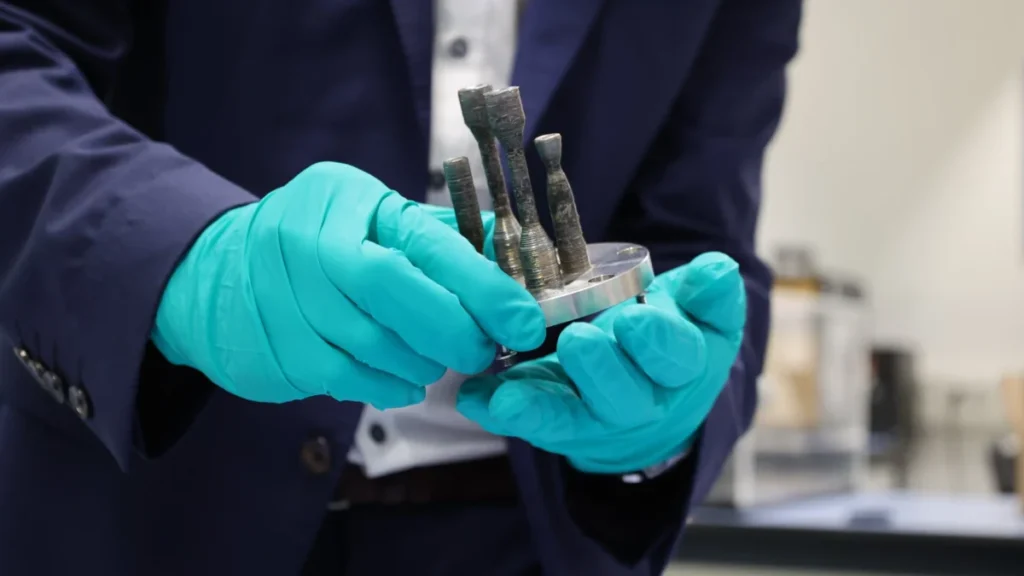
The fifth metal sample 3D-printed aboard the International Space Station (ISS) has successfully returned to Earth, marking a significant milestone in the development of in-space manufacturing capabilities. This latest sample, produced by the European Space Agency’s (ESA) cutting-edge Metal 3D Printer located within the Columbus module, contains the pioneering first thrusters ever fabricated in the microgravity environment of space. The critical retrieval was executed in July by ESA astronaut Sophie Adenot, bringing this revolutionary payload back for in-depth analysis and functional testing.
A New Era of Space Fabrication: From Launch to First Sample
The journey of this groundbreaking technology began in January 2024 with the launch of ESA’s Metal 3D Printer to the ISS. Within a remarkably short period of just a few months, the sophisticated printer achieved a monumental feat: producing its very first complete metal sample, the inaugural metal component ever manufactured beyond Earth’s atmosphere. This initial success was not merely a demonstration of technological capability; it initiated a crucial scientific inquiry. ESA’s material scientists, based at the European Space Research and Technology Centre (ESTEC) in the Netherlands, undertook the meticulous examination and testing of this first sample. Their primary objective was to understand the intricate ways in which the unique microgravity conditions of space influence the metal 3D printing process.
The insights gleaned from this initial investigation were instrumental. These findings directly informed and facilitated improvements to the printing procedure for the subsequent, more complex components of the fifth sample. This iterative refinement process underscores the scientific rigor driving ESA’s in-space manufacturing initiatives.
Precision Engineering for Propulsion: The Thruster Design
The two smaller, yet critically important, parts of the fifth sample were meticulously designed by the German Aerospace Center (DLR). These components are not merely abstract technological demonstrations; they are functional thrusters – essential satellite parts responsible for propulsion. The incorporation of thrusters into this mission highlights the immediate practical applications of in-space manufacturing, moving beyond theoretical advancements to tangible contributions to spacecraft operations.
Florian Merz, a research associate and test engineer at DLR, elaborated on the strategic design of these thrusters, detailing two distinct versions: "We have designed two versions of the thruster: one manufactured as closely as possible to the desired shape, and one with thicker walls that allow for post-processing to refine the thruster’s inner diameter." This dual-pronged approach is designed to comprehensively evaluate the capabilities and limitations of space-based metal 3D printing for propulsion systems. The first version aims to assess the inherent precision achievable in microgravity, while the second allows for the exploration of post-processing techniques that can further enhance performance.
Rigorous Testing on Earth: Validating Space-Made Components
The true validation of these space-manufactured thrusters will occur on Earth through a series of demanding tests. Merz outlined the upcoming procedures: "At our vacuum test bench in Lampoldshausen, Germany, we will assess the functionality and performance of the thrusters in hot-fire tests under representative operating conditions, demonstrating that space-manufactured components can achieve the precision required for propulsion and withstand relevant temperatures and pressures." These hot-fire tests are designed to simulate the extreme conditions that thrusters encounter during operation, providing critical data on their endurance and efficiency. The ability of these components to meet stringent performance requirements, including precision, temperature resistance, and pressure tolerance, will be a key indicator of the viability of in-space manufacturing for critical spacecraft subsystems.
Sonja Steinbach, DLR’s project manager, emphasized the comparative nature of the upcoming evaluations: "By comparing the space-manufactured thrusters with equivalent components produced on Earth, we can investigate how microgravity influences the manufacturing process and how these effects translate into the performance of the finished components. The results will help us further optimise metal 3D printing for future in-space manufacturing." This comparative analysis is vital for understanding the subtle yet significant impacts of microgravity on material properties and manufacturing tolerances. By juxtaposing space-made components with their terrestrial counterparts, scientists can isolate and quantify the effects of the unique space environment, paving the way for more predictable and reliable in-space fabrication.
A Continuing Mission: Building Momentum for Autonomy
The successful return of the fifth metal sample, particularly one containing functional thrusters, represents a significant step forward in ESA’s broader objectives for in-space manufacturing and crew autonomy. The ability to produce critical spare parts, tools, and even complex components like thrusters directly on board a spacecraft or space station could revolutionize space exploration and operations. This capability would drastically reduce reliance on costly and time-consuming resupply missions from Earth, enabling longer-duration missions, greater mission flexibility, and enhanced crew safety.
Rob Postema, ESA’s technical officer for the project, conveyed the enduring excitement surrounding these deliveries: "Even though we have already received four samples from the ISS at ESTEC, the thrill of opening these very special packages remains the same." This sentiment highlights the pioneering nature of this work and the tangible progress being made in unlocking the potential of manufacturing in space. Each returned sample, and each successful test, builds upon a growing body of knowledge, inching humanity closer to a future where spacecraft can be maintained, repaired, and even expanded using resources and manufacturing capabilities located off-planet.
Background and Chronology of In-Space Metal 3D Printing
The quest for in-space manufacturing has been a long-standing ambition within the space sector. Traditional space missions rely heavily on pre-fabricated components launched from Earth. However, the limitations and costs associated with this approach become increasingly apparent for longer missions, such as those to Mars or for sustained lunar bases. The development of additive manufacturing, or 3D printing, has emerged as a transformative technology with the potential to overcome these hurdles.
ESA’s commitment to advancing metal 3D printing in space has been a multi-year endeavor, characterized by phased development and rigorous testing. The timeline leading to the return of the fifth sample can be broadly outlined:
- Early Research and Development: Years of terrestrial research and development into metal 3D printing technologies, material science, and process optimization for space applications. This phase involved extensive simulations and laboratory experiments to understand material behavior and printing parameters.
- January 2024: Launch of ESA’s Metal 3D Printer to the International Space Station. This marked a critical transition from Earth-based research to practical in-orbit experimentation.
- Early 2024: The Metal 3D Printer successfully produces its first complete metal sample in space. This achievement was a significant validation of the technology’s ability to function and print in the microgravity environment.
- Subsequent Printing Campaigns: The printer continued its operations, producing multiple metal samples, including the first four that were previously returned to Earth for analysis. Each sample provided valuable data on the effects of microgravity on the printing process.
- Design and Fabrication of Thrusters: The German Aerospace Center (DLR) designed two versions of satellite thrusters, which were then printed as part of the fifth metal sample. This represented a move towards printing functional, mission-critical components.
- July 2024: ESA astronaut Sophie Adenot retrieves the fifth metal sample, containing the first space-manufactured thrusters, from the ISS.
- Post-Return Analysis and Testing: The retrieved sample is now undergoing comprehensive examination and functional testing on Earth, with particular focus on the performance of the 3D-printed thrusters.
Supporting Data and Technological Advancements
The Metal 3D Printer aboard the ISS utilizes a sophisticated process, likely involving powder bed fusion or directed energy deposition, adapted for the unique challenges of space. While specific technical details regarding the printer’s operational parameters and the exact metal alloys used for the thrusters are proprietary, the general principles of metal 3D printing involve precisely layering molten or sintered metal powder to build complex geometries.
The success of this mission is underpinned by advancements in several key areas:
- Material Science: The development of metal powders that can be reliably printed in microgravity, with consistent material properties and minimal risk of contamination.
- Process Control: Sophisticated software and hardware systems capable of maintaining precise control over temperature, laser or electron beam power, and material deposition in a constantly changing environment.
- Design for Additive Manufacturing (DfAM): Engineers are increasingly designing components with the capabilities of 3D printing in mind, optimizing for lighter weight, reduced part count, and enhanced performance.
- Robotics and Automation: The ability for the printer to operate autonomously or with minimal astronaut intervention is crucial for maximizing efficiency and minimizing risk.
The successful printing of the thrusters suggests that the process can achieve the necessary dimensional accuracy and material integrity for these critical components. For context, conventional satellite thrusters are manufactured with extremely high precision, often involving complex machining and assembly. The ability to replicate this level of precision in space would be a paradigm shift.
Broader Impact and Implications for Future Space Exploration
The implications of successful in-space metal 3D printing, especially for components like thrusters, extend far beyond the immediate scientific findings.
- Enhanced Mission Capabilities: The ability to manufacture and replace critical parts in situ dramatically increases mission resilience and duration. This is particularly important for deep-space missions where resupply is impossible.
- Reduced Launch Mass and Cost: By enabling on-demand manufacturing, spacecraft can launch with fewer spare parts, reducing overall launch mass and associated costs.
- Development of Lunar and Martian Bases: For future permanent bases on the Moon or Mars, in-space manufacturing will be essential for constructing habitats, tools, and infrastructure, potentially even utilizing local resources.
- Space Debris Mitigation: The ability to repair or upgrade existing satellites in orbit could extend their operational lifespan, potentially reducing the generation of space debris.
- New Commercial Opportunities: The development of a robust in-space manufacturing capability opens up new commercial avenues for satellite servicing, component production, and even the creation of novel in-space structures.
The ongoing research and development by ESA and DLR are not just about printing parts; they are about building the foundational infrastructure and expertise for a future where humanity’s presence in space is more self-sufficient and sustainable. The successful return and subsequent testing of the first space-manufactured thrusters represent a tangible step towards this ambitious vision. The data gathered from these tests will be invaluable in refining the technology and paving the way for more complex and mission-critical applications in the years to come.