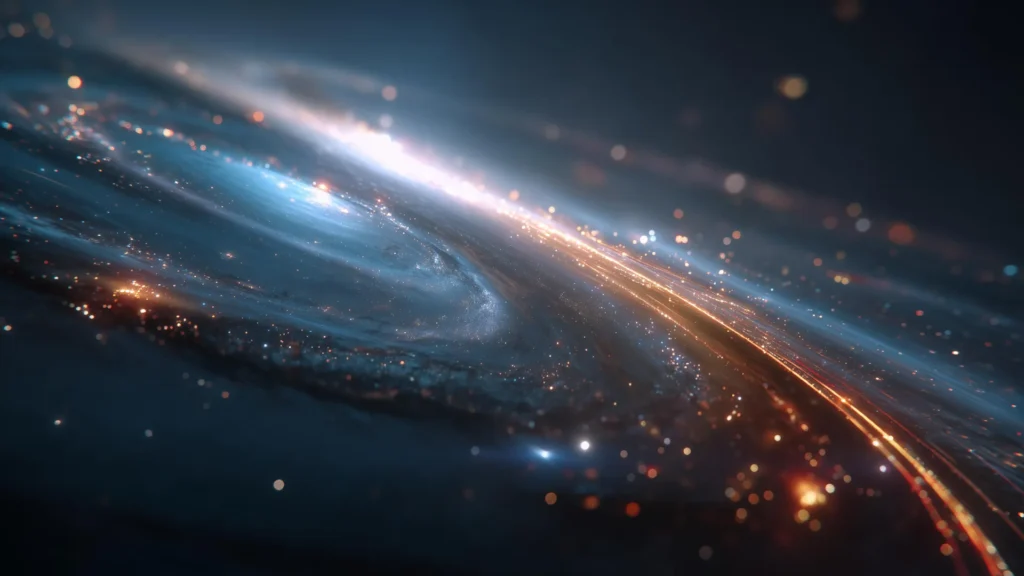
An international coalition of astrophysicists has released a comprehensive study confirming that the universe continues to expand at an accelerating rate, effectively debunking recent high-profile claims that suggested cosmic expansion might be losing momentum. The new research, led by the University of Southampton and involving a global network of institutions, reinforces the standing of the "Standard Model" of cosmology, which posits that a pervasive and mysterious force known as dark energy is pushing the boundaries of the cosmos outward with ever-increasing speed.
The findings, published in the Monthly Notices of the Royal Astronomical Society, serve as a direct rebuttal to a study released last year by a research team based in South Korea. That previous study had sent ripples through the scientific community by suggesting that the acceleration of the universe was an illusion caused by a failure to account for the evolution of stellar populations over billions of years. Had those claims been proven correct, they would have necessitated a complete rewrite of modern physics, potentially discarding the concept of dark energy entirely.
The Nature of the Cosmic Dispute
The controversy centers on the interpretation of Type Ia supernovae, which are often referred to as "standard candles" in astronomy. Because these stellar explosions occur with a consistent and predictable peak brightness, scientists use them to measure vast distances across the universe. By comparing how bright a supernova appears to be with how much its light has been stretched (redshifted) by the expansion of space, astronomers can determine how fast the universe was expanding at the time the star exploded.
In the late 1990s, observations of these supernovae led to the groundbreaking discovery that distant galaxies are moving away from us at speeds that are increasing over time. This discovery earned Professor Adam Riess, Professor Brian Schmidt, and Professor Saul Perlmutter the 2011 Nobel Prize in Physics. It also led to the hypothesis of dark energy—a theoretical pressure that makes up approximately 68% of the energy density of the universe.
However, the South Korean team challenged this bedrock of modern cosmology by arguing that Type Ia supernovae are not, in fact, "standard." They claimed that as the universe ages, the chemical composition and environments of galaxies change, which in turn affects the peak brightness of the supernovae they produce. If supernovae in the early universe were inherently dimmer or brighter than those in the modern era, the calculations used to prove acceleration would be flawed. The South Korean researchers suggested that once these evolutionary changes were accounted for, the evidence for dark energy vanished, indicating that the universe’s expansion might actually be slowing down under the influence of gravity.
Identifying Methodological Discrepancies
The new analysis, led by Dr. Phil Wiseman of the University of Southampton, performed a rigorous "stress test" on the claims of the South Korean study. The international team, which included Nobel Laureates Riess and Schmidt, identified what they describe as fundamental flaws in the earlier analysis.
The primary issue identified by Dr. Wiseman’s team concerned the estimation of stellar ages. The South Korean researchers had allegedly used the average age of a host galaxy as a proxy for the age of the specific star that exploded. Dr. Wiseman noted that galaxies are complex environments containing populations of stars of many different ages. Treating a galaxy as a monolithic entity with a single age led to significant errors in calculating the properties of the supernovae.
Furthermore, the Southampton-led team pointed out that the previous study failed to properly account for the "mass step"—a well-documented phenomenon in cosmology where supernovae in more massive galaxies appear slightly brighter than those in less massive galaxies. Correcting for the mass of the host galaxy is a standard procedural requirement in modern cosmological measurements. When the international team re-analyzed the data using these standard corrections and more precise age-dating techniques for the local stellar environments, the evidence for an accelerating universe returned to its previous, robust levels.
"The previous and well-accepted measurements were, in fact, fine, and our current understanding of the fate of the universe remains robust," Dr. Wiseman stated. "Thankfully we have averted this crisis, but the mystery about why the rate of expansion of the universe is still accelerating remains. By proving our measurements are correct, we can get back to trying to understand what this dark energy actually is, rather than wondering if it exists at all."
A History of Measuring the Infinite
To understand the weight of this new study, one must look at the chronology of how humans have perceived the growth of the universe. For much of the early 20th century, the universe was assumed to be static. In 1929, Edwin Hubble provided the first observational evidence that galaxies were moving away from each other, leading to the "Big Bang" theory. For decades thereafter, the prevailing question was not whether the expansion would slow down, but rather if it would slow down enough to eventually stop and collapse back in on itself (the "Big Crunch").
The 1998 discovery of acceleration was a profound shock because it suggested the opposite: the universe would expand forever, eventually becoming cold, dark, and empty (the "Big Freeze").
The timeline of this specific debate highlights the self-correcting nature of the scientific method:
- 1998: Two independent teams observe distant Type Ia supernovae and conclude the expansion of the universe is accelerating.
- 2011: The leaders of these teams receive the Nobel Prize in Physics.
- 2024: A South Korean team publishes a paper claiming that supernova evolution accounts for the observed data without the need for dark energy, suggesting a slowdown.
- 2025: The University of Southampton-led team publishes their rebuttal in Monthly Notices of the Royal Astronomical Society, identifying errors in the 2024 analysis and reaffirming acceleration.
Supporting Data and Technical Calibration
The international team’s study relied on a much more nuanced calibration of supernova data. In modern cosmology, "standardizing" a supernova involves several variables: the "stretch" of its light curve (how long the explosion lasts) and its color (which can be affected by cosmic dust).
The researchers utilized data from the Dark Energy Survey (DES) and other major astronomical catalogs to examine thousands of supernovae. They found that even when accounting for the chemical "metallicity" of the stars and the age of the stellar populations, the trend toward acceleration remained statistically significant. The study showed that the "evolutionary effects" claimed by the South Korean team were too small to counteract the massive signal provided by the redshift-distance relationship.
Professor Adam Riess emphasized the necessity of rigorous skepticism in science. "Extraordinary claims require especially careful testing," Riess noted. "What we find is that when we calibrate these supernovae, accounting for different host environments and populations, the evidence for cosmic acceleration remains remarkably consistent."
Broader Implications for the Future of Physics
The reaffirmation of cosmic acceleration has major implications for the future of physics and our understanding of the ultimate fate of the cosmos. If the universe were slowing down, it would imply that gravity—the attractive force of matter—was winning the cosmic tug-of-war. By confirming acceleration, the study reinforces the existence of "Lambda" ($Lambda$), the cosmological constant originally proposed by Albert Einstein, or some other form of quintessence that acts as a repulsive force.
The "Dark Energy Mystery" continues to be the most significant problem in modern physics. While we can measure its effects, we do not know what it is. It does not emit light, it does not interact with matter except through gravity, and it appears to be a property of space itself.
Professor Mark Sullivan of the University of Southampton highlighted that while the South Korean study’s conclusions were ultimately found to be incorrect, the challenge itself was valuable. "This is how progress is made," Sullivan said. "Although this idea did not turn out to be correct, it has opened up new ways of thinking about how supernovae explode and how we can measure dark energy more accurately."
The scientific community is now looking toward upcoming missions to provide even more precise data. The European Space Agency’s Euclid telescope and NASA’s Nancy Grace Roman Space Telescope are designed specifically to map the geometry of the dark universe. These missions will observe billions of galaxies and thousands of supernovae with unprecedented clarity, seeking to determine if dark energy is a constant force or if it changes over time.
Conclusion: The Robustness of the Standard Model
By successfully defending the evidence for acceleration, the international team has stabilized the foundation upon which much of modern astrophysics is built. The "Lambda-CDM" model (Lambda Cold Dark Matter) remains the most successful framework for explaining the cosmic microwave background, the distribution of galaxies, and the expansion history of the universe.
As Dr. Brodie Popovic, a co-author of the study, remarked, the debate provided a vital opportunity for the community to re-examine their assumptions. "We’ve recently been really focused on the astrophysics of the explosions and how they impact cosmology," Popovic said. "This was a good opportunity to go back and go over all of our assumptions—it turns out, yes, we do understand this stuff and we’re accounting for it in our cosmology measurement."
For now, the universe remains on its path of runaway expansion, destined to grow larger and thinner until the light from distant galaxies can no longer reach the Milky Way. While the "crisis" in cosmology regarding the expansion rate has been largely settled for the moment, the quest to identify the source of dark energy remains the final frontier of celestial mechanics.