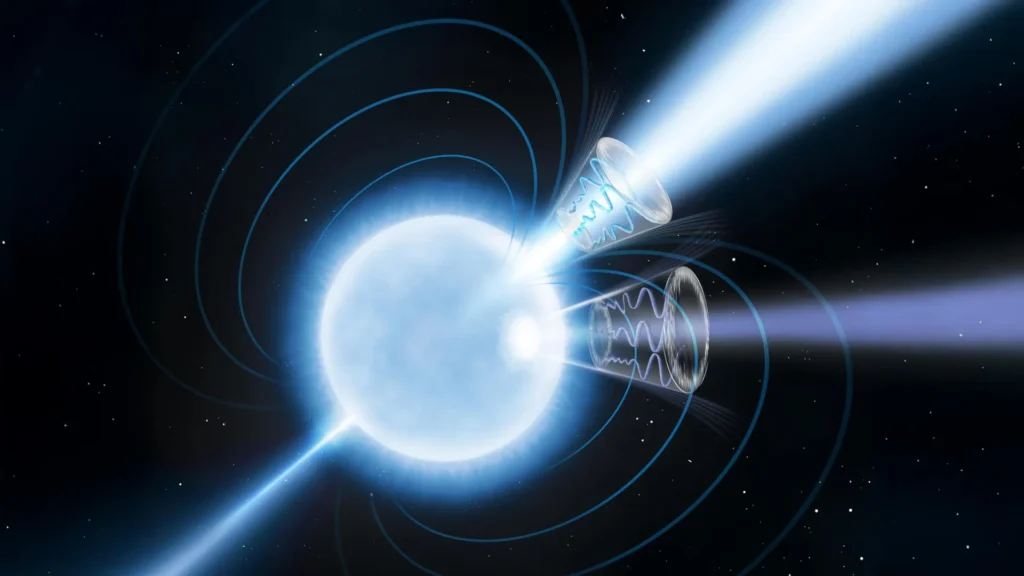
Nearly 90 years ago, the pioneering physicist Werner Heisenberg theorized a peculiar quantum phenomenon known as vacuum birefringence, suggesting that even the most pristine vacuum is not truly empty but rather a dynamic sea of "virtual particles" that spontaneously emerge and vanish. This effect, if real, would cause seemingly empty space to alter the behavior of light passing through it. Despite significant advancements in nuclear physics since the 1930s and decades of intensive research involving particle accelerators designed to probe the fundamental nature of matter, scientists have consistently struggled to definitively confirm Heisenberg’s prediction. Now, groundbreaking observations of one of the universe’s most extreme celestial objects may finally deliver the long-sought evidence.
A collaborative team of scientists, drawing expertise from numerous institutions worldwide, has meticulously studied a magnetar, a rare and enigmatic type of neutron star characterized by the most potent magnetic fields known in the cosmos. Their compelling findings represent what could be the inaugural observational evidence of vacuum birefringence, potentially inaugurating new avenues for investigating quantum physics under conditions that are utterly impossible to replicate within Earth-bound laboratories. This profound cosmic test of quantum mechanics marks a significant milestone in our understanding of the universe’s fundamental fabric.
The Elusive Phenomenon of Vacuum Birefringence
Werner Heisenberg first postulated the concept of vacuum birefringence in 1936, a time when quantum mechanics was still in its nascent stages, and quantum electrodynamics (QED) – the theory that describes how light and matter interact – was yet to be fully formulated. His prediction emerged from the understanding that, according to the Heisenberg Uncertainty Principle, even a vacuum is subject to quantum fluctuations. These fluctuations manifest as "virtual particles" – pairs of particles and antiparticles (like electrons and positrons) that briefly pop into existence from the vacuum, interact, and then annihilate each other, returning their energy to the vacuum. These fleeting entities are not directly observable, but their transient presence can, in theory, influence the properties of the vacuum itself.
Specifically, QED predicts that in the presence of an extraordinarily strong magnetic field, these virtual particles become temporarily polarized or aligned. This alignment, in turn, can cause the vacuum to behave like a birefringent material, similar to how certain crystals split light into two polarized beams. For light passing through such a magnetized vacuum, its polarization state – the orientation of its electromagnetic waves’ oscillations – would rotate. The challenge, however, has always been the sheer magnitude of the magnetic field required to induce a detectable effect. Theoretical calculations indicate that fields millions of times stronger than anything achievable in terrestrial laboratories are necessary. The strongest sustained magnetic fields generated on Earth barely reach 100 Tesla, while the required strength for a noticeable effect is closer to 10^8 Tesla (10^12 Gauss). This vast disparity has rendered direct experimental verification on Earth an insurmountable hurdle for nearly a century.
Magnetars: Nature’s Ultimate Quantum Laboratories
Fortunately, the universe itself provides unique, extreme environments that function as natural laboratories for testing such esoteric quantum predictions. Among the most extreme are magnetars. These are a special class of neutron stars, the ultra-dense remnants of massive stars that have undergone supernova explosions. While all neutron stars possess incredibly strong magnetic fields due to the conservation of magnetic flux during their gravitational collapse, magnetars take this to an unparalleled extreme. Their magnetic fields can reach astounding strengths, typically in the range of 10^14 to 10^15 Gauss (10^10 to 10^11 Tesla). To put this into perspective, Earth’s magnetic field is roughly 0.5 Gauss, and a powerful MRI machine operates at around 3 Tesla (30,000 Gauss). A magnetar’s field is thus quadrillions of times stronger than Earth’s and thousands of times stronger than a standard neutron star.
The formation mechanism for these hyper-magnetic fields is still a subject of active research, but it is believed to involve a rapidly rotating, highly convective core within the collapsing star, which amplifies the magnetic field through a powerful dynamo effect. Magnetars are also characterized by sudden, intense bursts of X-rays and gamma-rays, often referred to as "flares," which are thought to be caused by the cracking of their solid crusts due to immense magnetic stresses, or by magnetic field reconfigurations. These objects are relatively rare, with only about 30 known magnetars in our galaxy, making their study all the more challenging and rewarding. Their extraordinary magnetic environments make them the ideal, perhaps the only, cosmic crucibles where the subtle effects of vacuum birefringence might become manifest.
A Coordinated Astronomical Campaign
The recent study, published in the prestigious journal Nature, involved a formidable collaboration of scientists from institutions across the globe. Key contributors included researchers from the Center for Space Sciences and Technology, the South African Radio Astronomy Observatory (SARAO), the Los Alamos National Laboratory, NASA’s Marshall Space Flight Center, the Center for Research and Exploration in Space Science & Technology (CRESST), and the Astrophysics Science Division at NASA’s Goddard Space Flight Center, alongside numerous international universities. The research was spearheaded by Rachael E. Stewart, a Graduate Student of Physics at George Washington University, who led the comprehensive analysis.
The team focused their observations on the magnetar designated 1E 1547.0-5408 (often shortened to 1E1547). This particular magnetar is known for its relatively rapid rotation and high activity, making it a prime candidate for such an investigation. Dr. Marcus Lower, an Australian Research Council DECRA Fellow at the Center for Astrophysics and Supercomputing (CAS) at the Swinburne University of Technology, played a pivotal role in leading the observational component of the study. He emphasized the unique role of magnetars: "Detecting vacuum birefringence requires a magnetic field that is over 100 million times stronger than any we’ve ever made on Earth," Lower stated. "Thankfully, nature has provided us with magnetars, which are the perfect cosmic laboratories to go looking for this effect."
Leveraging Advanced Observational Tools
The observational strategy combined the strengths of multiple cutting-edge astronomical facilities. Lower led observations using CSIRO’s Murriyang, also known as the Parkes radio telescope, located in New South Wales, Australia. This iconic 64-meter dish is renowned for its sensitivity in detecting radio waves from distant cosmic sources. The vast amounts of data collected from these radio observations were subsequently processed and analyzed using the powerful Ngarrgu Tindebeek supercomputer at Swinburne University.
Crucially, these radio data were complemented by measurements from two advanced X-ray telescopes: NASA’s Imaging X-ray Polarimetry Explorer (IXPE) and the Neutron Star Interior Composition Explorer (NICER) aboard the International Space Station. IXPE, launched in late 2021, is specifically designed to measure the polarization of X-rays from cosmic sources, providing a unique window into the magnetic fields and geometries of extreme objects. NICER, on the other hand, excels at precisely timing X-ray pulses from neutron stars, offering insights into their rotation and surface features.
As the researchers monitored 1E1547’s radio emissions, they meticulously tracked the orientation of the waves’ oscillations – their "polarization state" – as the magnetar rotated. This involved analyzing how the plane of oscillation of the radio waves changed over time. The measurements revealed two critical characteristics of 1E1547 that made it an ideal candidate for this study: its magnetic axis and rotational axis are almost perfectly aligned, and observers on Earth view the object from a nearly pole-on perspective. This unique alignment simplifies the interpretation of polarization changes, as the magnetic field orientation relative to the line of sight varies predictably with the magnetar’s rotation, allowing for clearer detection of any vacuum-induced effects.
Unveiling Quantum Signatures from 1E 1547.0-5408
The combined analysis of radio and X-ray data yielded compelling results. The X-rays emanating from the magnetar, as detected by IXPE, exhibited an "extremely high" degree of polarization. More significantly, the researchers found that the direction of this X-ray polarization remained consistently aligned with 1E 1547’s magnetic field, mirroring the behavior observed in its radio waves.
Both of these observations – the high degree of polarization and its alignment with the magnetar’s magnetic field – are considered strong indicators that vacuum birefringence may indeed be occurring in the extreme environment surrounding 1E1547. If the vacuum were truly empty and unaffected by the magnetic field, the polarization of light might behave differently or show less coherence. The observed alignment provides a potential signature of the virtual particles’ influence.
Dr. Lower elaborated on the physical mechanism: "Because of the magnetic field’s strength, Heisenberg’s virtual particles become aligned with the direction the field is pointing. By carefully tracking the direction the radio waves and X-rays oscillate as the magnetar rotates, the team found that the alignment of 1E1547’s magnetic and rotational poles was ideal for detecting vacuum birefringence." This ideal geometry, combined with the extreme magnetic field, creates a "sweet spot" for observing the subtle quantum effect.
Expert Perspectives on the Groundbreaking Findings
The potential confirmation of vacuum birefringence holds immense significance for the physics community. For decades, QED has been one of the most rigorously tested and successful theories in physics, predicting phenomena with extraordinary precision. However, its predictions concerning vacuum birefringence have remained largely untested due to the extreme conditions required. Rachael E. Stewart’s leadership in this study, particularly as a graduate student, underscores the innovative spirit driving modern astrophysical research. While not directly quoted on the broader implications in the provided text, the successful execution of such a complex, multi-observatory study speaks volumes about the team’s dedication and the potential impact of their findings. The scientific community, upon full confirmation, would undoubtedly hail this as a triumph for quantum electrodynamics, extending its verified domain into the most exotic corners of the cosmos.
The Path Forward: Confirmation and Broader Implications
While the current findings are highly suggestive, the scientific process demands further scrutiny. The researchers themselves acknowledge that "more evidence is still needed." This includes additional observations of 1E1547 and potentially other magnetars, as well as more sophisticated computer simulations. These simulations would be crucial for ruling out alternative astrophysical processes that might mimic the observed polarization signatures. The complexity of magnetar environments means that other physical phenomena, such as scattering within the magnetar’s magnetosphere or the properties of its plasma, could theoretically influence light polarization. Future research will focus on differentiating these effects from the genuine quantum signature of vacuum birefringence.
If these results are definitively confirmed, the implications would be profound and far-reaching:
- Reaffirming Fundamental Theories: It would provide direct observational proof of a long-standing prediction of Quantum Electrodynamics (QED) in an extreme regime never before accessible. This would further solidify our understanding of how light and matter interact at the most fundamental level, particularly in the presence of incredibly strong fields that distort the very fabric of spacetime and quantum vacuum. It would bridge the gap between theoretical predictions and experimental verification in a way that terrestrial laboratories simply cannot.
- Expanding the Frontiers of Astrophysics: The ability to observe vacuum birefringence would open a powerful new diagnostic tool for studying the environments around magnetars and other extreme astrophysical objects. By analyzing how light’s polarization changes, scientists could infer properties of the magnetic fields, plasma densities, and even the curvature of spacetime in these exotic regions with unprecedented detail. This could lead to a deeper understanding of magnetar physics, the generation of their immense magnetic fields, and their role in the broader cosmic landscape.
- Probing New Physics: While QED is incredibly successful, there are still unknowns, particularly in scenarios where quantum mechanics and general relativity might intertwine. Detecting vacuum birefringence in such extreme conditions could potentially reveal subtle deviations from QED predictions, hinting at the existence of new particles or fundamental interactions beyond the Standard Model of particle physics. It offers a unique window into physics under conditions that push current theories to their limits.
- Technological Advancements: The need for increasingly sensitive and specialized telescopes like IXPE drives innovation in astronomical instrumentation. The techniques developed for this study, particularly in analyzing polarization in extreme environments, could have broader applications in other areas of astronomy and physics.
As Dr. Lower optimistically concluded, "With these future data on hand and our updated simulations, we may finally be able to complete the quest started by Heisenberg nearly 90 years ago." The pursuit of this elusive quantum effect, initiated in the intellectual crucible of early quantum mechanics, now finds its most promising path to resolution through the awe-inspiring power of cosmic phenomena and the ingenuity of modern astronomical observation. The universe continues to serve as the ultimate laboratory, holding the keys to unlocking the deepest secrets of reality.