The field of organometallic chemistry has reached a significant milestone as researchers at the Okinawa Institute of Science and Technology (OIST) successfully captured and characterized a highly elusive molecular structure that has long evaded scientific observation. This discovery, centered on the formation of metallocenes—compounds often referred to as "sandwich molecules" due to their unique architecture—provides the first definitive structural evidence of a doubly ring-slipped intermediate. Published in the Journal of the American Chemical Society (JACS), the study offers a transformative understanding of how these essential chemical building blocks assemble and transform, potentially unlocking new frontiers in materials science, medicine, and industrial catalysis.
The Historical Significance of the Sandwich Molecule
To appreciate the weight of the OIST discovery, one must look back to the mid-20th century. The discovery of metallocenes in the early 1950s is widely considered one of the most pivotal moments in the history of inorganic chemistry. It began with the accidental synthesis of ferrocene, a compound consisting of a single iron atom held between two planar cyclopentadienyl rings. This "sandwich" structure was so radical that it initially baffled chemists, eventually leading to the 1973 Nobel Prize in Chemistry for Ernst Otto Fischer and Geoffrey Wilkinson, who independently elucidated the nature of its bonding.
For decades, metallocenes have served as the backbone for various technological advancements. They are indispensable in the production of polymers, where they act as highly efficient catalysts. In the realm of energy, they are explored for their potential in battery technologies and hydrogen storage. More recently, their stability and unique electronic properties have made them candidates for drug delivery systems, where they can be engineered to release therapeutic agents in response to specific biological triggers.
Despite their ubiquity, a fundamental gap remained in the scientific community’s understanding: the exact mechanism of their birth. While the final, stable forms of metallocenes like ferrocene and ruthenocene are well-documented, the fleeting moments during their formation—the intermediate stages where the metal atom first meets the carbon rings—remained largely theoretical. These intermediates are typically so unstable that they exist for only fractions of a second before rearranging into a final state, making them nearly impossible to "see" using traditional laboratory equipment.
Breaking the 18-Electron Rule
The research team at OIST, led by Dr. Satoshi Takebayashi of the Organometallic Chemistry Group, did not set out specifically to find a ring-slipped intermediate. Instead, their journey began with a challenge to one of the most fundamental dictates of chemistry: the 18-electron rule.
In transition metal chemistry, the 18-electron rule is a heuristic used to predict the stability of metal complexes. It suggests that stable complexes are formed when the sum of the metal’s valence electrons and the electrons donated by its surrounding ligands equals 18, corresponding to the electron configuration of a noble gas. Ferrocene is the quintessential 18-electron complex.
Last year, Dr. Takebayashi’s group made headlines by successfully synthesizing unusual ferrocene derivatives that possessed 20 electrons. This achievement pushed the boundaries of what was thought possible for stable metallocene structures. Encouraged by this success, the team attempted to replicate the feat using ruthenium, a metal located directly below iron on the periodic table, which often exhibits similar chemical behaviors.
However, the ruthenium experiments yielded a surprise. Unlike the iron-based reactions, which stayed at the 20-electron count, the ruthenium reactions consistently reverted to the standard 18-electron ruthenocene. It was during the investigation of this "failed" attempt to create a 20-electron ruthenocene that the researchers stumbled upon something even more significant: a stable, isolated version of the intermediate structure that occurs just before the molecule reaches its final form.
The Discovery of the Doubly Ring-Slipped Intermediate
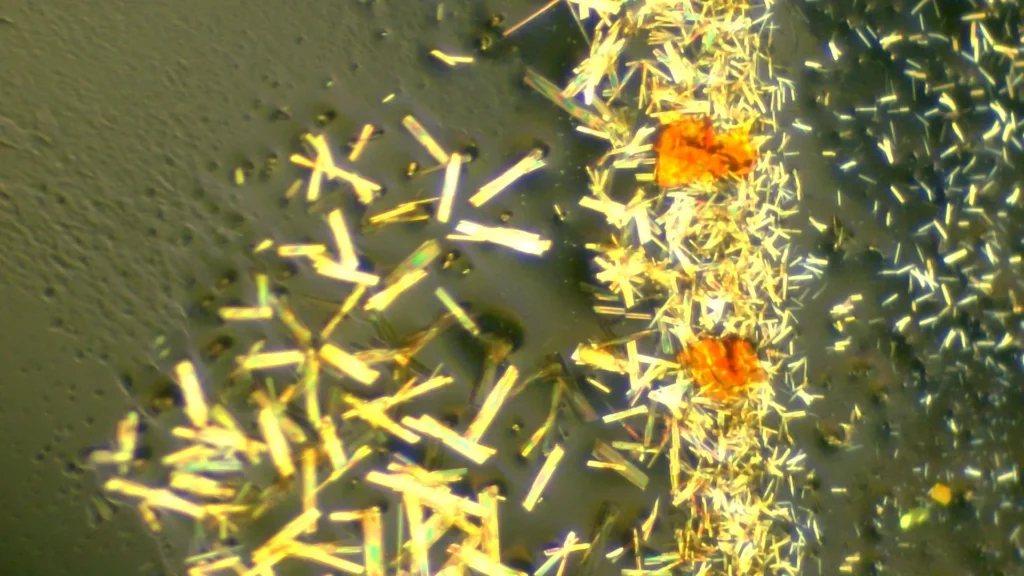
The OIST team utilized single-crystal X-ray diffraction to peer into the molecular structure of the reaction’s byproduct. This technique allows scientists to determine the precise arrangement of atoms within a crystal by observing how X-rays scatter upon hitting the sample. What they found was a "doubly ring-slipped" structure.
In a standard metallocene, the metal atom is bonded to all five carbon atoms in each of the two rings simultaneously. This is known as $eta^5$ (eta-five) coordination or hapticity. "Ring-slippage" occurs when the metal "slips" or moves so that it bonds with fewer atoms in the ring. In the OIST discovery, the researchers observed a structure where both rings had slipped from $eta^5$ to $eta^1$. This means the ruthenium atom was bonded to only a single carbon atom on each ring, rather than all five.
"We were able to isolate an intermediate structure from our ruthenium complex formation reaction and characterize this with single-crystal X-ray diffraction," explained Dr. Takebayashi. "Surprisingly, we found the structure to be doubly ring-slipped. This provides the first complete structural evidence of such a state, which had previously only been theorized in computational models."
Analytical Rigor and Computational Validation
To ensure the validity of their find, the OIST researchers did not rely on X-ray diffraction alone. They employed a multi-disciplinary approach to map the entire reaction pathway. Nuclear Magnetic Resonance (NMR) spectroscopy was used to observe the behavior of the molecules in solution, while mass spectrometry confirmed the molecular weight and composition of the intermediate.
Furthermore, the team utilized advanced computational modeling to simulate the energy states of the molecule. These models confirmed that the doubly ring-slipped structure was a genuine intermediate—a "valley" in the energy landscape that the molecule must pass through. Interestingly, their analysis also identified a second, even more transient stage: a single ring-slipped intermediate, where one ring is fully bonded ($eta^5$) and the other is slipped ($eta^1$). This single-slipped version forms as the doubly slipped structure begins its final transition into the stable ruthenocene.
This level of detail provides a "frame-by-frame" look at molecular assembly. It reveals that the formation of a metallocene is not a single-step event but a complex dance of shifting bonds and changing geometries.
Chronology of Metallocene Evolution
The OIST discovery adds a crucial chapter to the timeline of organometallic chemistry:
- 1951: Kealy and Pauson (and independently Miller, Tebboth, and Tremaine) discover ferrocene, initially misidentifying its structure.
- 1952: Robert Burns Woodward, Geoffrey Wilkinson, and Ernst Otto Fischer correctly identify the "sandwich" structure.
- 1973: Wilkinson and Fischer receive the Nobel Prize for their work on metallocenes.
- 1980s-2000s: Metallocenes become industry standards for polymerization (e.g., producing polyethylene and polypropylene) and are explored for medicinal uses.
- 2023: Dr. Satoshi Takebayashi’s group at OIST reports the creation of 20-electron ferrocene derivatives, challenging the 18-electron rule.
- 2024: The OIST group publishes findings in JACS, characterizing the doubly ring-slipped intermediate in ruthenium-based complexes, providing the "missing link" in metallocene formation.
Implications for Responsive Materials and Beyond
The ability to understand and potentially control ring-slippage has profound implications for the future of materials science. If scientists can design metallocenes that "slip" and "un-slip" in response to external stimuli—such as temperature changes, light, or chemical signals—they can create smart materials.
In drug delivery, for instance, a metallocene could be designed to hold a medicinal payload securely in its "sandwich" state while traveling through the bloodstream. Once it reaches a target site (like a tumor with a specific pH level), the rings could slip, changing the molecule’s shape and releasing the drug.
In the field of catalysis, understanding these intermediates allows for the design of more efficient and selective catalysts. By knowing the exact pathway a reaction takes, chemists can tweak the structure of the metallocene to lower the energy required for the reaction to occur, leading to greener and more cost-effective industrial processes.
Dr. Takebayashi highlighted the renewed interest in these compounds: "There is a recent renewed interest in incorporating metallocenes into materials to access different properties. By understanding how they can react and deform, we can design tunable structures for use in drug delivery systems, catalysts, sensors, and other settings."
A New Benchmark for Organometallic Research
The work at OIST represents a triumph of modern analytical techniques and persistent scientific inquiry. By capturing a moment in time that was previously invisible, the team has not only answered a long-standing question about the nature of the "sandwich bond" but has also provided a toolkit for future innovation.
The scientific community has reacted with high interest. Experts in the field note that the characterization of such an unstable intermediate provides a rare "experimental anchor" for theoretical chemists who have spent decades modeling these reactions on supercomputers. With this physical evidence in hand, the models can be refined, leading to even more accurate predictions of molecular behavior.
As OIST continues to push the boundaries of the 18-electron rule and explore the nuances of transition metal complexes, the "sandwich molecule"—once a chemical curiosity—continues to prove itself as one of the most versatile and mysterious structures in the laboratory. The discovery of the doubly ring-slipped intermediate ensures that the legacy of metallocenes will continue to evolve, bridging the gap between historical discovery and future technological breakthroughs.