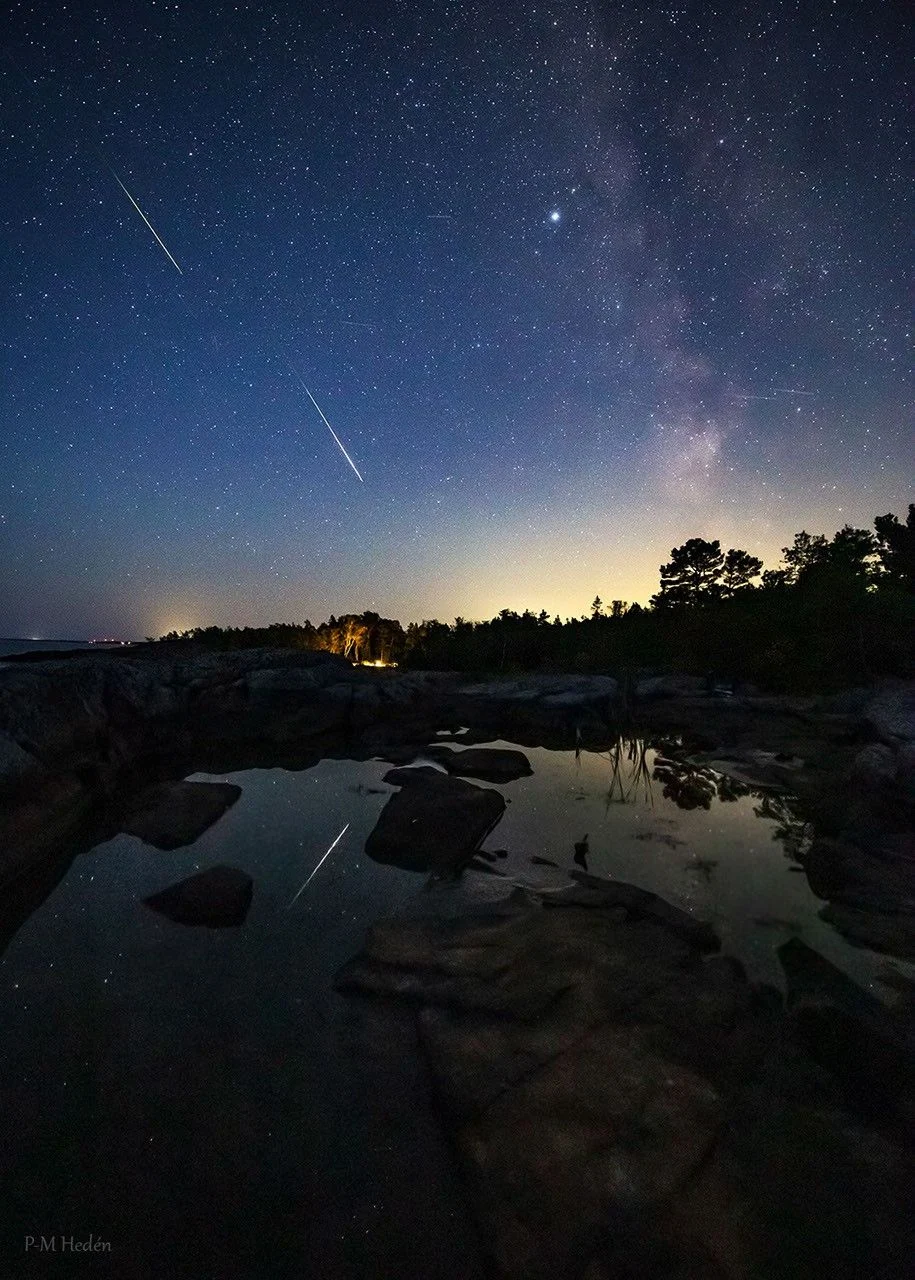
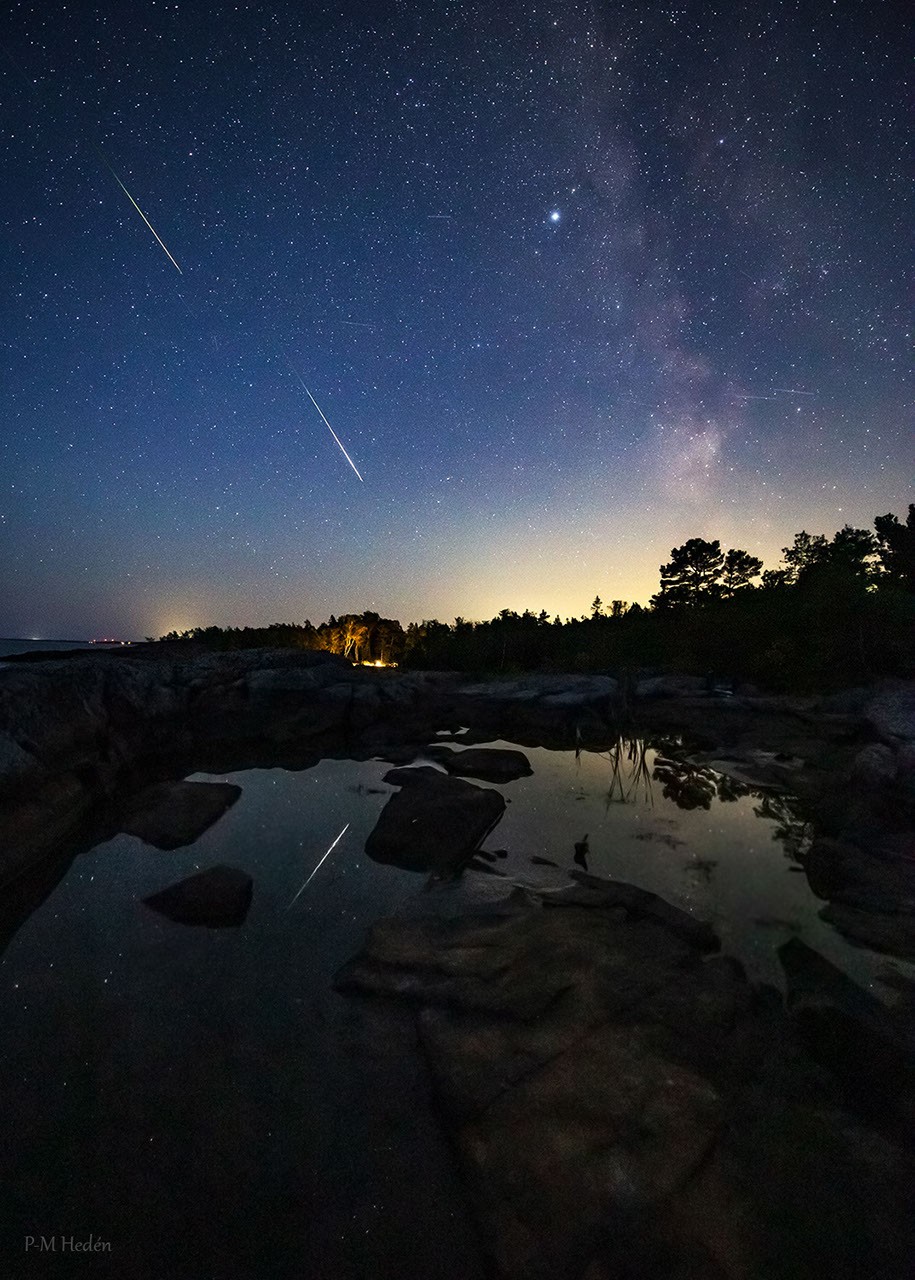
The annual Perseid Meteor Shower, renowned for its brilliant and swift celestial displays, graced Earth’s atmosphere, emanating from a radiant point within the constellation Perseus. This year’s spectacle, occurring near the peak of activity on August 12th, was particularly striking for observers in Sweden, where a photographer captured a breathtaking composite image. The photograph, taken near the coastal village of Grisslehamn, not only documented two exceptionally bright Perseid meteors streaking across the night sky but also their ethereal reflection in the still waters below. The event coincided with a New Moon, offering an exceptionally dark canvas that allowed the fainter streaks of the Milky Way to be visible, enhancing the overall cosmic panorama.
A Cosmic Spectacle Fueled by a Comet’s Legacy
The Perseid Meteor Shower is a celestial phenomenon that occurs each year as the Earth passes through the debris trail left behind by Comet 109P/Swift-Tuttle. This periodic comet, with an orbital period of approximately 133 years, sheds dust and ice particles along its path. As these minuscule fragments, often no larger than grains of sand, enter Earth’s dense atmosphere at tremendous speeds – up to 133,000 miles per hour – they ignite due to friction, creating the brilliant streaks of light that observers perceive as meteors. The Perseids are particularly celebrated for their high rate of fireballs, which are exceptionally bright meteors.
The radiant point of the Perseid shower, the apparent origin of the meteors in the night sky, lies in the constellation Perseus, hence the shower’s name. This celestial alignment makes the meteors appear to emanate from this specific region of the sky. While the shower is active for several weeks, its peak activity, when the highest number of meteors can be observed per hour, typically falls around August 11th to August 13th.
A Perfect Confluence of Astronomical Events
This year’s Perseid peak held a special significance for skywatchers due to the fortunate timing with a New Moon. The New Moon phase occurs when the Moon is between the Earth and the Sun, making it invisible from Earth. This absence of lunar illumination is a crucial factor for meteor shower observation, as the fainter meteors can easily be washed out by the glare of a full or even a quarter moon. The dark skies provided by the New Moon on August 12th meant that even the subtlest of meteor streaks were visible, allowing for an unhindered appreciation of the shower’s full splendor.
Furthermore, the preceding day, August 11th, saw a highly anticipated total solar eclipse. While the eclipse itself was a daytime event and not directly related to the nighttime meteor shower, the anticipation and viewing of the New Moon’s silhouette during the eclipse likely heightened the public’s awareness and interest in celestial events. This confluence of a significant solar eclipse followed by an ideal night for meteor watching created a memorable astronomical period for many.
The Swedish Vista: A Photographer’s Triumph
The photograph that forms the visual centerpiece of this year’s Perseid coverage was captured near Grisslehamn, a village on the coast of Sweden. The photographer, P-M Heden, utilized a composite technique to record multiple meteors within a single frame. This method involves taking a series of photographs over a period of time and then layering the images to showcase multiple events that occurred sequentially.
The image vividly illustrates two bright Perseid meteors, their trails arcing across the dark sky. The fainter, diffuse band of the Milky Way is also discernible, providing a sense of depth and the vastness of our galaxy. Crucially, one of the meteors is perfectly mirrored in the calm waters of the Baltic Sea below, adding a unique and symmetrical dimension to the celestial display. This reflection not only enhances the aesthetic appeal of the image but also highlights the importance of location and environmental conditions in capturing such moments. The reflection suggests a relatively calm water surface, often found in sheltered coastal areas like Grisslehamn, especially during the night.
The meteors themselves are described as being "almost as bright as Altair," which is the brightest star in the constellation Aquila and the twelfth brightest star in the night sky. This comparison provides a scale for the intensity of the Perseid flashes, indicating they were significant enough to rival the brightness of a prominent star.
Data and Context: Understanding Meteor Showers
Meteor showers are predictable annual events, and their intensity can vary year to year. The Perseids are consistently one of the most reliable and active showers. While the rate of meteors can fluctuate, under ideal conditions, observers can expect to see anywhere from 50 to over 100 meteors per hour during the peak.
The parent comet, 109P/Swift-Tuttle, was discovered independently by Lewis Swift and Horace Tuttle in 1862. Its orbit takes it far beyond Neptune, and its nucleus is estimated to be about 26 kilometers (16 miles) in diameter. Each passage of the comet replenishes the debris stream, ensuring the annual recurrence of the Perseid shower.
The practice of capturing meteor showers has evolved significantly with advancements in digital photography. Long-exposure photography, coupled with stacking and compositing techniques, allows astronomers and astrophotographers to document these fleeting events with greater detail and impact. The specific details of Heden’s photographic setup, such as the camera model, lens, exposure times, and ISO settings, would provide further insight into the technical aspects of capturing such a high-quality image. However, the resulting image speaks volumes about the skill and dedication involved.
Implications for Astronomy and Public Engagement
Events like the Perseid Meteor Shower and the accompanying solar eclipse serve as powerful tools for public engagement with science. They provide accessible and awe-inspiring opportunities for people of all ages to connect with the cosmos. The widespread sharing of images and accounts of these events, facilitated by social media and news outlets, fosters a sense of wonder and curiosity about astronomy.
The "Growing Gallery" mentioned in the accompanying text, specifically a Facebook album titled "Solar Eclipse of 2026 August 12," suggests an ongoing effort to document and share astronomical phenomena. This initiative likely aims to create a comprehensive archive of images and potentially personal accounts from the eclipse, which can be used for educational purposes and to inspire future generations of scientists and stargazers.
The continued observation and study of meteor showers also contribute to our understanding of cometary dynamics and the composition of our solar system. By analyzing the light spectrum of meteors, scientists can determine the chemical makeup of the cometary dust, providing clues about the early history of the solar system.
Looking Ahead: The Ever-Present Cosmos
The Astronomy Picture of the Day (APOD) initiative, by featuring a different astronomical image and explanation daily, plays a vital role in democratizing access to cutting-edge scientific imagery and knowledge. The brief explanations, written by professional astronomers, translate complex scientific concepts into understandable narratives, making the universe accessible to a broad audience.
The inclusion of "Tomorrow’s picture: Milky Way over Yellowstone" hints at the continuous stream of breathtaking celestial imagery that NASA and its partners are making available. Each day brings a new opportunity to explore the wonders of the universe, from the fiery streaks of meteor showers to the majestic sweep of our own galaxy across iconic terrestrial landscapes. The Perseid Meteor Shower, captured in such stunning detail over the Swedish coast, serves as a potent reminder of the beauty and dynamism of the cosmos, a spectacle that unfolds above us year after year, inviting us to look up and wonder.