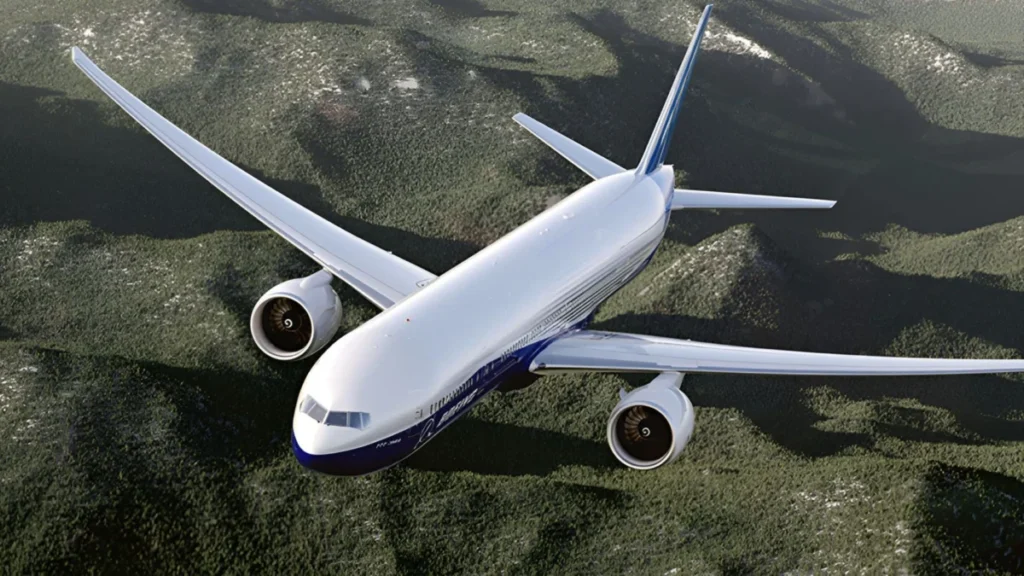
Stratolaunch, a leading provider of high-speed flight testing services, announced on September 30, 2024, the significant acquisition of a Boeing 777-200ER aircraft, a strategic move poised to substantially augment its capabilities in the burgeoning field of hypersonic development. This addition to its carrier fleet is projected to increase the Mojave, California-based company’s overall flight capacity by an impressive 35 percent and broaden the geographic scope for its critical test missions. The move underscores Stratolaunch’s commitment to scaling its operations to meet the intensifying global demand for hypersonic flight testing.
The Boeing 777-200ER, a renowned widebody jetliner, will undergo extensive modifications to integrate seamlessly into Stratolaunch’s unique air-launch system. Engineers will reconfigure the aircraft to facilitate the release of the company’s Talon-A reusable hypersonic test vehicles directly through its fuselage. This complex engineering endeavor is anticipated to conclude by 2027, at which point the 777 will become fully operational, offering Stratolaunch a crucial third platform for deploying its advanced test vehicles into flight.
A Growing Fleet for Critical Flight Testing
The addition of the 777-200ER signifies a pivotal expansion for Stratolaunch, complementing its existing carrier aircraft: Roc, the world’s largest aircraft by wingspan, and the Spirit of Mojave, a modified business jet. Roc, a colossal twin-fuselage aircraft originally conceived to launch satellites, has successfully transitioned to serve as the primary air-launch platform for the Talon-A. Its immense size and carrying capacity make it uniquely suited for lifting the Talon-A to the necessary altitudes before release. The Spirit of Mojave, a more nimble asset, often serves as a chase aircraft, telemetry relay, and potentially a future secondary launch platform for smaller test articles or support missions. The 777 will bridge a gap, offering a more agile, yet still high-capacity, alternative to Roc, enhancing the fleet’s versatility.
Stratolaunch’s strategic decision to expand its fleet comes amidst a dramatic surge in demand for hypersonic testing capabilities. The global "hypersonic race" among major powers, including the United States, China, and Russia, has intensified, driving an urgent need for robust and frequent flight test opportunities. By adding another carrier, Stratolaunch aims to provide its customers, primarily government agencies and defense contractors, with more opportunities to schedule missions, thereby reducing reliance on a single aircraft and mitigating potential scheduling bottlenecks. This expansion is critical for accelerating the development cycles of hypersonic technologies, which are seen as pivotal for future national security and strategic deterrence.
The Strategic Imperative of Hypersonic Flight
Hypersonic flight, defined as speeds exceeding Mach 5 (five times the speed of sound), represents a frontier in aerospace engineering with profound strategic implications. Vehicles capable of sustained hypersonic flight offer unprecedented speed, maneuverability, and altitude capabilities, making them extremely difficult to detect, track, and intercept with current defense systems. This makes them highly attractive for both offensive strike capabilities and advanced reconnaissance. The development of these technologies is not merely an academic pursuit; it is a critical component of modern military strategy, promising to redefine future aerial warfare and strategic balance.
However, the development of hypersonic systems presents formidable engineering challenges. The extreme speeds generate intense heat, subjecting airframes and internal components to temperatures that can reach thousands of degrees Fahrenheit. Aerodynamic forces at Mach 5+ are also vastly different from those at subsonic or supersonic speeds, requiring novel materials, advanced thermal management systems, and sophisticated guidance, navigation, and control (GNC) algorithms. Ground-based simulations and wind tunnels, while essential, cannot fully replicate the complex, dynamic environment of real hypersonic flight. This gap necessitates extensive and iterative flight testing to validate designs, refine performance, and collect invaluable data under authentic operational conditions.
Talon-A: The Core of Stratolaunch’s Mission
At the heart of Stratolaunch’s hypersonic testing business is the Talon-A, an innovative autonomous, reusable hypersonic test vehicle. Designed to be launched from a carrier aircraft, the Talon-A conducts high-speed atmospheric tests before executing an unpowered glide return for recovery on a conventional runway. This reusability is a game-changer in the typically expensive realm of hypersonic development, offering a more cost-effective and efficient means of data collection over multiple missions. The vehicle’s modular design also allows for rapid payload changes, accommodating a variety of sensors and experiments tailored to specific test objectives.
The Talon-A program has demonstrated remarkable progress and success. In July, Stratolaunch proudly announced that the Talon-A had completed 10 successful hypersonic flights, marking a significant milestone in its operational history. These successes underscore the vehicle’s reliability and the maturity of Stratolaunch’s air-launch and recovery system. This track record was instrumental in securing a substantial $90.8 million contract under the U.S. Department of Defense’s Test Resource Management Center’s (TRMC) MACH-TB (Multi-Service Advanced Capability Test Bed) program. This award specifically covers air-launched capability test vehicles, solidifying Talon-A’s role as a vital asset for supporting U.S. hypersonic development initiatives and providing a consistent demand for Stratolaunch’s services.
Strategic Advantages of an Expanded Carrier Fleet
The acquisition of the Boeing 777-200ER brings several profound advantages to Stratolaunch and its customers. Foremost among these is the significant increase in operational flexibility. With three carrier aircraft—Roc, Spirit of Mojave, and the forthcoming 777—Stratolaunch will be better positioned to support parallel missions, a capability that dramatically reduces scheduling constraints and enables a higher flight cadence. This is crucial for hypersonic programs, which often require numerous test flights to iterate on designs and thoroughly validate performance across a spectrum of flight conditions.
Furthermore, a larger fleet enables Stratolaunch to support operations from diverse locations. Different test programs may necessitate specific ranges, unique weather conditions, or particular mission profiles that are geographically constrained. For instance, some tests might require vast, unpopulated airspace over oceans, while others might benefit from specific atmospheric conditions found in certain regions. The 777’s inherent range and endurance as a commercial airliner, even after modifications, will offer greater flexibility in deploying to and operating from various airfields globally, opening up new possibilities for mission execution.
From a technical standpoint, utilizing a carrier aircraft like the 777 as a reusable first stage offers distinct advantages over traditional ground-based launch systems. By carrying the Talon-A to a high altitude and significant initial velocity before release, the test vehicle can begin its hypersonic mission with a substantial energy advantage. This translates to longer hypersonic flight durations, reduced fuel consumption for the test article itself, and the ability to reach target speeds and altitudes more efficiently. More importantly, air-launch allows researchers to initiate missions from specific points in the atmosphere, enabling the collection of data during flight profiles that are difficult or impossible to reproduce with ground-based rockets, such as specific angles of attack at hypersonic speeds, or simulated re-entry trajectories. This precision in mission initiation is invaluable for advanced aerodynamic and thermal testing.
Stratolaunch’s Vision for Routine Hypersonic Testing
Zachary Krevor, Stratolaunch’s President and CEO, articulated the strategic rationale behind the 777 acquisition, stating, "As demand for hypersonic technologies continues to grow, we’re building the operational scale to make routine hypersonic testing a reality." He emphasized that the additional aircraft will provide greater flexibility as the company works to increase its overall testing capacity. This vision aligns with the broader industry trend towards more accessible and routine access to advanced testing infrastructure, moving away from bespoke, costly, and infrequent test campaigns.
Stratolaunch’s journey reflects an evolution from its ambitious origins under Paul Allen, which initially focused on air-launching orbital rockets, to its current, highly specialized role in hypersonic testing. This pivot has allowed the company to carve out a unique niche in the aerospace market, providing a critical service that directly addresses national security priorities. By continuously expanding its capabilities and fleet, Stratolaunch aims to solidify its position as the premier enabler for hypersonic development, offering an end-to-end solution that encompasses carrier aircraft, reusable test vehicles, ground support, and data analysis. This integrated approach not only streamlines the testing process but also has the potential to significantly reduce the overall cost and timeline for developing new hypersonic systems.
The market implications of Stratolaunch’s expansion are substantial. As government and commercial programs worldwide accelerate their efforts in hypersonics, the bottleneck often lies in the availability of reliable, frequent, and cost-effective flight test opportunities. By addressing this bottleneck head-on, Stratolaunch positions itself as an indispensable partner, fostering innovation and accelerating the maturation of these critical technologies. The ability to conduct more frequent tests means faster iteration cycles for engineers, leading to quicker discovery of design flaws, more rapid validation of solutions, and ultimately, a faster path to operational deployment of hypersonic capabilities.
The Road Ahead: Modifications and Operational Readiness
While the acquisition of the Boeing 777-200ER marks a significant step forward, the aircraft will not enter service immediately. Stratolaunch faces the complex task of modifying the widebody jet to meet the exacting requirements for air-launching the Talon-A. This involves extensive structural reinforcement, the design and installation of a specialized payload bay and release mechanism within the fuselage, and the integration of sophisticated control and telemetry systems to ensure safe and precise deployment. These modifications are not trivial; they require meticulous engineering, rigorous testing, and compliance with stringent aerospace safety standards.
The planned 2027 completion date for these modifications underscores the scope and complexity of the undertaking. Once the aircraft joins the operational fleet, it will mark another significant milestone in Stratolaunch’s ongoing effort to expand its testing infrastructure. The addition of a third carrier aircraft will not only provide more room to schedule missions but will also enable Stratolaunch to respond more effectively to customers seeking additional hypersonic flight data and increased testing flexibility. This expanded capacity is crucial for advancing aerospace technology, strengthening national defense capabilities, and ultimately, making routine and cost-effective hypersonic testing a reality in the years to come. The future of high-speed flight hinges on such dedicated infrastructure, and Stratolaunch is actively building that future.