Astronomers have made a groundbreaking discovery that is fundamentally altering our understanding of the early universe, revealing that some of the most colossal galaxies that existed billions of years ago harbored a significantly larger population of small, faint stars than previously accounted for. This previously obscured stellar multitude implies that these ancient cosmic behemoths were, in fact, far more massive than earlier estimates, presenting a profound challenge to existing theories of galaxy formation and evolution. The findings, a collaborative effort involving an international team with key contributions from Penn State researchers, were recently published in the prestigious journal Nature Astronomy.
JWST Unveils the Faint Stars of Cosmic Dawn
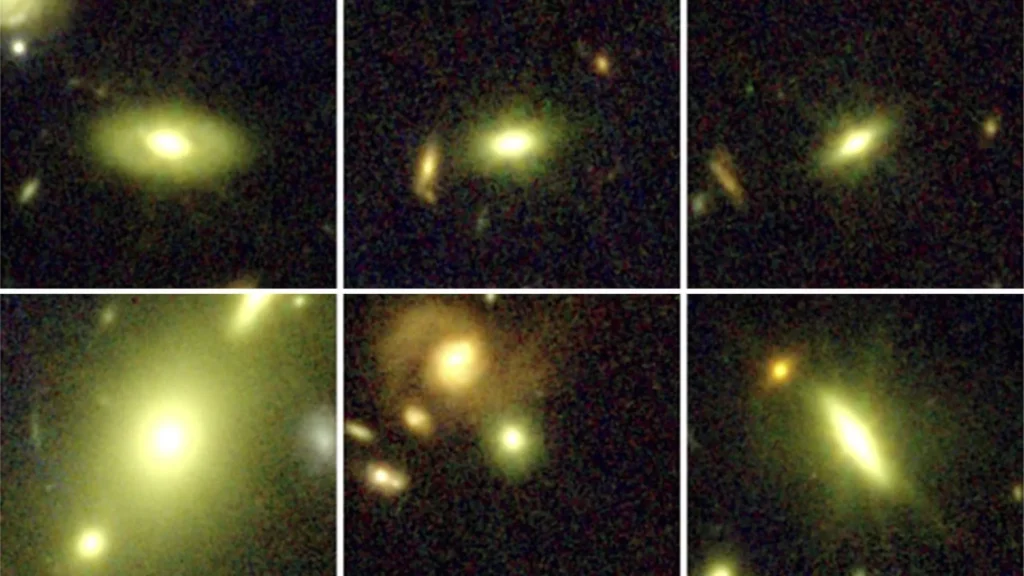
The revolutionary insights emerged from meticulous observations conducted using NASA’s James Webb Space Telescope (JWST). Researchers focused their advanced gaze on nine massive, mature galaxies that had ceased their star-forming activities billions of years in the past. By synergizing the unparalleled sensitivity of JWST’s deep-space observations with complementary, earlier ground-based data from the Very Large Telescope (VLT), the team achieved a feat previously thought impossible: reliably estimating the relative proportions of minuscule, dim stars and their much larger, brighter counterparts in galaxies situated at immense cosmological distances.
"These galaxies are fundamentally different from what we anticipated," stated Joel Leja, the Dr. Keiko Miwa Ross Mid-Career Associate Professor of Astronomy and Astrophysics at Penn State and a coauthor of the pivotal paper. "Their difference lies in a way that is profoundly challenging to comprehend. They are substantially more massive than we had projected – in fact, they possess three to four times the mass that our previous models indicated."
The methodology underpinning this discovery relies on the intricate analysis of light emitted by these distant galaxies. By dispersing each galaxy’s light into its constituent spectrum, astronomers can identify subtle color variations. These variations act as spectral fingerprints, indicative of the types of stars present within the galactic population. However, a persistent challenge in such analyses has been the overwhelming dominance of light from large, luminous stars, which effectively shroud the fainter signatures of their smaller stellar siblings. Penn State researchers played a crucial role by contributing their specialized expertise and providing critical guidance in the complex modeling of the light spectra detected from these ancient galactic systems.
Bright Stars Mask Vast Stellar Populations: A Cosmic Deception
To illustrate the complexity of their findings, lead author Chloe Cheng, a recent doctoral graduate of Leiden University, employed a compelling analogy. "If a galaxy were a city, the brightest stars would be the skyscrapers that immediately capture your attention from afar," Cheng explained. "Our models demonstrate that a far more numerous population of low-mass stars is concealed by those rare, bright stars, much like houses are hidden between skyscrapers. Consequently, this galaxy turns out to be much more massive than previous estimates suggested."
Historically, astronomers estimating the mass hidden within dim, low-mass stars have operated under a long-held assumption: that stars form in roughly similar proportions across the vast expanse of the universe. This new research directly challenges that fundamental assumption. The findings indicate that the most massive galaxies in the early universe appear to have a disproportionately greater abundance of low-mass stars when compared to smaller galaxies, such as our own Milky Way.
One particular galaxy, singled out by coauthor Martje Slob, a doctoral candidate at Leiden University, stands as a remarkable example. This galaxy is estimated to have formed less than 1.5 billion years after the Big Bang and, with the newly accounted-for stellar population, could be as much as four times more massive than prior calculations suggested.
"Until very recently, measurements of this nature were simply not feasible," Slob elaborated. "We required not only a telescope with the capability to magnify extremely distant galaxies but also spectra of exceptional quality, coupled with novel analytical techniques to reliably detect the subtle signatures of faint, low-mass stars that were concealed within these cosmic titans."
The Early Universe: An Even Bigger Puzzle Emerges
These revelations have far-reaching implications for scientists striving to unravel the intricate tapestry of galactic development in the nascent universe. Since the JWST commenced its observational mission, astronomers have repeatedly encountered unexpectedly massive and mature galaxies that existed surprisingly early in cosmic history, shortly after the Big Bang. These discoveries have already placed considerable strain on established models of galaxy formation, which often struggle to explain the rapid assembly of such large structures.
"This discovery carries crucial implications for our understanding of the early universe," emphasized Leja, who also holds an affiliation with The Penn State Institute for Computational and Data Sciences. "Since the launch of JWST, astronomers have identified surprisingly massive and mature galaxies that were already present in the cosmos shortly after the Big Bang. These very early galaxies are theorized to evolve into the types of galaxies we have studied in this work. Therefore, by adding up to four times more stars to these massive, early-forming galaxies, we further sharpen these existing tensions within our theoretical frameworks."
If these ancient galaxies indeed contained substantially more stars than researchers had previously estimated, then theories of galaxy formation must now account for the mechanisms by which such an enormous number of small stars could have emerged so early in cosmic history. This necessitates a re-evaluation of the initial conditions and evolutionary pathways of these primordial galaxies.
Hidden Stars Hint at Abundant Early Planets
The ramifications of this discovery may extend beyond the realm of galaxy formation and into the domain of exoplanet research.
"This result demonstrates that a significantly greater amount of mass than previously thought is hidden within low-mass stars," observed Mariska Kriek, who led the research and holds the position of professor of extragalactic astronomy at Leiden Observatory. "This has consequences for numerous areas of astronomy. For instance, given that many planets orbit low-mass stars, this finding could even suggest that more planets formed in the early universe than we had previously assumed."
The implications for planetary science are indeed profound. If the number of low-mass stars in the early universe was significantly underestimated, then the potential number of planets that formed around these stars would also have been much larger. This could reshape our understanding of when and where the first planetary systems emerged.
Looking ahead, the research team plans to leverage the same sophisticated technique to investigate galaxies from even earlier epochs of the universe. Their ambitious goal is to push observational limits closer to the very moment when the universe’s first generations of stars and galaxies began to coalesce, offering an unprecedented glimpse into the dawn of cosmic structures.
Background and Chronology of the Discovery
The pursuit of understanding the early universe has been a long and arduous journey for astronomers. For decades, the prevailing cosmological models suggested a gradual build-up of galaxies over billions of years. However, the advent of increasingly powerful telescopes, culminating in the capabilities of the James Webb Space Telescope, has begun to challenge these established timelines.
Early Theories of Galaxy Formation (Pre-JWST Era): Cosmological simulations and theoretical models generally posited that the first galaxies were relatively small and grew through mergers and accretion of gas over vast stretches of cosmic time. The number and mass of stars within these early galaxies were thought to follow a relatively predictable distribution, often modeled on the stellar populations observed in the Milky Way.
The Advent of JWST (Launched December 25, 2021): The launch of JWST marked a paradigm shift in observational astronomy, providing unprecedented sensitivity and resolution for studying the distant universe. Its infrared capabilities allow it to peer through cosmic dust and detect light from the earliest, most redshifted objects.
Early JWST Discoveries (2022-2023): Almost immediately after becoming operational, JWST began returning data that revealed galaxies existing much earlier and appearing far more massive and mature than expected. These initial findings put significant pressure on existing models, prompting a flurry of research to reconcile these observations with theoretical frameworks.
The Current Study (Publication in Nature Astronomy): This recent research, by focusing on the spectral signatures of faint stars, has provided a crucial piece of the puzzle. By combining JWST’s sensitivity with the VLT’s data and advanced modeling techniques, the international team was able to quantify the hitherto hidden stellar populations. This study represents a significant leap forward from simply observing the presence of massive early galaxies to understanding the composition of their stellar mass.
Supporting Data and Methodological Advancements
The core of this discovery lies in the precise spectral analysis of distant galaxies. Astronomers typically analyze the light from galaxies by splitting it into a spectrum, which reveals the characteristic wavelengths of light emitted by different elements and star types.
- Stellar Mass Function: This refers to the distribution of stellar masses within a population of stars. Traditionally, astronomers assumed a relatively universal stellar mass function, where smaller stars are far more numerous than larger ones. This study suggests that in the most massive early galaxies, this function is skewed towards an even higher proportion of low-mass stars.
- Spectral Signatures: Low-mass stars, particularly red dwarfs and brown dwarfs, emit light primarily in the infrared spectrum and are significantly dimmer than sun-like stars or massive, blue giants. Detecting these faint signatures requires exceptional telescope sensitivity and sophisticated algorithms to disentangle them from the overwhelming light of brighter stars.
- JWST’s Role: JWST’s Near-Infrared Spectrograph (NIRSpec) and Mid-Infrared Instrument (MIRI) were critical in capturing the faint infrared light from these distant galaxies, enabling the identification of the spectral features associated with low-mass stars.
- VLT Contribution: Data from the Very Large Telescope (VLT) provided complementary observations, potentially at different wavelengths or with higher spatial resolution, which helped to refine the overall analysis and cross-validate the JWST findings.
Broader Impact and Implications for Cosmology
The revelation that early massive galaxies were significantly more massive than previously thought has cascading effects across multiple fields of astrophysics.
- Galaxy Formation Models: Current models will need to be revised to explain how such a large number of low-mass stars could have formed so early in the universe’s history. This may involve new insights into the initial conditions of star formation, the efficiency of gas accretion, and the role of dark matter in the assembly of early galactic structures.
- Cosmic Evolution: The total mass of galaxies is a key parameter in understanding the large-scale structure of the universe and its evolution. A higher total mass for early galaxies implies a different trajectory for cosmic structure formation.
- Stellar Population Synthesis: The way astronomers model the light and evolution of galaxies relies heavily on understanding their stellar populations. This discovery necessitates a re-evaluation of these synthesis models.
- The Search for Extraterrestrial Life: As noted by the researchers, the increased estimate of low-mass stars in the early universe directly translates to a potentially higher number of early planets. This could significantly impact estimates for the prevalence of habitable exoplanets and the possibility of life emerging in the early cosmos.
This ongoing research promises to continue pushing the boundaries of our cosmic knowledge, potentially rewriting chapters of astronomical textbooks and deepening our appreciation for the complex and dynamic history of the universe.