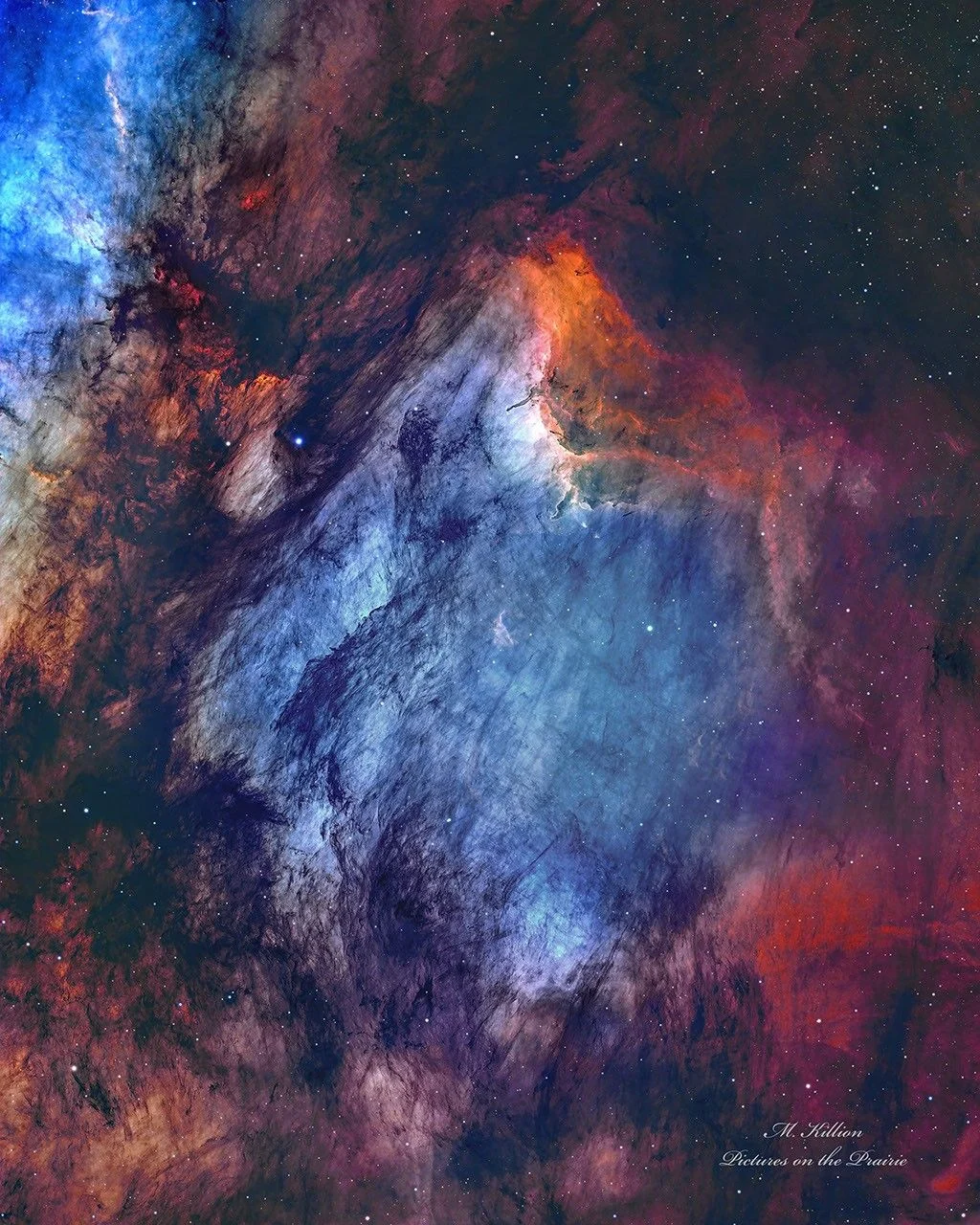
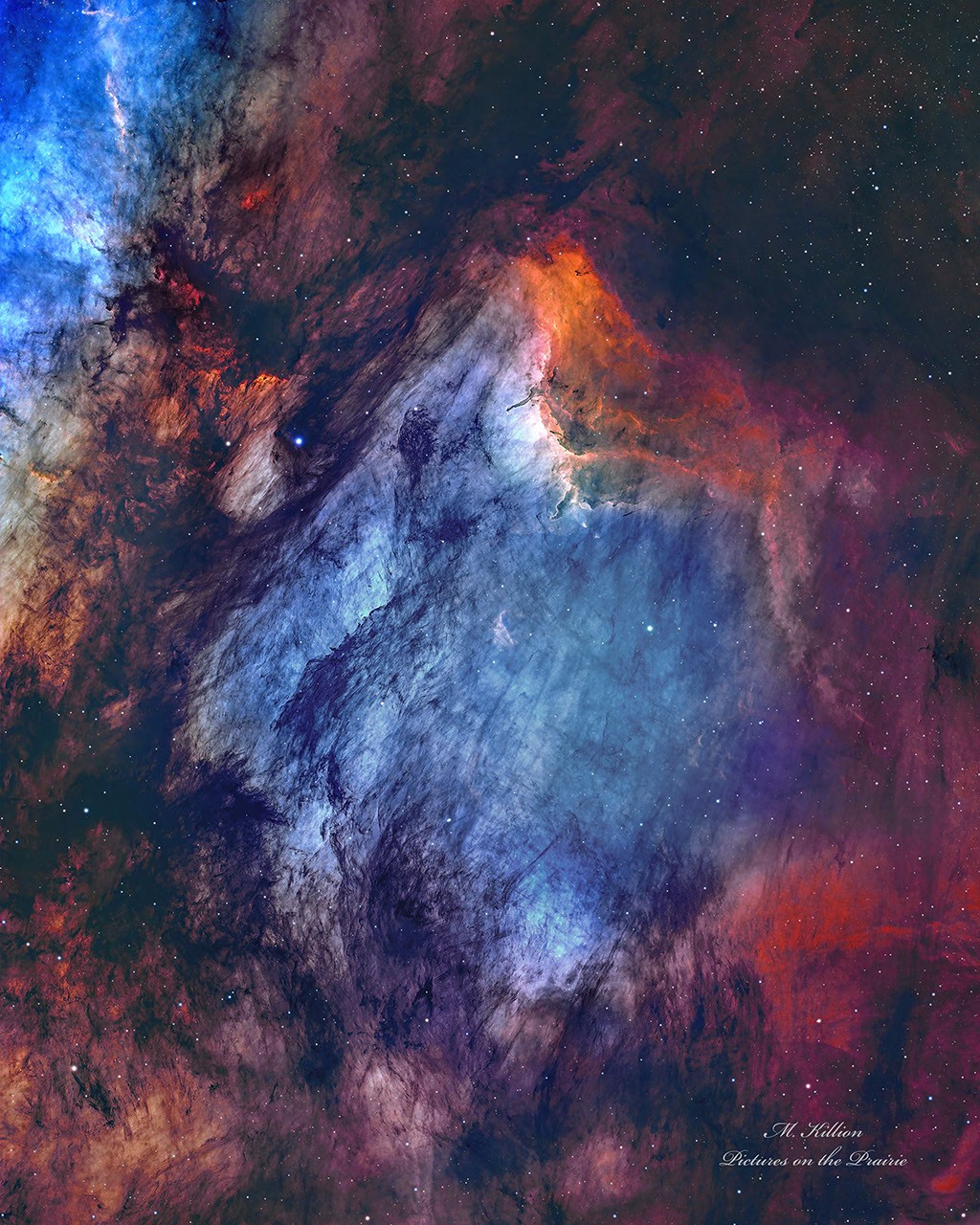
On September 7, 2026, the Astronomy Picture of the Day (APOD) unveiled a breathtaking image of the Pelican Nebula, officially designated IC 5070. This celestial spectacle, captured in exquisite detail by astrophotographer Mark Killion from Utah, USA, offers a profound glimpse into the dynamic processes of star formation and the evolutionary dance of interstellar gas and dust. The image, a composite of 25 hours of exposure, reveals a vibrant tapestry of red and blue glowing gas interwoven with dark, filamentary dust clouds, prompting many to perceive the nebula’s outline as that of a pelican.
A Nebula in Flux
The Pelican Nebula, situated approximately 1,800 light-years away in the constellation Cygnus, is a region of intense astronomical activity. It is gravitationally bound to, and separated from, the larger North America Nebula by a dense molecular cloud rich in dark dust. This molecular cloud acts as a veil, obscuring the nascent stars within and contributing to the nebula’s intricate structure. The featured image masterfully highlights these filamentary dust structures, revealing the raw materials from which new stars are born.
At its core, the Pelican Nebula is a cosmic nursery, a place where the extreme conditions are conducive to the birth and evolution of stars. Young, energetic stars within the nebula are the primary drivers of its transformation. Their intense radiation heats the surrounding cold gas, gradually converting it into hotter gas. This process creates a distinct boundary, known as an ionization front, which is vividly displayed in the image as a bright orange band across the upper right portion of the nebula. This advancing front signifies the ongoing battle between the cold, dense gas clouds and the powerful stellar winds and radiation emanating from newly formed stars.
The Science Behind the Image
The detailed depiction of the Pelican Nebula showcases the complex interplay of astrophysical phenomena. The red hues primarily originate from ionized hydrogen atoms, excited by ultraviolet radiation from young, hot stars. The blue regions, conversely, often represent scattered light from these stars off of dust particles, or emissions from other elements like oxygen. The dark filaments are concentrations of interstellar dust, dense enough to block visible light, but also playing a crucial role in shielding cooler regions where new stars can condense and form.
The photographic achievement by Mark Killion involved an impressive 25 hours of exposure time. This extensive integration period allowed for the capture of faint details and subtle color variations that would be imperceptible in shorter exposures. The processing of such a large dataset is a testament to modern astrophotography techniques, enabling amateur astronomers to contribute scientifically significant observations. The location in Utah, known for its dark skies, provided an optimal environment for capturing this deep-sky object.
A History of Observation and Study
The Pelican Nebula is not a new discovery. Its official designation, IC 5070, places it within the Index Catalogue, a compilation of deep-sky objects compiled in the late 19th and early 20th centuries. However, its active star-forming regions have made it a subject of ongoing scientific interest for decades. Astronomers have utilized powerful ground-based telescopes and space observatories like the Hubble Space Telescope to study its intricate structures and the processes occurring within.
Previous APOD features have highlighted related objects and phenomena. The North America Nebula, its larger neighbor, has also been showcased, emphasizing the vastness and interconnectedness of these cosmic structures. Dark molecular clouds, such as the one separating IC 5070 from its neighbor, have been explained as essential reservoirs of material for star formation. The concept of ionization fronts, prominently visible in the Pelican Nebula, has been a recurring theme in APOD, illustrating the powerful impact of massive stars on their surroundings.
Chronology of Stellar Evolution within IC 5070
While the complete timeline of the Pelican Nebula’s formation is on a cosmic scale, astronomers can infer a general chronology of events within such star-forming regions:
- Pre-stellar Collapse: Dense cores of molecular gas and dust within the nebula begin to collapse under their own gravity. This is a slow process, taking millions of years.
- Protostar Formation: As these cores collapse, they heat up and form protostars. These early-stage stars are still enshrouded in their natal dust and gas envelopes.
- Star Birth and Ignition: The protostars continue to accrete mass. When their cores become hot and dense enough, nuclear fusion begins, marking the birth of a true star.
- Stellar Radiation and Ionization: Young, massive stars emit intense ultraviolet radiation. This radiation begins to ionize the surrounding cooler gas, creating glowing nebulae and ionization fronts.
- Nebula Transformation: The outward pressure from stellar winds and radiation from these young stars starts to erode and sculpt the remaining gas and dust. This process gradually transforms the nebula, potentially revealing new stellar clusters and shaping the interstellar medium.
- Future State: Over millions of years, the nebula will continue to evolve. The dense molecular cloud separating IC 5070 from the North America Nebula will likely dissipate, and the appearance of the Pelican Nebula itself will change dramatically as its stars mature and its gas is dispersed. It is highly probable that the current iconic "pelican" shape will eventually be unrecognizable, replaced by entirely new structures dictated by the evolving stellar population and its interactions with the interstellar medium.
Supporting Data and Astronomical Context
The Pelican Nebula is part of a larger star-forming complex in the constellation Cygnus. Its distance of approximately 1,800 light-years places it within our own Milky Way galaxy, in the Perseus Arm. The nebula’s estimated mass is significant, containing enough material to form thousands of stars. The energetic stars within IC 5070 are typically O and B-type stars, which are among the most massive and luminous stars in the universe, and have relatively short lifespans, often only a few million years.
The presence of dark nebulae like LDN 935, mentioned in the explanation, further underscores the complex and layered nature of interstellar space. These dark clouds are not empty voids but are rich in molecules and dust, acting as the raw material for future generations of stars. The balance and placement of stars and gas within a nebula are critical factors that determine its long-term evolution and ultimate appearance.
Official Statements and Service
The Astronomy Picture of the Day (APOD) is a collaborative effort, serving as a gateway to the wonders of the cosmos for a global audience. The program is a service of NASA’s Astrophysics Science Division (ASD) at Goddard Space Flight Center, in partnership with NASA Science Activation and Michigan Technological University. The editors responsible for curating and explaining these celestial images, including Robert Nemiroff, Jerry Bonnell, Cecilia Chirenti, and Keighley Rockcliffe, play a vital role in making complex astronomical concepts accessible to the public.
The move of APOD’s main site from apod.nasa.gov to science.nasa.gov/apod signifies an ongoing effort to integrate astronomical content within broader NASA science outreach initiatives. This transition ensures that the rich educational resources provided by APOD continue to reach an ever-wider audience.
Broader Impact and Implications
Images like the one of the Pelican Nebula serve multiple purposes. For the general public, they offer a sense of awe and wonder, inspiring curiosity about the universe and our place within it. For students and educators, APOD provides invaluable visual aids and explanations that can ignite a passion for science, technology, engineering, and mathematics (STEM) fields. For the scientific community, these images, often derived from professional astronomical observations or exceptional amateur efforts, can highlight areas of particular interest for further research and study.
The ongoing transformation of the Pelican Nebula serves as a potent reminder of the dynamic nature of the universe. Celestial objects are not static; they are constantly evolving, being born, aging, and transforming over vast timescales. Understanding these processes is fundamental to comprehending the life cycle of stars, the formation of planetary systems, and the evolution of galaxies. The Pelican Nebula, with its visible star formation and evolving gas clouds, offers a tangible, albeit distant, illustration of these fundamental cosmic processes, making it a valuable subject for both scientific inquiry and public appreciation. The continued exploration and documentation of such phenomena by programs like APOD are essential for fostering a scientifically literate society and advancing our understanding of the universe.