Physicists at the University of California, Santa Barbara (UCSB), have significantly advanced the search for microscopic black holes and extra spatial dimensions, utilizing data from the Compact Muon Solenoid (CMS) experiment at the Large Hadron Collider (LHC). Operating at the European Center for Nuclear Research (CERN), the research team, led by postdoctoral researcher Tamas Vami and graduate student Danyi Zhang under the supervision of Professor Joe Incandela, has pushed the boundaries of known physics into unexplored energy territories. Although the search did not yield a discovery of these hypothetical objects, the results have established rigorous new "exclusion limits" that narrow the search for quantum gravity and provide a roadmap for future high-energy experiments.
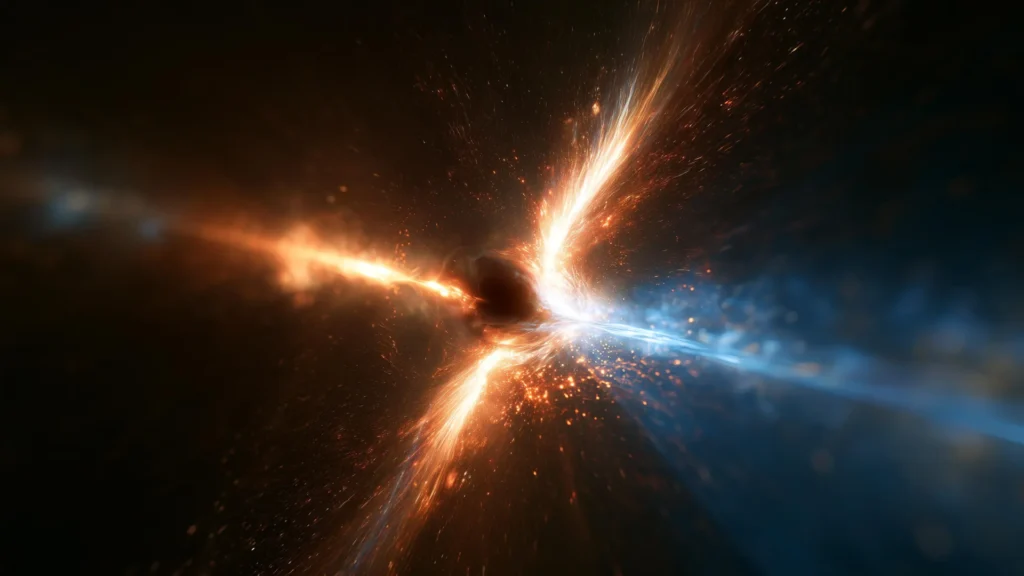
The study, recently published in the journal Progress in High Energy Physics (PHEP), represents a critical juncture in the effort to unify the fundamental forces of nature. By analyzing trillions of proton-proton collisions, the researchers sought evidence of "quantum black holes"—infinitesimal, short-lived voids in spacetime that would exist only if gravity behaves differently at extremely short distances than it does at the cosmic scale.
The Scientific Context: Bridging the Great Divide
Modern physics is defined by a fundamental schism between two highly successful but incompatible frameworks: General Relativity and Quantum Mechanics. General Relativity, Albert Einstein’s masterpiece, describes the universe at a macro scale, explaining how gravity governs the behavior of stars, galaxies, and the curvature of spacetime. Quantum Mechanics, conversely, describes the subatomic world through the Standard Model, which accounts for the electromagnetic, weak, and strong nuclear forces with incredible precision.
The primary challenge for 21st-century physics is the "Hierarchy Problem"—the observation that gravity is exponentially weaker than the other fundamental forces. For example, a simple refrigerator magnet can overcome the gravitational pull of the entire Earth to lift a paperclip. Physicists have long theorized that gravity might only appear weak because much of its strength "leaks" into extra spatial dimensions that are invisible to human perception.
If these extra dimensions exist, as suggested by string theory, the fundamental energy scale of gravity (the Planck scale) could be much lower than previously thought. In such a scenario, the LHC—the world’s most powerful particle accelerator—could potentially concentrate enough energy into a small enough volume to create microscopic black holes, offering a direct window into the mechanics of quantum gravity.
The Theory of Microscopic Black Holes
The possibility of creating black holes in a laboratory setting first gained scientific traction roughly two decades ago. Unlike the massive astrophysical black holes formed by collapsing stars, which can persist for billions of years, quantum black holes would be smaller than an atomic nucleus and would evaporate almost instantaneously via Hawking radiation.
"They wouldn’t stick around very long—if you made one, it would disintegrate immediately," explained UCSB physics theorist Steven Giddings, an expert on the intersection of quantum mechanics and gravity. Giddings was among the first scientists to propose that these tiny voids could exist under specific conditions involving extra spatial dimensions.
The search for these objects has historically been a point of public fascination and, at times, concern. During the LHC’s inception, fears were raised that the collider might create a stable black hole that could consume the Earth. However, the scientific community countered these concerns with extensive safety reports, noting that ultra-high-energy cosmic rays have been striking the Earth’s atmosphere for billions of years with higher energies than the LHC can produce, without any catastrophic effects. The quantum black holes sought by the UCSB team are strictly theoretical phenomena that would decay into a "spray" of particles within a fraction of a second.
Methodology: Machine Learning and Phase-Space Distance
To identify the presence of these rare events amidst the massive "background noise" of standard particle collisions, the UCSB team employed a sophisticated new analytical technique. The researchers analyzed data collected by the CMS detector between 2016 and 2018, a period known as "Run 2" of the LHC.
The team utilized two primary indicators for black hole detection:
- Sphericity: When a quantum black hole decays, it is expected to emit particles in a highly symmetrical, spherical pattern, rather than the "jets" of particles typically seen in standard proton collisions.
- Total Transverse Energy ($H_T$): Because black holes are high-energy objects, their decay products would carry an unusually large sum of energy.
The innovation in this study was the application of "phase-space distance," a method developed by UCSB theorist Nathaniel Craig. This approach utilizes a Support Vector Machine (SVM)—a type of supervised machine learning—to distinguish signal events from background events. In particle physics, "phase space" refers to a multidimensional map of a system’s possible states, including variables like position, momentum, and energy.
By converting the mathematical distances between different collision events into an "SVM score," the researchers could more accurately isolate events that resembled black hole signatures. This marked the first time the phase-space distance method was used in a major particle physics data analysis, proving to be more effective than traditional sphericity measurements.
Chronology of the Search and Results
The research followed a rigorous timeline of data acquisition and validation:
- 2016–2018: The CMS detector recorded trillions of proton collisions at an energy of 13 Tera-electron volts (TeV).
- 2019–2022: The UCSB team developed the machine learning framework and applied it to the Run 2 dataset, processing petabytes of information.
- 2023–2024: The analysis was finalized, peer-reviewed, and published in PHEP.
The search ultimately yielded a "null result," meaning no definitive evidence of quantum black holes or extra dimensions was found. However, in the realm of high-energy physics, a null result is a vital piece of the puzzle. The study established that quantum black holes do not exist at energy levels up to approximately 12 TeV within the parameters of the models tested.
Furthermore, the results placed new constraints on string theory and related models. While string theory often assumes 10 dimensions, the UCSB findings suggest that if certain theoretical parameters are correct, the number of extra dimensions accessible at these energy scales is strictly limited.
Searching for Sphalerons and Matter-Antimatter Asymmetry
The UCSB team expanded their study to include a search for "sphalerons"—theoretical non-particle configurations of field energy. Like quantum black holes, sphalerons would produce spherical energy signatures in the detector.
Sphalerons are of particular interest because they may hold the key to the "matter-antimatter asymmetry problem." Current cosmological models suggest that the Big Bang should have produced equal amounts of matter and antimatter, which would have annihilated each other, leaving an empty universe of pure radiation. The fact that the universe is made of matter suggests an imbalance occurred in the early moments of creation. Sphalerons are one of the few theoretical mechanisms that could explain how this imbalance arose.
As with the black hole search, no evidence of sphalerons was detected. This allowed the researchers to set upper limits on the "cross-section" (the probability of occurrence) of sphaleron transitions, providing essential data for theorists attempting to refine the history of the early universe.
Analysis and Broader Implications
The absence of new particles or phenomena at the LHC has led some in the scientific community to discuss a "nightmare scenario" where the Standard Model remains unbroken, but no further clues to the universe’s mysteries are found. However, Joe Incandela and his team view the situation differently.
"It’s not a dead-end," said graduate researcher Danyi Zhang. "The result is an exclusion limit, which is a real, publishable statement… That’s genuine knowledge about how the universe works."
The history of physics is replete with instances where the failure to find an expected signal led to a revolution. The Michelson-Morley experiment’s failure to detect "luminiferous aether" in the 19th century paved the way for Einstein’s Special Relativity. Similarly, the long search for the Higgs boson involved decades of null results that slowly narrowed the search area until its eventual discovery in 2012.
By ruling out the existence of black holes at 12 TeV, the UCSB researchers have effectively "cleared the map," forcing theorists to look toward higher energy scales or alternative explanations for the hierarchy problem.
The Future: High-Luminosity LHC
The search is far from over. The LHC is currently undergoing a series of massive upgrades to become the High-Luminosity LHC (HL-LHC). This next phase of the experiment, slated to begin later this decade, will increase the number of collisions by a factor of ten.
With a significantly larger dataset, physicists will be able to search for even rarer events that are currently buried in the noise. The "phase-space distance" method pioneered by the UCSB team is expected to be a cornerstone of these future analyses, providing a more sensitive tool for detecting the "unfamiliar and the unusual."
For now, the mystery of gravity’s weakness remains one of the most profound problems in science. Whether the answer lies in extra dimensions, undiscovered symmetries, or a framework yet to be imagined, the work at UC Santa Barbara ensures that the search continues with more precision and better tools than ever before. As Tamas Vami noted, each step—even one that finds nothing—is a step toward the century-long goal of unifying the fundamental forces of the universe.