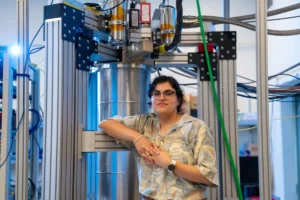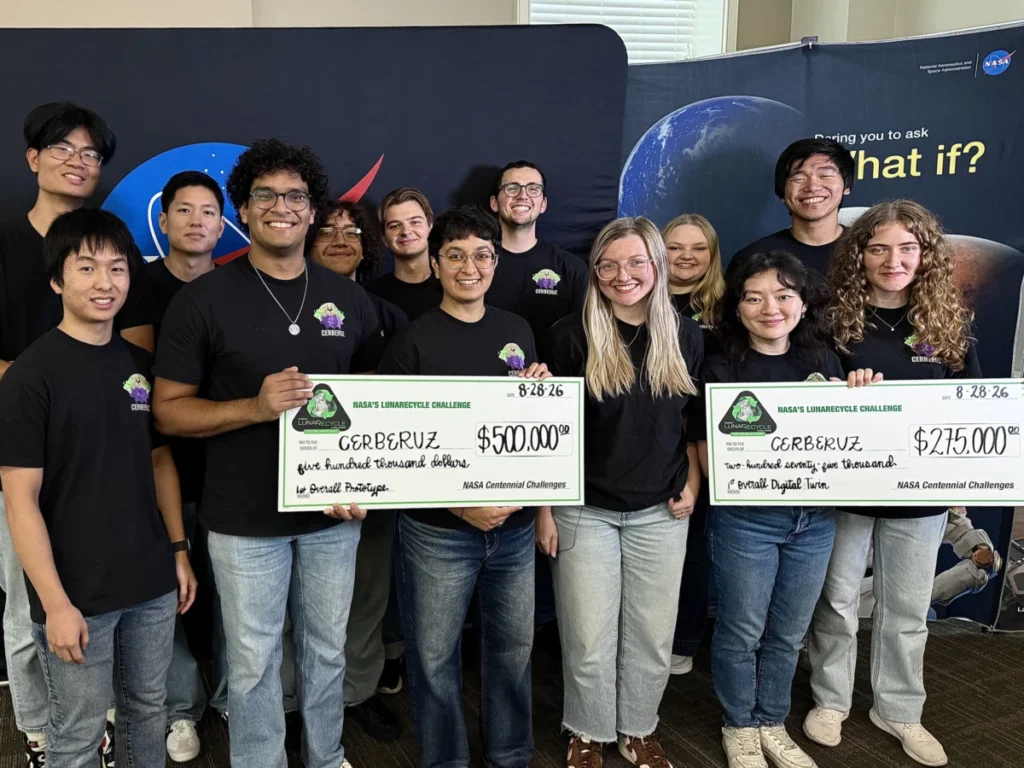
The Massachusetts Institute of Technology (MIT) has been awarded first prize in Phase 2 of NASA’s LunaRecycle Challenge, a groundbreaking initiative focused on developing sustainable solutions for waste management during lunar and deep space missions. The winning team, known as CERBERUZ (Composites for Extraterrestrial Recycling By Engineering the Reuse and Upcycling of Zotek), comprised a multidisciplinary group of undergraduate, graduate, and doctoral students who have devised a novel method for processing common mission waste materials like fabrics, plastics, foam, and metals into valuable resources. This significant achievement comes with a substantial award of $775,000, recognizing the team’s ingenuity and the practical viability of their technology.
The CERBERUZ team’s innovative approach tackles the pervasive issue of waste accumulation in space, a critical bottleneck for extended crewed missions and the establishment of off-world habitats. Instead of treating mixed waste as an unusable contaminant requiring laborious sorting, their technology grinds these materials into a fine powder. This finely processed material then serves as a versatile feedstock, capable of being repurposed through injection molding to create finished parts or extruded into filament for 3D printing. A key aspect of their winning solution is the effective integration of materials like Zotek foam, which is often discarded, as a reinforcing agent within the recycled composite. This not only reduces waste but also adds structural integrity to newly manufactured components, embodying the core principles of a circular economy in an extraterrestrial context.
The MIT team’s triumph extends across both crucial tracks of the LunaRecycle Challenge’s Phase 2: the prototype development track, where they demonstrated a tangible working model of their recycling system, and the digital twin track, where they successfully created a virtual, data-driven replica of their recycling process. This dual success underscores the comprehensive nature of their solution, demonstrating both its physical functionality and its potential for sophisticated digital monitoring, optimization, and replication.
A Culmination of Innovation and Collaboration
Jennifer Edmunson, program manager for Centennial Challenges at NASA’s Marshall Space Flight Center in Huntsville, Alabama, expressed her enthusiasm for the outcome of the challenge. "The LunaRecycle Challenge finale is the culmination of two years of innovation spurred by this competition," Edmunson stated. "It’s incredible to see these technologies go from concept to prototype and digital twin demonstrations in that time. Driving rapid and creative innovation is what NASA challenges are all about." Her remarks highlight the critical role of such competitions in accelerating the development of essential technologies for the future of space exploration.
The LunaRecycle Challenge itself is a significant $3 million, two-phase competition that NASA initiated in partnership with The University of Alabama’s Lee J. Styslinger Jr. College of Engineering. This collaboration leverages academic expertise and institutional resources to foster groundbreaking solutions. Phase 2, which culminated with the recent demonstration event, specifically required U.S. teams to submit a working prototype of their waste recycling system. The inclusion of an optional digital twin component allowed teams to provide a virtual, data-rich representation of their system, offering a powerful tool for analysis, simulation, and remote management.
The Grand Finale: Prototypes and Digital Twins on Display
The culmination of Phase 2 saw 14 finalist teams from across the United States converge at The University of Alabama’s Lee J. Styslinger Jr. College of Engineering in Tuscaloosa. From August 24th to August 28th, these teams presented their technological prototypes, offering a firsthand look at the future of space waste recycling. Alongside their physical demonstrations, several teams also showcased their meticulously developed digital twin models, providing a comprehensive view of their proposed solutions.
The diverse backgrounds of the competitors underscored the broad appeal and importance of the LunaRecycle Challenge. Participants included university students and faculty, seasoned entrepreneurs, and passionate space technology enthusiasts. This wide array of expertise ensured a rich tapestry of innovative ideas, with teams encouraged not only to address the specific challenges of deep space recycling but also to envision solutions with potential terrestrial applications. This dual focus on extraterrestrial and terrestrial relevance amplifies the potential impact of the technologies developed through the challenge, promising benefits for both space exploration and sustainability on Earth.
Recognizing Diverse Innovations
Beyond the first-place triumph of the CERBERUZ team, the LunaRecycle Challenge Phase 2 recognized the achievements of nine other teams across various categories. While the original announcement did not detail the specific winners for all prototype and digital twin tracks, the structured approach of the challenge indicates a commitment to acknowledging a spectrum of innovative contributions. The inclusion of a "People’s Choice Award," with a $25,000 prize, further democratized the recognition process, allowing public engagement to highlight a particularly compelling solution. This award is typically determined by votes cast during the demonstration event or through online platforms, offering a unique perspective on which innovations resonate most with a broader audience.
Chris Frangione, who manages the LunaRecycle Challenge in support of NASA Centennial Challenges through a contract with Amentum Space Exploration Division, emphasized the collaborative spirit that defined the event. "This competition highlights how collaborations can lead to incredible solutions," Frangione remarked. "Between the solver teams, The University of Alabama, and NASA, this finale showcases what can be achieved when we bring together resources and great ideas towards a common goal." His statement underscores the power of public-private partnerships and interdisciplinary teamwork in pushing the boundaries of technological advancement.
A Legacy of Crowdsourced Innovation
The success of Phase 2 builds upon the remarkable momentum generated by the competition’s initial phase. Phase 1 of the LunaRecycle Challenge garnered unprecedented interest, attracting over 1,200 registrations from the global innovator community. This figure represents a historic benchmark, exceeding the participation in any other competition within the 20-year history of NASA’s Centennial Challenges program. The initial phase, which concluded in 2025, allowed participants worldwide to submit designs in either or both of the prototype and digital twin tracks. A distinguished panel of 50 judges meticulously evaluated nearly 200 Phase 1 submissions, ultimately selecting 17 winning teams hailing from five different countries and nine U.S. states. It is important to note that Phase 2 entries were required to be independent of Phase 1 submissions, ensuring a fresh wave of innovation and distinct solutions.
The LunaRecycle Challenge is a testament to NASA’s broader strategy of leveraging crowdsourcing and prize competitions to tackle complex technical challenges. Managed at NASA’s Marshall Space Flight Center by the Centennial Challenges program, which falls under NASA’s Research and Technology Mission Directorate, this initiative has a proven track record of inspiring breakthroughs. For over two decades, NASA Centennial Challenges have engaged the public in solving critical problems that advance the agency’s missions. Past challenges have spurred significant advancements in diverse fields such as robotics, additive manufacturing (3D printing), power and energy systems, advanced textiles, chemistry, and biology, demonstrating the wide-reaching impact of this approach.
The development of these cutting-edge recycling technologies is also supported by invaluable expertise from NASA centers across the country. Subject matter experts at NASA’s Kennedy Space Center in Florida, NASA’s Ames Research Center in California’s Silicon Valley, and NASA’s Langley Research Center in Hampton, Virginia, provide crucial guidance and technical insights, ensuring that the solutions developed are aligned with the stringent requirements of spaceflight.
The Future of In-Situ Resource Utilization
The implications of the LunaRecycle Challenge extend far beyond the immediate context of waste management. The successful development of these technologies is a critical step towards enabling In-Situ Resource Utilization (ISRU), a cornerstone of sustainable long-duration space exploration. ISRU refers to the ability to use resources found on other celestial bodies – such as water ice, regolith, and atmospheric gases – to support human activities, thereby reducing the need to transport all necessary supplies from Earth. By transforming waste into usable materials, the LunaRecycle Challenge directly contributes to the principles of ISRU.
The ability to recycle and repurpose materials on the Moon or Mars will significantly reduce the mass and volume of supplies that must be launched from Earth, dramatically lowering mission costs and increasing mission endurance. For example, a mission to establish a permanent lunar base would generate substantial amounts of waste over time. Without effective recycling, this waste would accumulate, posing logistical and safety challenges. The CERBERUZ team’s technology, which can convert diverse waste streams into feedstock for 3D printing, could enable astronauts to manufacture tools, spare parts, habitat components, and even consumables directly on-site, using what would otherwise be discarded.
The digital twin aspect of the challenge is also of immense importance. A digital twin is a virtual representation of a physical asset, process, or system that uses real-time data to simulate performance, predict outcomes, and optimize operations. In the context of space exploration, digital twins of recycling systems can allow mission planners and astronauts to monitor the recycling process remotely, identify potential issues before they become critical, and fine-tune the system’s efficiency. This is particularly crucial for missions where communication delays are significant, or where direct human intervention is limited.
Furthermore, the emphasis on terrestrial applications suggests a dual benefit. Technologies developed for the harsh and resource-constrained environment of space often find innovative applications back on Earth, particularly in areas like waste management, sustainable manufacturing, and resource recovery. The CERBERUZ team’s method of turning mixed waste into a valuable composite material could offer new solutions for the recycling of complex waste streams on Earth, contributing to a more circular economy and reducing landfill burden.
The LunaRecycle Challenge represents a forward-thinking approach by NASA, recognizing that the sustainability of future space endeavors hinges on our ability to effectively manage resources and minimize waste. By fostering innovation through competitions like this, NASA is not only advancing the technological readiness for ambitious space missions but also driving solutions that can benefit humanity on a global scale. The success of teams like CERBERUZ signals a promising future where space exploration is not just about reaching new frontiers, but about doing so responsibly and sustainably.
For those interested in learning more about the LunaRecycle Challenge and its ongoing contributions to space exploration and sustainable technology development, NASA provides detailed information at: www.nasa.gov/lunarecycle.