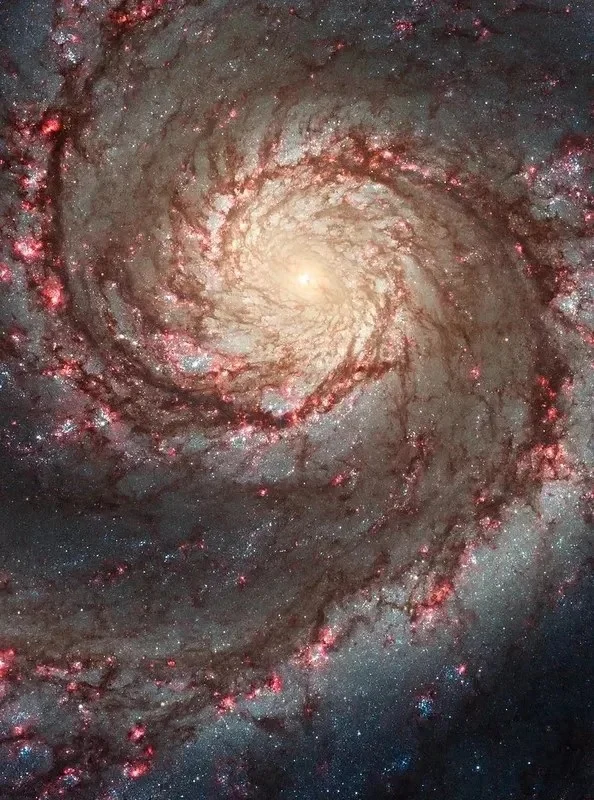
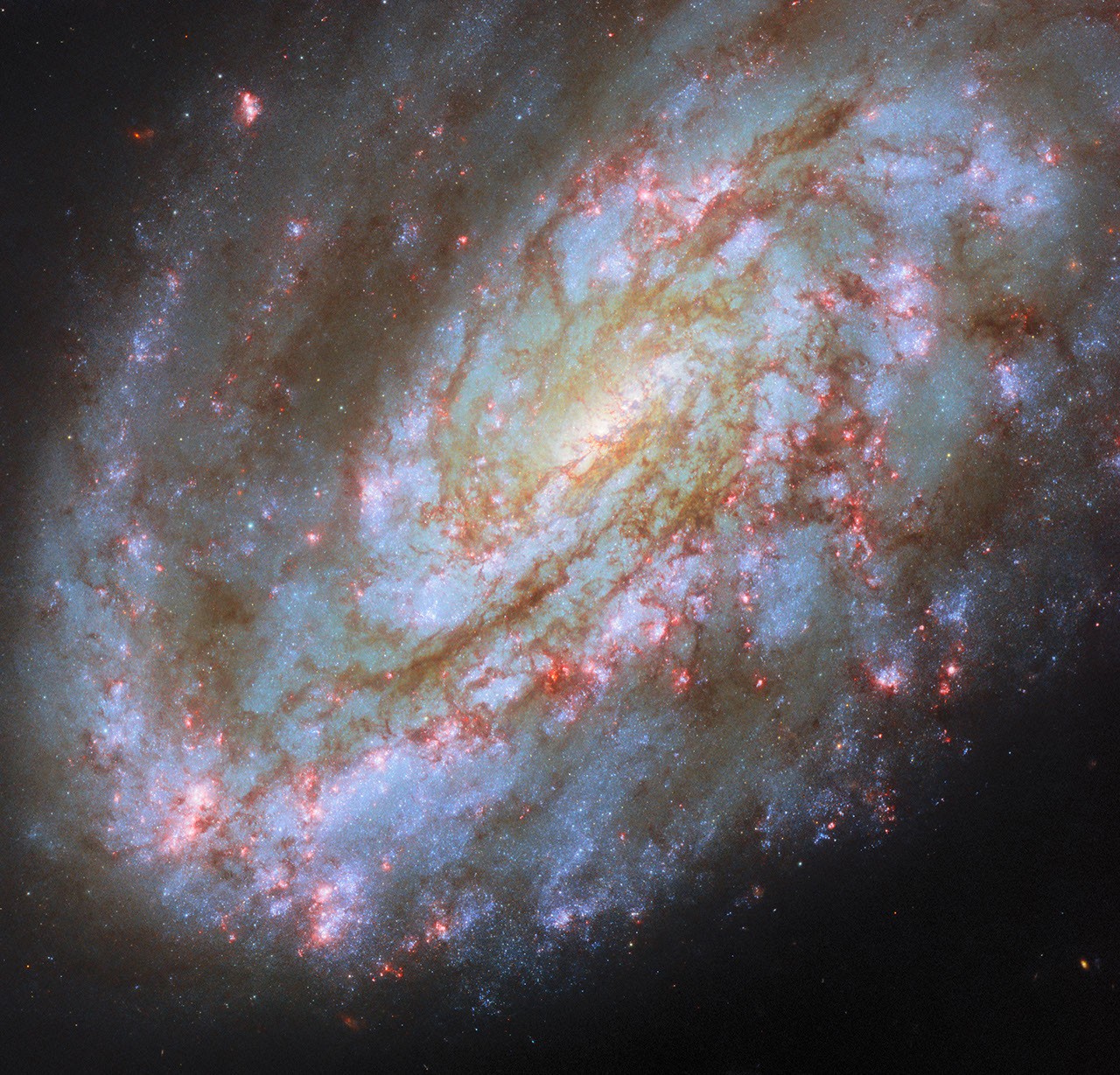
The NASA/ESA Hubble Space Telescope has captured a striking image of NGC 4654, an intermediate spiral galaxy locked in a dramatic cosmic struggle. Located 72 million light-years away in the heart of the Virgo Cluster, this galaxy is a compelling subject for astronomers studying the dynamic interactions that shape celestial structures on grand scales. The image reveals a galaxy that is far from serene, displaying a pronounced asymmetry and a spectacular tail of gas, testament to the powerful forces at play within this dense galactic environment.
The Forces of Galactic Transformation
NGC 4654’s designation as an "intermediate" spiral galaxy signifies its position between galaxies with prominent central bars and those without. It possesses a subtle bar structure at its core, but its most arresting feature is its pronounced asymmetry. One side of the galaxy presents a rounded, well-defined edge, while the opposite flank is dramatically elongated by a vast tail of gas extending far beyond the telescope’s field of view.
This striking gaseous appendage is the direct consequence of ram pressure stripping. As NGC 4654 traverses the Virgo Cluster at high velocity, it encounters and ploughs through the intensely hot, tenuous gas that permeates the space between galaxies – a substance known as the intracluster medium. This intergalactic gas exerts a powerful "ram pressure" on the galaxy, akin to the drag experienced by an object moving through a fluid. This pressure compresses the leading edge of NGC 4654, while simultaneously sweeping away its own gas, stretching it out into the observed tail. This process effectively acts as a cosmic broom, sweeping the galaxy clean of its interstellar gas.
A Tale of Two Galactic Encounters
The asymmetry in NGC 4654 is not solely a product of ram pressure stripping; its stellar distribution also bears the marks of cosmic encounters. While the spiral arm facing the direction of the galaxy’s motion is abundant with stars and gas, the opposing arm is notably deficient. This uneven distribution of stars contributes significantly to the galaxy’s lopsided appearance.
Astronomers hypothesize that ram pressure alone is unlikely to account for this specific stellar deficiency. Instead, they propose that NGC 4654 was also influenced by the gravitational pull of a neighboring galaxy within the Virgo Cluster, specifically NGC 4639. Although these two galaxies are now separated by a considerable distance, evidence suggests that a close gravitational encounter, or "fly-by," approximately 500 million years ago, played a crucial role. During this interaction, the gravitational forces would have ripped away gas from one side of NGC 4654, thereby suppressing star formation in that region and contributing to the galaxy’s current asymmetric stellar population and overall shape.
Star Formation in the Face of Adversity
A common consequence of ram pressure stripping is a significant reduction in a galaxy’s star formation rate. The cold gas within galaxies is the fuel for stellar birth, and when this gas is stripped away, the process of star formation is curtailed. However, NGC 4654 presents a compelling counterpoint to this general trend.
Despite the ongoing ram pressure and the effects of past gravitational interactions, NGC 4654 continues to form stars at a remarkable rate, producing the equivalent of nearly two Sun-like stars annually. This rate is comparable to that of other galaxies of similar size, indicating a resilience in its star-forming processes.
The latest Hubble data incorporated into this image vividly showcases this active star formation. The telescope’s observations, specifically tuned to detect wavelengths of red light emitted by energized gas clouds, highlight regions where new stars are actively being born. Across NGC 4654, bright pink bubbles are visible, punctuating its forward spiral arm, its weak central bar, and extending to the edges of its disk. These luminous nebulae are nurseries for nascent stars, shining brightly as they emerge into the cosmos.
Scientific Inquiry and Observational Programs
The data utilized in this image originates from two dedicated Hubble observing programs: Program #15654 and Program #17502. Both initiatives share a common scientific objective: to establish a direct correlation between the gas content of galaxies and their star formation activity. By focusing on prominent galaxies in our cosmic neighborhood, including those within the Virgo Cluster, researchers aim to deepen their understanding of the intricate processes governing galactic gas dynamics.
Key questions being addressed by these programs include:
- Gas Kinematics: How does gas move within galaxies? Understanding the velocities and trajectories of gas is crucial for comprehending its role in galactic evolution.
- Star Formation Triggers: Where and when does this gas collapse under gravity to form new stars and star clusters? Identifying the specific conditions that initiate star birth is a fundamental goal.
- Stellar Feedback: What impact do newly formed stars have on the surrounding gas? Massive stars, for instance, can inject energy and heavy elements back into the interstellar medium, influencing subsequent generations of star formation.
By meticulously analyzing the gas and star formation properties of galaxies like NGC 4654, scientists hope to build a more comprehensive model of galactic evolution, applicable across a wide range of cosmic environments.
The Virgo Cluster: A Cosmic Metropolis
The Virgo Cluster is not merely a backdrop for NGC 4654’s drama; it is a significant celestial entity in its own right. As one of the closest and most massive galaxy clusters to our own Milky Way, it serves as a vital laboratory for studying the behavior of galaxies in dense environments. The cluster contains over 2,000 galaxies, ranging from giant elliptical galaxies to smaller dwarf galaxies, all bound together by gravity.
The sheer density of galaxies within the Virgo Cluster amplifies the effects of gravitational interactions and ram pressure stripping. Galaxies within the cluster are in constant motion, often on trajectories that lead to close encounters with their neighbors. This dynamic environment is responsible for shaping the morphology and evolutionary pathways of its constituent galaxies.
Broader Implications for Galactic Evolution
The study of NGC 4654 offers valuable insights into the diverse mechanisms that drive galactic evolution. While galaxies in less crowded regions of the universe may evolve more gradually, those residing in dense clusters like Virgo experience a more tumultuous existence.
The resilience of NGC 4654’s star formation in the face of intense stripping highlights the complex interplay between galactic gas reservoirs and the processes that can deplete them. It suggests that even under significant environmental pressure, galaxies can retain enough fuel to continue creating new generations of stars, albeit potentially at altered rates or with modified stellar populations.
Furthermore, the combined influence of ram pressure and gravitational interactions, as observed in NGC 4654, underscores the multifaceted nature of galactic evolution. Galaxies are not isolated entities; their development is intricately linked to the presence and behavior of their cosmic neighbors. The ongoing research utilizing Hubble data from this galaxy and others like it will continue to refine our understanding of these fundamental cosmic processes.
A Legacy of Discovery: The Hubble Space Telescope
The Hubble Space Telescope, a joint project of NASA and the European Space Agency (ESA), has been observing the universe for over three decades. Its unparalleled resolution and sensitivity have revolutionized our understanding of cosmology, galaxy formation, and the life cycles of stars. Images like the one of NGC 4654 are not just aesthetically captivating; they are critical scientific data points that enable astronomers to probe the most fundamental questions about the universe.
The data captured by Hubble allows for detailed analysis of galactic structures, gas composition, stellar populations, and the dynamics of cosmic interactions. The programs focused on NGC 4654 are a testament to Hubble’s enduring capability to provide the high-quality observations needed to unravel the complexities of galactic evolution.
As the scientific community continues to analyze the wealth of data provided by Hubble, galaxies such as NGC 4654 serve as vivid examples of the dynamic and ever-changing nature of the cosmos, revealing the intricate dance of forces that sculpt the universe we inhabit.