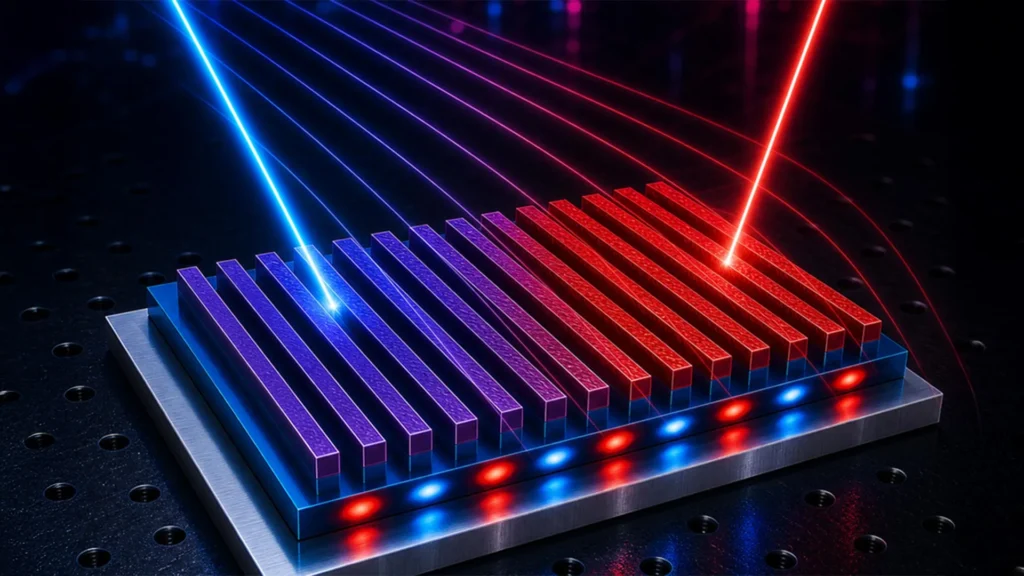
For over a century and a half, the fundamental laws of thermodynamics have dictated a rigid symmetry in how objects interact with thermal energy. According to Kirchhoff’s Law of Thermal Radiation, formulated in 1860, the ability of a material to absorb energy at a specific wavelength and angle is inherently tied to its ability to emit energy under those same conditions. This principle, known as reciprocity, has long been viewed as an unbreakable constraint in materials science, forcing engineers to accept that any surface designed to be an efficient absorber of heat would inevitably be an equally efficient emitter. However, an international research team led by Professor Koichi Okamoto and Dr. Shunsuke Murai of the Graduate School of Engineering at Osaka Metropolitan University has successfully challenged this paradigm. By developing a sophisticated device that utilizes magneto-optical materials and phase-change alloys, the team has demonstrated a method to decouple absorption and emission, effectively "programming" heat radiation for the first time.
The Scientific Challenge: Breaking Kirchhoff’s Law
The concept of reciprocity is not merely a theoretical observation but a practical hurdle in thermal management. In traditional systems, if a material is optimized to harvest heat from the sun or an industrial furnace, it simultaneously loses a significant portion of that energy by radiating it back toward the source. This bidirectional flow limits the efficiency of energy conversion devices, such as thermophotovoltaic cells, and complicates the cooling of sensitive electronic components.
To break this symmetry, scientists must introduce "non-reciprocity." Historically, this has required the use of strong magnetic fields or complex topographical structures that only function at extreme, "grazing" angles. These limitations made previous non-reciprocal devices impractical for real-world applications, as they were inefficient at normal incidence—the straight-on angle where most energy transfer occurs. The breakthrough by the Osaka Metropolitan University team represents a shift toward "smart" thermal materials that can operate efficiently at standard angles and retain their functional states without a constant power supply.
Innovation through Material Synergy: Magneto-Optics and GST
The core of the researchers’ success lies in a hybrid device architecture that combines two distinct classes of advanced materials: magneto-optical materials and a phase-change material known as Ge2Sb2Te5, or GST.
Magneto-optical materials are unique because their optical properties—how they reflect, absorb, or transmit light—change when they are exposed to an external magnetic field. By applying a magnetic field to the device, the researchers could break the time-reversal symmetry of the photons interacting with the surface. This allows the material to "distinguish" between incoming and outgoing thermal radiation, creating a one-way street for heat.
However, the team went a step further by integrating GST. GST is a chalcogenide glass widely used in optical disc technology (such as rewritable DVDs) and modern non-volatile electronic memory (Phase-Change RAM). It can switch between an amorphous state, where atoms are disordered, and a crystalline state, where atoms are highly ordered. This transition is triggered by temperature or electrical pulses and, crucially, is non-volatile—meaning the material stays in its new state even after the trigger is removed.
By pairing these two materials, the researchers created a device that is not only non-reciprocal but also programmable. The GST component acts as a "memory" for the thermal configuration, while the magneto-optical component provides the active control over the direction of radiation.
Chronology of Development and Experimental Milestones
The path to this discovery was built on decades of theoretical physics and recent advancements in nanofabrication.
- Theoretical Foundations (1860–2000s): For nearly 150 years, Kirchhoff’s Law remained the undisputed standard. It wasn’t until the early 21st century that theorists began proposing that magnetic fields could break this symmetry in thermal radiation.
- First Experimental Proofs (2010–2018): Various global research groups demonstrated non-reciprocal radiation using large, laboratory-grade magnets and specialized crystals. However, these experiments were limited to extreme angles of incidence, often exceeding 80 degrees, which meant the total amount of energy being manipulated was negligible.
- The Osaka Metropolitan University Initiative (2021–2023): Professor Okamoto and Dr. Murai began investigating how to achieve non-reciprocity at "normal incidence" (0 to 10 degrees). Their goal was to make a device that could be integrated into flat-panel electronics or sensors.
- Integration of GST (2023): The team successfully layered the magneto-optical material with a thin film of GST. This allowed them to "switch" the thermal behavior of the device by changing the phase of the GST, adding a layer of control that previous designs lacked.
- Successful Demonstration (2024): The team published their findings, showing that the device could maintain its thermal-control state even after power was disconnected, marking the birth of "photonic thermal memory."
Comparative Performance and Supporting Data
The performance of the new device significantly outclasses previous iterations in several key metrics. According to the research data, the device exhibits high efficiency at normal incidence, a feat that had eluded previous scientists.
In earlier designs, the non-reciprocal effect was only observable when light hit the surface at a very steep angle. This resulted in a "diluted" effect, as the surface area exposed to the radiation at such angles is minimal. The Osaka team’s device, however, maintains its directional control even when radiation is perpendicular to the surface. This maximizes the volume of heat that can be managed.
Furthermore, the "switching" capability represents a major leap in reliability. Previous experimental systems often suffered from "drift," where the material’s properties would slowly revert to a neutral state. The inclusion of GST ensures a stable, binary "on/off" state. When the GST is in its crystalline phase, the device behaves one way; when it is amorphous, it behaves another. This stability is critical for industrial applications where consistent performance over thousands of hours is required.
Official Responses and Scientific Impact
The lead researchers have expressed high expectations for the technology’s integration into the broader tech ecosystem. Dr. Shunsuke Murai emphasized the "intelligence" of the new material, noting that heat radiation is no longer a passive process but an active, manageable one. "Achieving these capabilities in a working model could enable a new generation of efficient infrared emitters, thermal-energy devices, sensors, and photonic memory technologies," Dr. Murai stated.
Professor Koichi Okamoto highlighted the ultimate vision of the project: the convergence of thermal management and electronic logic. "Our ultimate goal is to develop compact devices that can actively control heat radiation, much like electronic circuits control the flow of electricity," Okamoto said.
Industry analysts suggest that this technology could be particularly transformative for the semiconductor industry. As chips become smaller and more powerful, managing the "waste heat" they generate has become the primary bottleneck for performance. A material that can "pump" heat away from a processor in one direction while preventing ambient heat from returning could allow for a new era of high-speed computing.
Analysis of Broader Implications and Future Applications
The ability to program heat radiation has implications that extend far beyond simple cooling. The most immediate impact will likely be seen in four major sectors:
1. Advanced Infrared Sensing and Stealth
Current infrared sensors are often limited by the background noise of their own thermal emissions. A non-reciprocal material could allow a sensor to absorb infrared signals from the environment without emitting its own thermal signature in that same direction. This has profound implications for both civilian search-and-rescue equipment and military stealth technology.
2. High-Efficiency Energy Conversion
In thermophotovoltaic (TPV) systems, heat is converted into electricity using PV cells. A major source of efficiency loss is the radiation that bounces back from the cell to the heat source. By using a non-reciprocal emitter, engineers can ensure that heat flows only toward the cell, potentially doubling the efficiency of these systems and making portable thermal power generators a reality.
3. Photonic Memory and Computing
The "memory" aspect of the GST-integrated device opens the door to photonic computing. Instead of using electrical charges to store bits (0s and 1s), computers could use the thermal state of a material. Because this device is non-volatile and can be controlled with light and magnetic fields, it offers a pathway toward "green" computing with lower energy requirements than traditional silicon-based RAM.
4. Space Exploration
In the vacuum of space, radiation is the only way to shed heat. Spacecraft currently use heavy, complex louvers and heat pipes to manage temperature. A lightweight, programmable film that can change its emissivity on demand—and "remember" that setting without using power—would revolutionize the thermal design of satellites and long-range probes.
Conclusion: Toward a Thermal Circuit Revolution
The work of the Osaka Metropolitan University team signifies a transition from the era of "passive" thermal management to "active" thermal logic. By breaking the 160-year-old shackles of reciprocity, they have provided a blueprint for devices that treat heat with the same precision we treat electrons. While the technology is currently in the experimental phase, the move toward normal-incidence efficiency and non-volatile memory suggests that commercial applications may be on the horizon. As the world seeks more efficient ways to manage energy and store data, the ability to "program" heat may become as fundamental to the 21st century as the transistor was to the 20th.