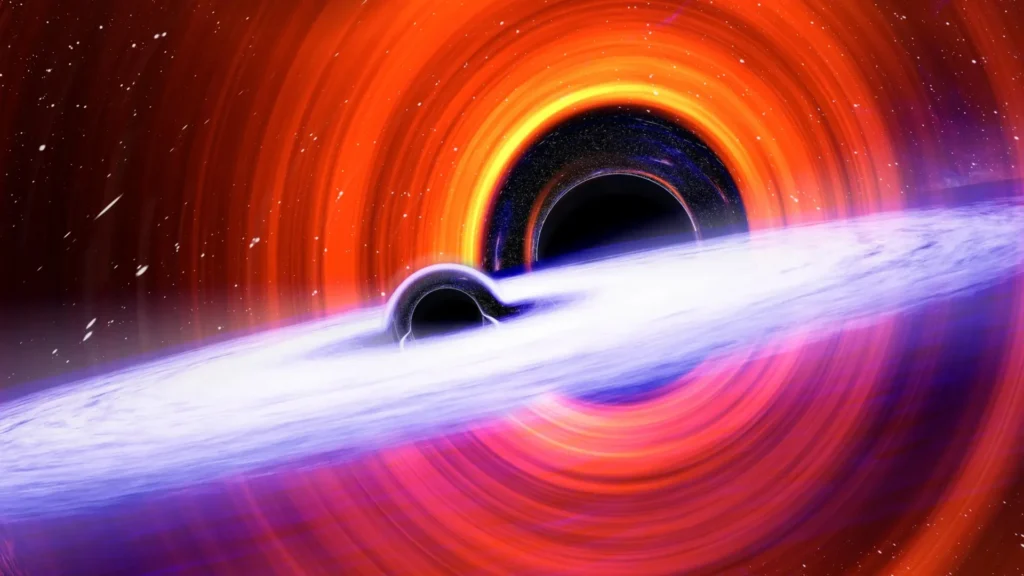
A potential paradigm shift in our understanding of the cosmos is unfolding as researchers at the University of Miami provide new evidence that could validate one of the most enduring theories in astrophysics. By analyzing a recent and highly unusual gravitational wave detection, scientists suggest that the universe may be populated by primordial black holes—objects formed in the chaotic moments following the Big Bang. If confirmed, this discovery would not only rewrite the history of the early universe but also provide a definitive answer to the nature of dark matter, the invisible scaffolding that holds the galaxy together.
The research, led by Nico Cappelluti, an associate professor in the University of Miami’s Department of Physics, and Ph.D. student Alberto Magaraggia, focuses on a signal captured by the Laser Interferometer Gravitational-Wave Observatory (LIGO). The signal suggests the existence of a black hole with a mass smaller than that of our Sun, a phenomenon that defies the standard models of stellar evolution. This finding, recently published in The Astrophysical Journal, adds significant weight to the hypothesis that black holes are not merely the remnants of dead stars, but ancient relics of the birth of time itself.
The Nature of Primordial Black Holes
To understand the significance of this discovery, one must distinguish between the black holes commonly discussed in astronomy and their primordial counterparts. Most known black holes are "stellar-mass" black holes, created when a massive star—at least 20 times the mass of the Sun—exhausts its nuclear fuel and collapses under its own gravity. This process typically results in a black hole with a minimum mass of approximately three times that of the Sun.
Primordial black holes (PBHs), however, are purely theoretical constructs—at least until now. They are hypothesized to have formed within the first fraction of a second after the Big Bang. During this epoch, the universe was an incredibly dense, hot plasma. Physical fluctuations in the density of this "primordial soup" could have caused certain regions to collapse directly into black holes without the need for a precursor star. Because they formed before the era of nucleosynthesis (the creation of the first atomic nuclei), PBHs could theoretically exist in any size, from the mass of an asteroid to thousands of times the mass of the Sun.
The University of Miami study posits that if these objects exist, they would be scattered throughout the universe, serving as the "missing link" in our understanding of cosmic structure.
The Anomalous LIGO Signal: A Smoking Gun?
The catalyst for this renewed interest is an automated alert issued by the LIGO-Virgo-Kagra (LVK) collaboration in late 2023. The detectors, which pick up "chirps" or ripples in spacetime caused by the collision of massive objects, recorded a merger event involving at least one object with a mass significantly lower than one solar mass.
In the standard astrophysical model, a black hole cannot form from a star if it is that small. Even neutron stars, the densest known objects short of black holes, have a lower mass limit of about 1.1 to 1.4 solar masses (the Chandrasekhar limit). Finding a "subsolar" black hole is, therefore, an indicator that the object did not originate from a star.
"The most common black holes form as the result of a supernova, the death of a massive star," Cappelluti explained. "But a merger involving an object with less than one solar mass points toward something much more exotic. Our study suggests that the most plausible explanation for this signal, which lacks any conventional astrophysical explanation, is the detection of a primordial black hole."
While some members of the scientific community remain skeptical, suggesting the signal could be a result of instrumental "glitches" or noise in LIGO’s hyper-sensitive vacuum arms, Cappelluti and Magaraggia’s statistical analysis suggests otherwise. They calculated the frequency of such events and found that the rarity of the signal aligns perfectly with the predicted distribution of primordial black holes in the universe.
Solving the Dark Matter Conundrum
The implications of confirming PBHs extend far beyond the classification of black holes. For decades, physicists have been haunted by the "dark matter" problem. Observations of rotating galaxies and the cosmic microwave background indicate that visible matter—stars, planets, gas, and dust—accounts for only about 15 percent of the total matter in the universe. The remaining 85 percent is "dark matter," a substance that does not emit, absorb, or reflect light, and is detectable only through its gravitational influence.
For years, the leading candidates for dark matter were WIMPs (Weakly Interacting Massive Particles). However, decades of underground experiments have failed to detect a single WIMP. This has led many scientists to reconsider "MACHOs" (Massive Compact Halo Objects), of which primordial black holes are a prime candidate.
"Our research indicates that these primordial black holes could account for a significant portion, if not all, of dark matter," said Cappelluti. If the universe is indeed filled with a "population" of small, ancient black holes, their collective gravity would provide the exact amount of "missing" mass required to explain why galaxies stay intact and how the cosmic web formed.
A Chronology of Discovery and Theory
The journey to this potential discovery spans more than half a century of theoretical physics and engineering:
- 1966: Soviet physicists Yakov Zeldovich and Igor Novikov first propose that the high density of the early universe could have produced black holes.
- 1971-1974: Stephen Hawking refines the theory, suggesting that PBHs could emit radiation (Hawking Radiation) and could potentially explain the dark matter mystery.
- 2015: LIGO makes the first-ever detection of gravitational waves from two merging stellar-mass black holes, proving that Einstein’s predictions were correct and providing a new tool to "hear" the universe.
- 2019-2021: LIGO begins detecting "intermediate-mass" black holes, which were previously thought to be rare, hinting that our understanding of black hole populations was incomplete.
- November 2023: LIGO detects the subsolar mass candidate, triggering the analysis by the University of Miami team.
- 2024: The Miami study is published, providing a statistical framework that links subsolar detections to the existence of PBHs and dark matter.
The Technical Challenge: Detecting the Invisible
The LIGO observatories—located in Hanford, Washington, and Livingston, Louisiana—are marvels of modern engineering. Each facility features L-shaped vacuum chambers with arms 2.5 miles (4 kilometers) long. Lasers are bounced between mirrors to measure changes in the length of these arms to a precision smaller than the width of an atomic nucleus.
Despite this sensitivity, LIGO has limitations. It was primarily designed to detect the high-frequency waves produced by the collisions of objects between 1 and 100 solar masses. To truly map the history of primordial black holes, scientists need to look further back in time and at different frequencies.
"LIGO picked up what is very strong evidence that these types of black holes exist," Cappelluti noted. "But we’ll need to detect another such signal or even several others to get the smoking-gun confirmation."
The Future of Gravitational Wave Astronomy
The scientific community is already preparing for the next generation of observatories that will either prove or disprove the PBH-dark matter connection.
One of the most anticipated projects is the European Space Agency’s Laser Interferometer Space Antenna (LISA). Scheduled for launch in 2035, LISA will consist of three spacecraft flying in a triangular formation millions of miles apart in space. Because it will be free from Earth’s seismic noise, LISA will be able to detect low-frequency gravitational waves, allowing it to "see" mergers from the very edge of the observable universe, dating back to the period just after the Big Bang.
In the United States, the proposed "Cosmic Explorer" project aims to build a ground-based detector ten times more sensitive than LIGO. This facility would be capable of detecting every black hole merger in the observable universe, providing a complete census of black hole populations and likely identifying more subsolar objects if they exist.
Scientific Analysis and Broader Implications
The confirmation of primordial black holes would represent a "Grand Slam" in physics. It would simultaneously validate a major prediction of early-universe cosmology, solve the dark matter mystery, and potentially provide insights into the nature of gravity itself.
If dark matter is composed of PBHs, it changes our search for new physics. Instead of looking for new subatomic particles in particle accelerators like the Large Hadron Collider, the focus would shift toward gravitational wave astronomy and high-energy astrophysics. Furthermore, it would prompt a re-evaluation of how the first stars and galaxies formed, as the presence of PBHs in the early universe would have acted as "seeds," pulling in gas and dust to accelerate the creation of the first cosmic structures.
However, the road ahead remains one of cautious optimism. "What is clear is that they cannot be excluded as being real," Cappelluti concluded. As LIGO continues its current observing run and planned upgrades increase its sensitivity, the "smoking gun" for primordial black holes may be just one more "chirp" away. For now, the University of Miami study stands as a vital roadmap for the next great discovery in our quest to understand the origin and composition of the cosmos.