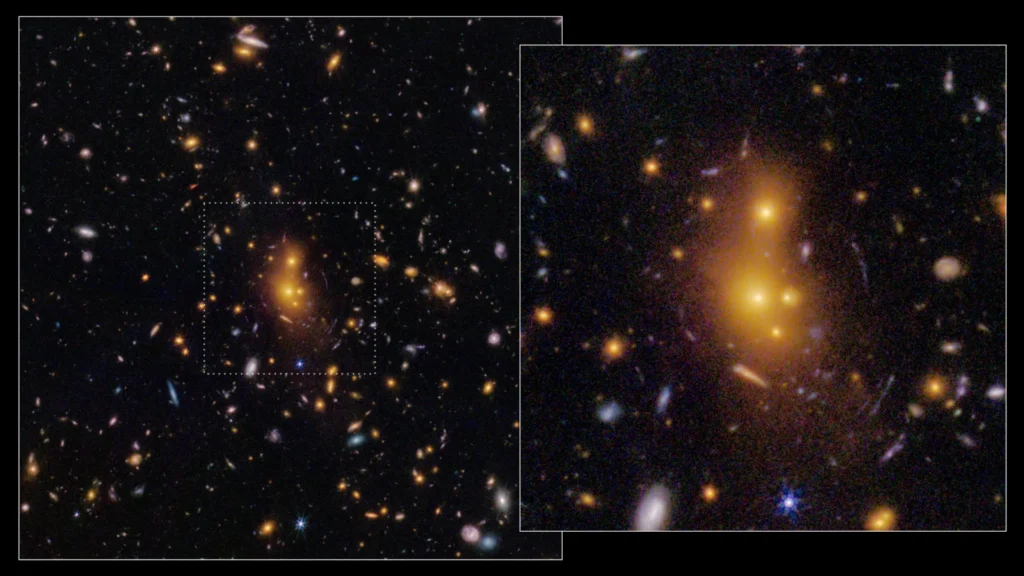
The cosmos has long been viewed as a structured tapestry that evolved gradually over billions of years, but new data from the James Webb Space Telescope (JWST) is forcing a significant reconsideration of the timeline governing the universe’s most massive structures. At the center of this scientific shift is XLSSC 122, a galaxy cluster located approximately 10.4 billion light-years from Earth. While its existence was known to astronomers for nearly a decade, recent high-resolution observations have revealed a level of maturity and mass concentration that defies the expectations of the standard cosmological model. The findings, presented by a team of researchers from IPAC at Caltech and Yonsei University during the 248th meeting of the American Astronomical Society on June 17, 2026, suggest that the early universe may have been far more efficient at assembling massive structures than previously theorized.
The Significance of XLSSC 122 in the Era of Cosmic Noon
XLSSC 122 dates back to a pivotal epoch known to astrophysicists as "cosmic noon." This period, occurring roughly 2 to 3 billion years after the Big Bang, represents the height of star formation in the history of the universe. During this era, galaxies were not the tranquil, slowly evolving systems we see in the local neighborhood today; instead, they were chaotic factories of stellar birth, churning out new stars at rates up to 100 times higher than those observed in the modern Milky Way.
In the standard hierarchical model of galaxy formation, clusters—which are the largest gravitationally bound structures in the universe—are expected to be in their infancy during cosmic noon. These structures typically grow by "cannibalizing" smaller groups of galaxies and slowly accumulating dark matter over billions of years. However, XLSSC 122 presents a paradox. Despite existing when the universe was less than a third of its current age, the cluster already exhibits a highly organized, "relaxed" appearance and a massive central concentration of matter usually found in clusters that have had much longer to stabilize. This discovery suggests that the "seeds" of the cosmic web may have grown with unexpected speed, potentially requiring a revision of the physics describing the early universe.
A Decade of Discovery: The Chronological Path to James Webb
The journey to understanding XLSSC 122 began long before the launch of the James Webb Space Telescope. The cluster was first identified in 2014 by the European Space Agency’s XMM-Newton spacecraft. Unlike optical telescopes, XMM-Newton looks for X-ray emissions, which are a primary signature of galaxy clusters. Clusters are filled with the Intracluster Medium (ICM)—a superheated plasma reaching temperatures of tens of millions of degrees. This gas glows brightly in X-rays, allowing astronomers to find clusters even when the individual galaxies within them are too faint to see.
Following the X-ray discovery, the Hubble Space Telescope was deployed to provide a more detailed look at the cluster’s optical and near-infrared characteristics. Hubble’s observations were instrumental in establishing the cluster’s distance at a redshift that corresponds to a light-travel time of 10.4 billion years. Hubble also confirmed that the cluster’s member galaxies appeared "red and dead," meaning they had already exhausted much of their star-forming gas—a trait usually reserved for much older clusters.
However, Hubble lacked the sensitivity to detect the more subtle signatures of the cluster’s total mass distribution. It was not until the James Webb Space Telescope turned its powerful gold-plated mirrors toward XLSSC 122 that the full extent of its gravitational influence became clear. JWST’s Near-Infrared Camera (NIRCam) captured unmistakable "lensing arcs"—streaks of light from even more distant galaxies that have been bent and magnified by the cluster’s immense gravity. This marked the first time strong gravitational lensing had been confirmed in a cluster at such an extreme distance, setting a new astronomical record.
The Mechanics of Gravitational Lensing: Mapping the Invisible
Gravitational lensing is one of the most powerful tools in the modern astronomer’s arsenal. Predicted by Albert Einstein’s General Theory of Relativity, the phenomenon occurs when a massive object, such as a galaxy cluster, acts like a giant magnifying glass. The mass of the cluster warps the very fabric of spacetime, causing the light from background objects to follow curved paths.
In the case of XLSSC 122, the cluster lies directly in front of one or more background galaxies. As the light from these background sources passes through the cluster’s gravitational field, it is distorted into elongated arcs. This is known as "strong lensing." By analyzing the curvature and brightness of these arcs, researchers can calculate the total mass of the cluster with incredible precision.
"When we got those first images back from JWST, we said, ‘wow, look at this, there’s strong lensing coming from this cluster!’" remarked Kyle Finner, a staff scientist at IPAC and the lead author of the primary study. The importance of this finding cannot be overstated: because lensing depends on the total mass—both visible and invisible—it allows scientists to map the distribution of dark matter.
The Dark Matter Mystery and Mass Concentration
The most startling revelation from the JWST data is the sheer concentration of mass at the cluster’s core. While XLSSC 122 contains hundreds of galaxies and vast reservoirs of hot gas, these "baryonic" (ordinary) components only account for a fraction of the gravity required to produce the observed lensing. The vast majority of the cluster’s mass is composed of dark matter, an elusive substance that does not emit, absorb, or reflect light.
Current cosmological simulations, such as the Lambda-Cold Dark Matter (ΛCDM) model, predict that dark matter should be more "puffy" or diffuse in the early universe. As time passes, gravity is supposed to pull this dark matter into tighter, more concentrated pockets. XLSSC 122, however, shows a central density that is significantly higher than what these models suggest should be possible 10 billion years ago.
This discrepancy suggests one of two things: either our understanding of the properties of dark matter is incomplete, or the processes that drive the collapse of matter into clusters were much more intense in the early universe than we currently believe. If the latter is true, it could mean that the universe was denser or that gravity acted more efficiently on large scales during the first few billion years after the Big Bang.
Intracluster Light: The Ghostly Glow of Galactic Mergers
Complementing the mass distribution studies, a third paper led by researchers at Yonsei University focused on "intracluster light" (ICL). This is a faint, diffuse glow found between the galaxies in a cluster. It is produced by "orphan stars"—stars that were violently stripped away from their parent galaxies during close encounters or collisions.
JWST’s sensitivity allowed the team to detect this ICL in XLSSC 122, marking the earliest such detection in the cosmic timeline. The researchers found that the shape and distribution of this faint light closely mirrored the distribution of the dark matter mapped through strong lensing.
"In this cluster, the intracluster light essentially traces the dark matter," Finner explained. This correlation is a breakthrough for observational cosmology. If ICL can be used as a reliable proxy for dark matter, astronomers can map the invisible "scaffolding" of the universe across different eras by simply looking for this faint stellar glow. Furthermore, the presence of the ICL suggests that XLSSC 122 is currently undergoing a merger. While the core is highly concentrated, the surrounding stars indicate that the cluster is still actively growing by incorporating new galaxies into its structure.
Broader Implications and the Future of Cosmological Research
The discovery of a "mature" and highly concentrated cluster like XLSSC 122 at such an early epoch raises fundamental questions about the "Standard Model" of cosmology. If XLSSC 122 is an outlier, it may simply be a rare statistical fluke. However, if more clusters like it are found, it could signal a "crisis in cosmology" similar to the current tensions regarding the Hubble constant (the rate at which the universe is expanding).
To resolve this, the research team is looking toward the next generation of wide-area surveys. While JWST provides unparalleled detail, its field of view is narrow, making it difficult to find new clusters. Instead, astronomers plan to use the Sunyaev-Zel’dovich (SZ) effect—a phenomenon where high-energy electrons in cluster gas interact with the Cosmic Microwave Background (CMB) radiation. This effect creates "shadows" or holes in the CMB maps, acting as a beacon for distant, massive clusters.
The goal is to identify dozens, or even hundreds, of clusters from the cosmic noon era. By building a larger statistical sample, scientists can determine if the high mass concentration seen in XLSSC 122 is a common feature of the early universe.
"It’s still early in the JWST era," Finner noted, emphasizing that the mission is only beginning to scratch the surface of the distant universe. As more data flows in, the story of how the universe grew from a smooth soup of particles into the complex web of galaxies we see today will likely continue to be rewritten. For now, XLSSC 122 stands as a silent, massive sentinel, challenging our theories and beckoning us to look deeper into the infrared shadows of the ancient past.