On August 12, 2026, a breathtaking celestial event will unfold as a total solar eclipse sweeps across parts of Europe, offering a rare and fleeting glimpse into the Sun’s enigmatic outer atmosphere, the solar corona. While this natural spectacle captivates skygazers, it also presents a critical opportunity for scientists to advance our understanding of the Sun and its profound impact on Earth. The European Space Agency (ESA) is at the forefront of this scientific endeavor, leveraging both groundbreaking space missions and sophisticated computational modeling to maximize the scientific return from this astronomical phenomenon.
The Rarity and Significance of Total Solar Eclipses
Total solar eclipses, where the Moon completely obscures the Sun’s bright disc, are infrequent occurrences. Globally, they happen roughly once or twice a year, but their visibility is limited to narrow paths across the Earth’s surface. These events are cherished not only for their visual grandeur but also for the unique scientific window they open. During totality, which lasts for a maximum of a few precious minutes, the Sun’s faint and ethereal corona becomes visible to the naked eye. This outer atmosphere is the birthplace of space weather – the dynamic phenomena originating from the Sun that can significantly influence our technological infrastructure.
The corona is where the solar wind, a constant stream of charged particles, accelerates outwards into the solar system. It is also the source of powerful solar flares and coronal mass ejections (CMEs), bursts of energy and plasma that can disrupt satellite communications, damage power grids, and pose risks to astronauts in space. For centuries, the limited duration of natural eclipses was the primary constraint on studying these crucial solar processes.
ESA’s Innovative Approach: Creating Artificial Eclipses
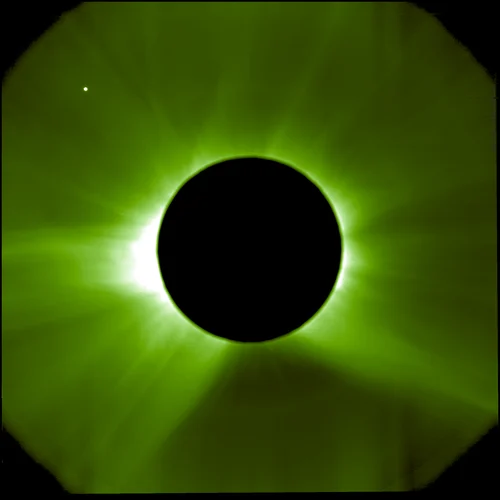
To overcome the limitations of natural eclipses, scientists have developed methods to simulate these events artificially. The core technology enabling this is the coronagraph, a specialized telescope equipped with a disc designed to block out the Sun’s direct light, thereby revealing the corona. However, traditional coronagraphs often struggle to capture detailed imagery of the inner corona, the region closest to the Sun’s surface.
ESA’s Proba-3 mission represents a significant leap forward in artificial eclipse technology. This innovative mission comprises a pair of satellites that operate in tandem, maintaining a precise 150-meter separation in orbit. One satellite, the “Occulter,” functions as the artificial Moon, precisely positioning itself to eclipse the Sun. The second satellite, equipped with the Advanced Spaceborne Polarimetric Coronagraph (ASPIICS) instrument, then captures detailed images of the solar corona for extended periods, often for hours at a time. This sophisticated system allows scientists to study the corona with unprecedented detail and duration, filling the observational gaps left by natural eclipses.
Proba-3: A Precursor to the August 12th Eclipse
The Proba-3 mission has been instrumental in advancing our understanding of the corona. Andrei Zhukov, principal investigator for the ASPIICS instrument at the Royal Observatory of Belgium, highlighted the mission’s recent achievements. He noted that one of Proba-3’s recent artificial eclipses, captured approximately two weeks before the upcoming natural eclipse on August 12th, provided valuable predictive data. Zhukov explained, "It takes the Sun two weeks to rotate halfway around its axis, so if we mirror the image horizontally, we get a prediction of what the corona will look like during the natural eclipse seen from Earth two days from now. The overall large-scale coronal structure usually doesn’t change much during that time.” This capability allows scientists to prepare for and interpret observations of natural eclipses with greater accuracy.
Solar Orbiter: A Unique Perspective on Solar Activity

Complementing the work of Proba-3, ESA’s Solar Orbiter mission is undertaking a dedicated observation campaign in the lead-up to the August 12th eclipse. Solar Orbiter follows a unique orbital path around the Sun, offering a perspective distinct from other solar observatories located closer to Earth. This allows it to observe regions of the Sun that are not yet facing Earth, providing crucial data for predictive modeling.
During total solar eclipses, the structures visible in the corona are shaped by the Sun’s magnetic field. This presents a vital opportunity to validate and refine the computer simulations used to model the Sun’s magnetic environment. Jorge Amaya, ESA’s Space Weather Modelling Coordinator, emphasized the importance of this validation process: "A total solar eclipse lets us verify that our models are correct by comparing forecasts with actual observations."
Solar Orbiter’s Polarimetric and Helioseismic Imager (PHI) instrument is particularly valuable. It captures magnetic maps (magnetograms) of the Sun’s visible surface from its unique vantage point. These data provide modellers with a more comprehensive three-dimensional understanding of the Sun’s magnetic field. For instance, PHI recently detected a newly emerging active region on the Sun, which is expected to influence the appearance of the corona during the upcoming eclipse. "The magnetic field lines that we see in simulations are like hairs in a fuzz ball," Amaya added. "Observing the Sun from multiple viewpoints allows us to determine their orientation in three dimensions. That is the key to dramatically improving forecasts of how solar activity will affect our technology."
The data gathered by Solar Orbiter today offers a preview of what ESA’s future space weather forecasting mission, Vigil, will observe. Vigil, scheduled for launch in 2031, will maintain a position trailing Earth, providing continuous, near real-time monitoring of the Sun’s side.
Miho Janvier, ESA’s project scientist for both Proba-3 and Solar Orbiter, underscored the synergistic nature of these missions: "With Proba-3 and Solar Orbiter, we have an unprecedented view of our star. Both missions are contributing to our understanding of the Sun, from its surface to its extended atmosphere. The upcoming total solar eclipse offers a chance to see how this knowledge comes together, comparing observations with modelling.”
Timeline of Scientific Preparations and Observations
The scientific community has been meticulously preparing for the August 12, 2026, total solar eclipse for months, with coordinated efforts involving ground-based observations, space missions, and theoretical modeling.
-
Pre-Eclipse Period (Months to Weeks Before August 12, 2026):
- Proba-3 Operations: ESA’s Proba-3 mission has been conducting regular artificial eclipses to gather continuous data on the solar corona, refining models and providing predictive insights. Artificial eclipses prior to the natural event are crucial for calibrating instruments and testing observational strategies.
- Solar Orbiter Campaign: The Solar Orbiter mission initiated a comprehensive observation campaign, focusing its instruments, including PHI, on regions of the Sun expected to be visible during the eclipse. This includes mapping magnetic fields and identifying active regions that could influence coronal structures.
- Predictive Modeling: Scientific institutions like Predictive Science Inc. and KU Leuven have been developing sophisticated computer models to predict the appearance of the solar corona during the eclipse. These models integrate data from various sources, including Solar Orbiter magnetograms and solar wind observations.
-
August 10-11, 2026 (Two Days Prior to Eclipse):
- Final Model Refinements: Scientists are comparing the latest real-time solar data with their predictions, making final adjustments to forecasts. The mirroring of Proba-3 data from two weeks prior provides a key benchmark.
-
August 12, 2026 (Eclipse Day):
- Natural Eclipse Observation: As the Moon traverses its path across Europe, observers on the ground and participating scientists will witness the total solar eclipse.
- Ground-Based Telescopes: A network of telescopes, both professional and amateur, will be deployed to capture high-resolution images and spectroscopic data of the corona during totality.
- Solar Orbiter’s Role: Solar Orbiter’s unique vantage point will provide complementary observations, allowing for a 3D reconstruction of coronal structures.
- Proba-3’s Support: While not directly observing the natural eclipse, Proba-3 continues its artificial eclipses, providing baseline data and long-term context for the phenomena observed on August 12th.
-
Post-Eclipse Analysis (Weeks to Months Following August 12, 2026):

- Data Integration: Scientists will meticulously analyze the vast datasets collected from ground-based observatories, Solar Orbiter, and Proba-3.
- Model Validation: The collected observations will be rigorously compared against theoretical predictions to assess the accuracy of current solar models and identify areas for improvement.
- Space Weather Forecasting Enhancement: Insights gained from the eclipse will contribute to more accurate forecasting of space weather events, bolstering the capabilities of future missions like Vigil.
Virtual Totality and Public Engagement
Recognizing that not everyone will be able to witness the eclipse firsthand, ESA is facilitating virtual observation opportunities. The agency is collaborating with Predictive Science Inc. to provide access to their latest eclipse predictions, allowing the public to visualize what the Sun’s corona will look like. These predictions are accessible through interactive online platforms.
Furthermore, KU Leuven is contributing to ESA’s Space Weather Office with their own eclipse predictions, offering another avenue for the public to engage with the event. These virtual totality initiatives aim to democratize access to scientific understanding and inspire interest in space science.
Live Broadcast and Safety Guidance
For those unable to experience the eclipse in person, ESA will be hosting a live broadcast on August 12th between 19:30 and 20:45 CEST. This broadcast will offer a professionally curated view of the celestial event, accompanied by expert commentary.
Crucially, ESA emphasizes the paramount importance of eye safety when observing a solar eclipse. Looking directly at the Sun without adequate protection can lead to severe and permanent eye damage. Standard sunglasses are entirely insufficient for eclipse viewing. Certified eclipse glasses that meet international safety standards are essential for observing the partial phases of the eclipse. It is only during the brief period of totality, when the Sun is completely obscured by the Moon, that it is safe to look directly without protection. As soon as the Sun begins to reappear, eclipse glasses must be worn again. Detailed safety guidelines are available through ESA’s CESAR (The European Space Agency’s Children’s Educational Resources and Activities) program.
The Broader Impact: Protecting Our Technological Future
The scientific endeavors surrounding the August 12, 2026, total solar eclipse extend far beyond satisfying astronomical curiosity. Understanding the Sun’s corona and the space weather it generates is critical for safeguarding our increasingly technology-dependent society. Disruptions caused by solar activity can lead to widespread power outages, communication blackouts, and the failure of critical satellite systems that underpin modern life, from navigation and weather forecasting to financial transactions and global communication networks.
By combining the unique capabilities of missions like Proba-3 and Solar Orbiter with advanced computational modeling and the rare opportunity presented by a natural total solar eclipse, ESA and its international partners are building a more robust understanding of our Sun. This knowledge is not merely academic; it is essential for developing more accurate space weather forecasts, enabling us to better predict and mitigate the impacts of solar events on Earth and in space, thus ensuring the resilience of our technological infrastructure for the future. The August 12th eclipse, therefore, represents a significant milestone in this ongoing quest to comprehend and coexist with our star.