The long-standing principle of "what you see is what you get" in software engineering, where the editing interface mirrors the final output, has found a new frontier in 3D design with the advent of InstructMesh. This groundbreaking approach, developed by a collaborative effort between researchers at MIT’s Computer Science and Artificial Intelligence Laboratory (CSAIL), Google, and Northeastern University, promises to bridge the gap between generative artificial intelligence’s creative potential and the practical demands of real-world functionality in 3D printed objects.
Traditionally, generative AI systems for 3D printing have excelled at producing visually impressive designs based on textual or image prompts. However, these AI models often lack a fundamental understanding of how objects function in the physical world. This disconnect can lead to aesthetically pleasing but entirely impractical creations – a mug that cannot hold liquid, a chair that would buckle under weight, or a robot with components that cannot connect. This inherent limitation has been a significant hurdle for widespread adoption of AI in functional 3D design, particularly for users without extensive expertise in 3D modeling software, who find it challenging to identify and rectify these functional flaws.
InstructMesh directly addresses this critical challenge by introducing an AI-driven interface that not only understands how designs should look but also learns to interpret user intent for functional refinement. This empowers both novice and expert users to generate 3D designs for a diverse range of items, from everyday household objects and accessories to intricate robotic enclosures, with a significantly higher likelihood of producing functional end products.
The Genesis of InstructMesh: A Collaborative Endeavor
The development of InstructMesh is rooted in a desire to combine the burgeoning capabilities of 3D generative models with the sophisticated reasoning power of large language models (LLMs). The project leverages Microsoft’s TRELLIS system, a powerful engine capable of generating 3D models from textual and visual inputs, and integrates it with GPT-4, the advanced LLM that underpins technologies like ChatGPT. This synergistic combination of visual and textual knowledge is at the core of InstructMesh’s ability to interpret complex prompts and generate designs that are both creative and functional.
Faraz Faruqi, lead author of the paper presenting the project and a graduate student from MIT’s Department of Electrical Engineering and Computer Science, articulated the vision behind InstructMesh: "We wanted to bring together the talents of 3D generators and the reasoning skills of LLMs in an interactive space to make objects that people actually want. Language models are great at text and images, while TRELLIS’s talent lies in its ability to create 3D models, since it’s seen so many." This sentiment underscores the project’s ambition to create a more intuitive and effective design pipeline.
Demonstrating Creative and Functional Prowess
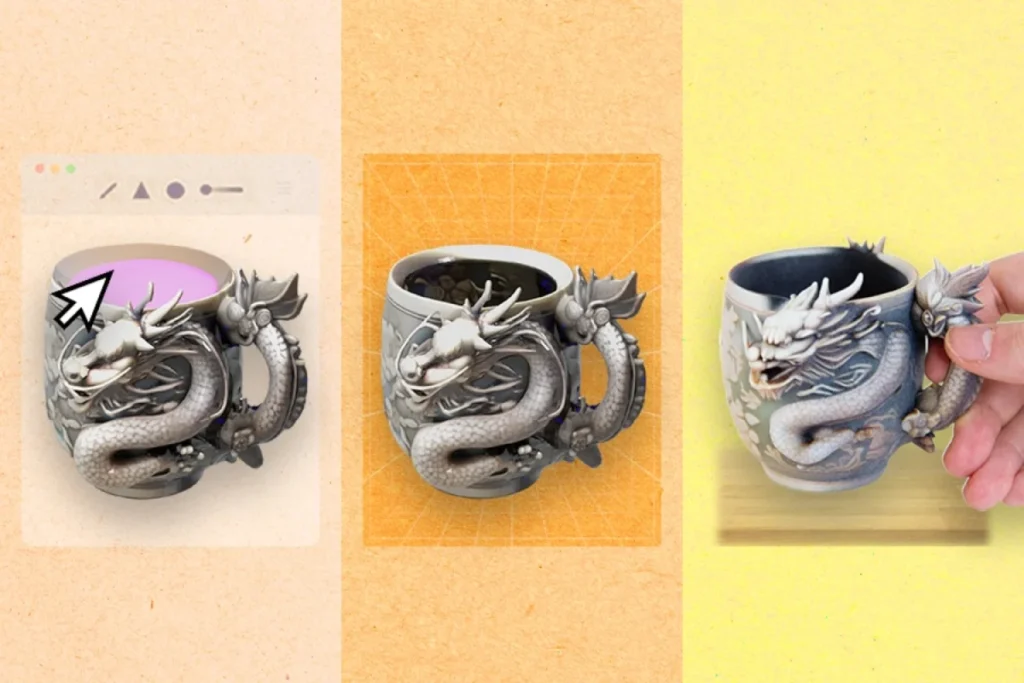
The capabilities of InstructMesh have been showcased through a series of compelling examples. Researchers have used the tool to reimagine common objects with a distinct creative flair. One notable creation is a mug seemingly enveloped by a dragon, with its tail ingeniously forming the handle. Another example is a shiny blue whistle designed to resemble a seashell, and a pair of eyeglasses adorned with delicate butterfly wings extending from just above the lenses. Demonstrating its versatility, InstructMesh also produced an octopus-like dispenser designed to simultaneously pour liquids from its tentacles into multiple cups, highlighting its capacity for complex, multi-functional designs.
Beyond purely aesthetic creations, InstructMesh has proven its mettle in more practical applications. The researchers utilized the system to fabricate a custom knee brace designed to mimic the appearance of denim, allowing it to seamlessly match a patient’s jeans. This application highlights the tool’s potential for personalized medical devices that also prioritize aesthetic integration.
Furthermore, InstructMesh has shown promise in the realm of robotics, specifically in the creation of functional enclosures for wireless components. As a demonstration, the team designed and fabricated a "bristle bot" that resembles a colorful shrimp. This small, mobile robot, powered by a hidden motor, is capable of sliding across surfaces, akin to a wind-up toy, showcasing InstructMesh’s ability to generate complex mechanical components within an imaginative design.
Addressing Functional Deficiencies: A Novel Approach to User Interaction
A significant challenge in AI-driven 3D design has been the difficulty in identifying and rectifying functional flaws. InstructMesh tackles this by enabling users to interact with the AI-generated models in a more granular and intuitive manner. Users can prompt the system to generate a 3D design, for instance, a pair of glasses, and then have the ability to highlight specific parts of the blueprint they wish to refine before proceeding to 3D printing. This interactive feedback loop is crucial for ensuring that the final object meets both aesthetic and functional requirements.
To rigorously test the system’s effectiveness in identifying design flaws, the researchers employed a unique methodology. They tasked TRELLIS with recreating popular 3D models sourced from Thingiverse, a vast online repository of 3D printable designs. The results were telling: approximately 80% of the AI-generated models exhibited some form of structural flaw. Following this, the CSAIL researchers engaged individuals with no prior 3D modeling experience to identify and correct these errors using InstructMesh. Remarkably, these novices were able to accurately detect and rectify these design flaws in about 90% of the cases, as validated by expert review. This demonstrates that while technical expertise in 3D modeling may be lacking, intuitive understanding and the right tools can empower users to identify and correct functional issues.
Faruqi elaborated on the underlying mechanism: "InstructMesh scaffolds the actual modeling process, which previously required domain expertise in 3D modeling tools. With manipulation happening in the latent space of the generative model, InstructMesh supports natural language description of issues, and creates interpretive changes in the geometry for the user to evaluate and approve." This means that users can describe problems in plain language, and the AI translates these descriptions into geometric modifications that can be reviewed and approved.
User Feedback and The "What You See Is What You Get" Realization
The feedback from novice users engaging with InstructMesh has been overwhelmingly positive. They reported ease of use in creating items such as phone stands and vases. Crucially, the tool enabled them to express a broad spectrum of creative ideas, while intuitive sliders provided the precision needed for specific adjustments, like enlarging or extruding particular sections of a model.
"The users got what they prompted for and easily tweaked designs where needed," added Faruqi. "What they saw is what they got, and the items worked as advertised, so to speak." This statement directly echoes the guiding principle of "what you see is what you get," signifying a significant leap forward in making AI-powered 3D design accessible and reliable for functional applications.
Future Horizons: Expanding the Scope of InstructMesh
The vision for InstructMesh extends far beyond its current capabilities. Faruqi, now working at Google, is exploring the integration of InstructMesh into augmented reality (AR) platforms. The proposed concept involves users prompting the system by describing their needs within their immediate surroundings. The AI would then rapidly generate a 3D printable solution tailored to that context – for example, creating a custom phone case that perfectly complements the user’s wallet.
Further advancements are also on the horizon, including the incorporation of physics simulations. This would allow InstructMesh to model how a design might perform under specific real-world conditions, such as assessing the likelihood of a bowl breaking when dropped, or determining the most suitable materials for a particular application. The software may also integrate the more recent TRELLIS.2 technology to enable the refinement of even finer details within 3D models, pushing the boundaries of design precision.
The research paper detailing InstructMesh’s development includes a comprehensive list of contributors. Stefanie Mueller, an associate professor at MIT, served as a senior author. Faruqi and Mueller collaborated on the paper with researchers from Google, including Ahmed Katary, Fabian Manhardt, Vrushank Phadnis, Ruofei Du, and Federico Tombari. Additional co-authors from Northeastern University include Assistant Professor Megan Hofmann, along with several colleagues from CSAIL: Demircan Tas, Theresa Hradilak, Ning Zhang, Jiaji Li, and Martin Nisser.
The groundbreaking work on InstructMesh received support from Google and the MIT-HPI Collaborative Research Program. The researchers are scheduled to present their findings at the ACM Symposium on User Interface Software and Technology in November, a significant platform for showcasing advancements in human-computer interaction and user interface design.
Broader Implications and The Democratization of Functional Design
The implications of InstructMesh are far-reaching, potentially democratizing the creation of functional 3D printed objects. By lowering the barrier to entry for users without specialized design skills, it empowers individuals to create bespoke solutions for their everyday needs, educational projects, or even entrepreneurial ventures. The ability to translate imaginative ideas into tangible, functional objects with ease could foster a new wave of innovation and personalized manufacturing.
For industries such as product design, engineering, and even specialized fields like prosthetics and assistive devices, InstructMesh offers a powerful tool for rapid prototyping and iterative design. The reduction in design cycle times and the enhanced ability to incorporate user-specific requirements could lead to more efficient development processes and ultimately, better-performing products.
Moreover, the project’s emphasis on combining visual aesthetics with functional integrity addresses a critical gap in current AI design tools. It suggests a future where AI is not just a creative assistant but a comprehensive design partner, capable of understanding and fulfilling complex functional requirements. As InstructMesh continues to evolve, it is poised to redefine the landscape of 3D design, making the creation of functional, personalized objects more accessible and intuitive than ever before. The "what you see is what you get" paradigm, once confined to the digital realm, is now extending its influence into the tangible world of 3D printing, thanks to innovations like InstructMesh.