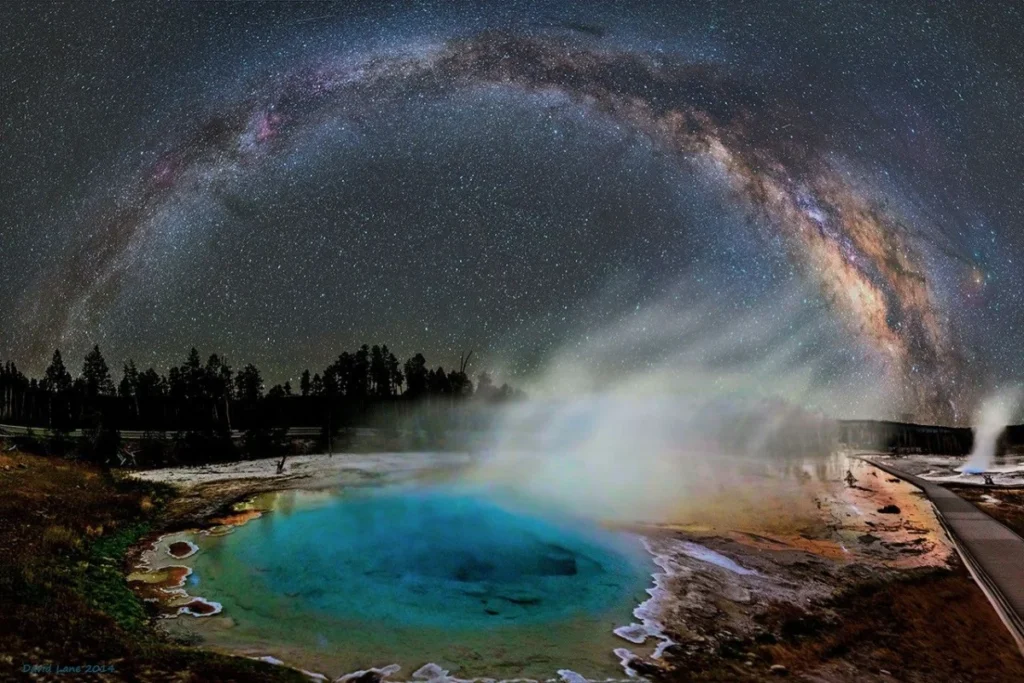
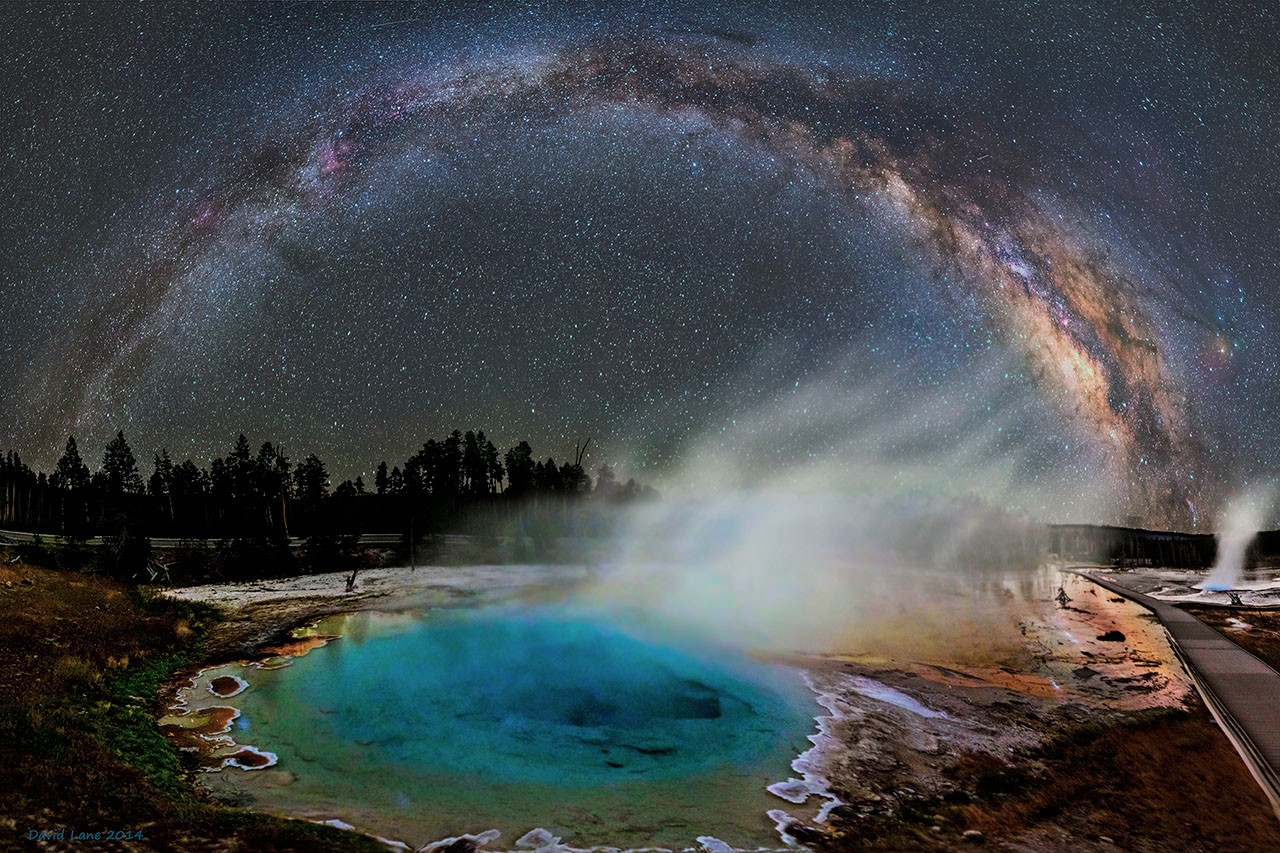
The celestial spectacle of the Milky Way galaxy, a breathtaking panorama of billions of stars, arches majestically over the otherworldly landscapes of Yellowstone National Park. This stunning composite image, captured in 2014, juxtaposes the vibrant, geothermally-heated Silex Spring with the distant, ethereal glow of our home galaxy. The photograph, a testament to the profound beauty found both on Earth and in the cosmos, serves as a daily reminder of humanity’s place within a vast and dynamic universe.
A Convergence of Terrestrial and Cosmic Wonders
The image, a 16-image panorama meticulously stitched together by astrophotographer Dave Lane, highlights the striking contrast between two seemingly disparate phenomena. In the foreground, Silex Spring, a geothermally active pool measuring approximately 10 meters across, emanates a vivid spectrum of colors. These hues are not the result of exotic extraterrestrial processes, but rather the natural consequence of thermophilic bacteria, microorganisms that thrive in extreme environments. These extremophiles form distinct layers within the hot spring, each with a preference for specific temperature ranges, thus creating the visually striking coloration. The water, heated by the immense geological forces at play beneath Yellowstone, releases plumes of steam that further enhance the mystical atmosphere of the scene.
Beneath this earthly display of geothermal activity lies the true marvel: the central band of the Milky Way Galaxy. This luminous arc, a dense concentration of stars, gas, and dust within our own galaxy, is a constant presence in the night sky, though often obscured by light pollution in populated areas. In the remote wilderness of Yellowstone, far from artificial illumination, the Milky Way reveals its full glory, a humbling reminder of the immensity of the universe and the billions of star systems that populate it. The light from these distant suns has traveled for eons to reach our eyes, painting a picture of cosmic history across the night sky.
Understanding the Geological Heart of Yellowstone
The geothermal features of Yellowstone National Park are directly linked to the Yellowstone Hotspot, a geological anomaly that has been shaping the landscape for millions of years. This hotspot is characterized by a plume of superheated mantle material rising from deep within the Earth’s interior. As the North American tectonic plate drifts westward over this stationary hotspot, it creates a chain of volcanic calderas and geothermal features. The current location of the hotspot is responsible for the intense volcanic and hydrothermal activity observed in Yellowstone today.
The underground magma associated with the Yellowstone Hotspot is the engine driving the park’s geysers, hot springs, and fumaroles. Silex Spring, with its elevated temperatures, provides an ideal habitat for specialized bacteria, such as Thermus aquaticus, which was first discovered in the park in 1965 and has since become invaluable in molecular biology (specifically in the polymerase chain reaction, or PCR). The steam rising from the spring is a visible manifestation of this intense subterranean heat, a constant reminder of the powerful forces at work beneath the surface.
The Yellowstone Hotspot: A Geological Timeline and Future Implications
The geological history of the Yellowstone Hotspot is marked by a series of colossal volcanic eruptions, known as supervolcanic eruptions, that have profoundly impacted the North American continent. Approximately 2.1 million years ago, the Huckleberry Ridge Tuff eruption created the park’s first and largest caldera. Another major eruption, the Mesa Falls Tuff, occurred about 1.3 million years ago. The most recent supervolcanic event, the Lava Creek Tuff eruption, took place around 640,000 years ago, carpeting vast swathes of the continent in volcanic ash and fundamentally altering landscapes.
The presence of the Yellowstone Hotspot is a constant subject of scientific study and public fascination, not only for its geological significance but also for the potential implications of future activity. While the probability of another supervolcanic eruption in the immediate future is considered very low, geologists closely monitor seismic activity, ground deformation, and gas emissions within the park. A future eruption of the magnitude seen in the past could have widespread and devastating consequences, affecting large parts of North America with ashfall, pyroclastic flows, and significant climatic changes. Scientists estimate that such an event could render a large portion of the continent uninhabitable and disrupt global weather patterns for years.
The Astronomy Picture of the Day (APOD) Initiative
The "Astronomy Picture of the Day" (APOD) is a long-standing NASA initiative that has been inspiring and educating the public about the wonders of the universe since its inception. Launched on June 16, 1995, APOD features a different image or photograph of the cosmos each day, accompanied by a concise yet informative explanation written by a professional astronomer. The program aims to make astronomy accessible to a broad audience, fostering a deeper appreciation for the scientific exploration of space and the natural world.
The APOD archive, accessible through the provided link, offers a treasure trove of astronomical imagery, ranging from distant galaxies and nebulae to planets within our solar system and captivating terrestrial phenomena that offer unique perspectives on celestial events. Each day’s entry serves as a mini-lesson, breaking down complex astronomical concepts into easily understandable terms. The program’s commitment to accuracy and engagement has made it a trusted and beloved resource for students, educators, and astronomy enthusiasts worldwide.
A Growing Gallery of Celestial Events
This particular image, "Milky Way over Yellowstone," is part of a broader collection of astronomical and atmospheric phenomena showcased by APOD. The mention of a "Growing Gallery: Solar Eclipse of 2026 August 12" suggests a curated selection of images related to upcoming or recent significant celestial events. The inclusion of "Tomorrow’s picture: eclipse shower" hints at the program’s dynamic nature, constantly adapting to highlight current astronomical news and observable events. This forward-looking approach encourages regular engagement with the APOD platform, as viewers anticipate what cosmic marvel will be revealed next.
The Collaborative Effort Behind APOD
The "Milky Way over Yellowstone" feature, like all APOD entries, is a product of a collaborative effort involving dedicated individuals and institutions. Dave Lane, the astrophotographer responsible for capturing the stunning image, is credited with the photography and copyright. The explanations are meticulously crafted by a team of authors and editors, including Robert Nemiroff, Jerry Bonnell, Cecilia Chirenti, and Keighley Rockcliffe, all of whom bring their expertise to bear in making complex astronomical information accessible.
The program itself is a service of the Astrophysics Science Division (ASD) at NASA’s Goddard Space Flight Center (GSFC), in partnership with NASA Science Activation and Michigan Technological University. This interdisciplinary collaboration ensures the scientific accuracy and educational effectiveness of the APOD content, underscoring NASA’s commitment to public outreach and science communication. The inclusion of links to Wikipedia and other informational resources within the explanation further enhances the educational value of the APOD entries, allowing curious readers to delve deeper into specific topics of interest.
The Enduring Fascination with Our Universe
The "Milky Way over Yellowstone" image resonates with a fundamental human curiosity about our place in the universe. It serves as a potent reminder that while we are grounded on Earth, with its own dynamic geological processes and breathtaking natural beauty, we are also inhabitants of a vast and awe-inspiring cosmos. The juxtaposition of the vibrant geothermal features with the distant glow of our galaxy encourages contemplation of both the immediate and the infinite. Such images, curated and explained by scientific experts, play a crucial role in fostering scientific literacy and inspiring the next generation of explorers and innovators to continue looking up and asking, "What else is out there?" The ongoing efforts of programs like APOD ensure that the wonders of the universe remain accessible and captivating for all.