Automation is no longer a nascent concept in additive manufacturing (AM); it has become a critical imperative. As the industry experiences a renewed surge in scale and adoption, clients are actively seeking ways to automate their production processes. For many, particularly those utilizing technologies like Laser Powder Bed Fusion (LPBF), automation isn’t just about efficiency; it’s about unlocking viable business cases. Processes such as depowdering, resurfacing, sieving, and machine turnaround, which have historically been bottlenecks, can be significantly optimized through automated solutions. These improvements directly translate into enhanced yield, superior surface finish, greater repeatability, and ultimately, a reduction in the cost per part—factors that are paramount in today’s competitive 3D printing landscape.
While the forefront of AM innovation often captures public attention, the companies quietly enabling this crucial automation are less frequently highlighted. Ossberger, a German engineering firm with a rich 150-year history, stands as a key player in this domain. Originally rooted in fluid mechanics, Ossberger has evolved to encompass plastics processing equipment, industrial cleaning solutions, and, more recently, specialized powder management systems for additive manufacturing. To gain insight into their approach, we spoke with Markus Garscha, Director of Ossberger’s Additive Manufacturing Business Unit. With 13 years at Ossberger, including a decade dedicated to AM, and prior experience at precision manufacturing leader Liebherr and the renowned Fraunhofer IIS, Garscha brings a wealth of expertise to the discussion.
Ossberger’s entry into the additive manufacturing sector was organically driven. The company began incorporating AM to produce intricate flow nozzles for its own industrial cleaning solutions. During this internal adoption, it became apparent that the post-processing steps were a significant cost driver. This realization spurred the development of internal equipment designed to streamline these operations, making their own AM workflow more efficient. The positive reception of these solutions at industry events like Formnext prompted Ossberger to formally enter the market as a vendor, offering their expertise to a broader clientele.
A distinguishing factor for Ossberger, according to Garscha, lies in their foundational expertise in fluid mechanics. "We sometimes solve problems quite differently from our competitors in the additive manufacturing industry," he explained. This unique perspective shapes their focus, which is predominantly on the critical post-build processes in LPBF. Their solutions are geared towards powder preparation, powder management, and the crucial unpacking of printed parts, with a strong emphasis on optimizing overall "process output."
A Holistic Approach to the AM Workflow
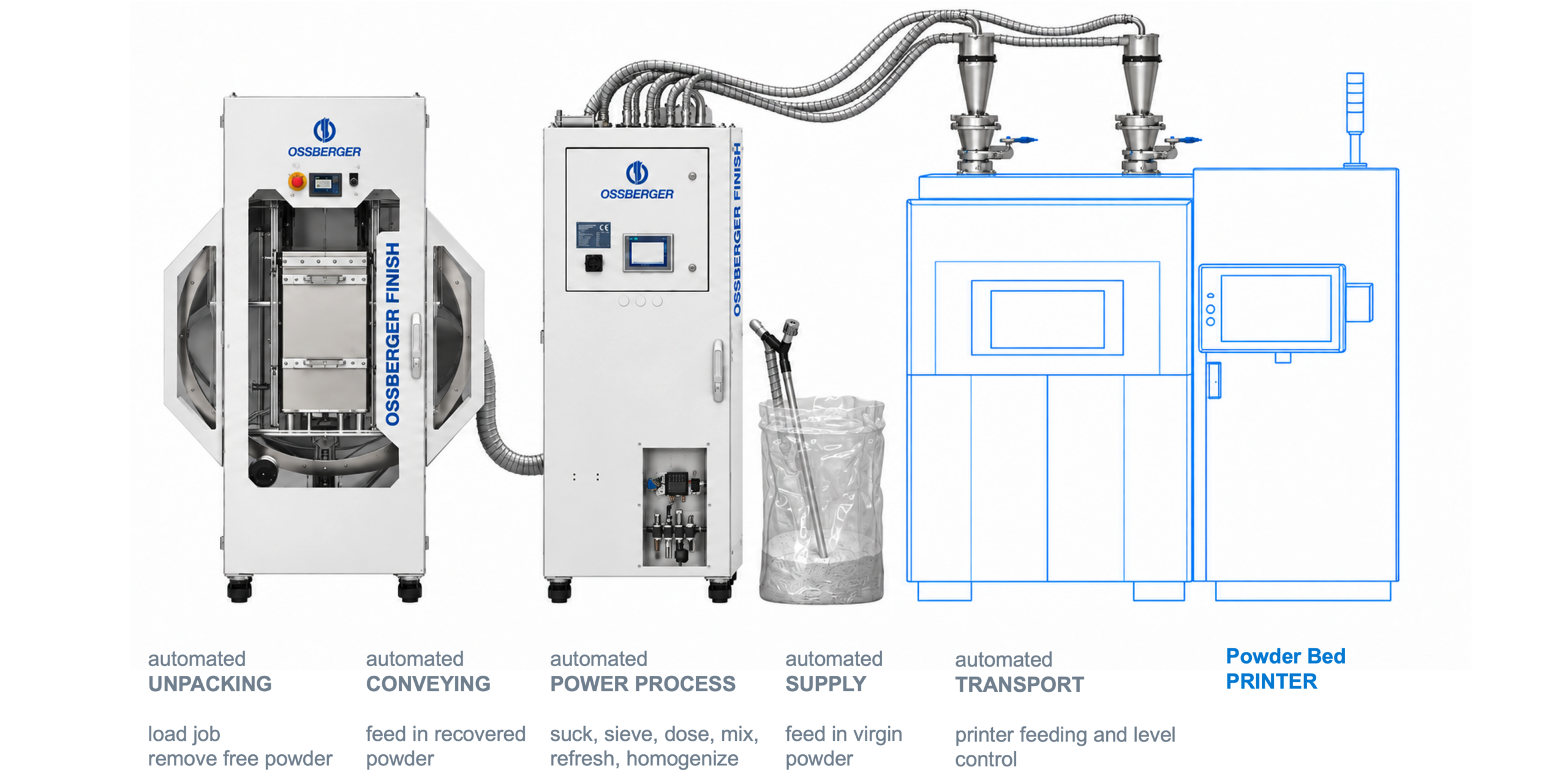
Ossberger’s philosophy centers on a complete, end-to-end workflow rather than isolated machine functionalities. "At the end of our process chain, we want to deliver one of two things: ready-to-use powder directly back into the printer, or unpacked and separated parts that are ready for the next manufacturing step," Garscha articulated. "So our focus is not simply on individual machines. We look at the complete workflow and how we can make it closed, reproducible, and highly efficient." This holistic approach, informed by their fluid mechanics background, allows for a comprehensive optimization of powder flow, condition, and utilization across the entire additive manufacturing lifecycle.
Quantifying the Impact of Automated Unpacking
The immediate benefit of automated unpacking is often perceived as labor savings. However, Garscha points out that the economic advantages extend far beyond reducing manual intervention. "An automated unpacking process is significantly faster and, most importantly, reproducible," he stated. "The quality of the recovered powder and the quality of the unpacked parts are determined by defined machine parameters rather than by the individual operator." This standardization leads to a more predictable and reliable output.

When combining these factors—labor savings, increased throughput, process reliability, and reproducibility—Ossberger typically observes a return on investment (ROI) for their automated unpacking solutions within a timeframe of 6 to 18 months. This payback period is contingent on several variables, including the utilization rate of the equipment, the specific materials being processed, and the overall production environment.
The Undervalued Significance of Sieving and Powder Management
While seemingly a rudimentary process, often compared to beach activities, sieving plays a surprisingly pivotal role in the economics of LPBF. Garscha strongly disagrees with the notion that it is a low-value operation. "With sieving, the business case goes beyond simply reducing labor," he emphasized. "The more important aspect is creating a controlled and reproducible powder loop."
In AM, particularly with high-value metal powders, the material itself represents a substantial portion of the production cost. The ability to reliably recover, prepare, and return this powder to the printing process directly enhances the economic viability of additive manufacturing. "So the value is not just in the sieving process," Garscha elaborated. "It is in keeping valuable powder in a controlled production loop."
Garscha further elaborated on why sieving and powder preparation are frequently underestimated. "You cannot directly see the quality of the powder or the quality of the powder-handling process," he explained. "You usually only see the consequences when something goes wrong—through quality issues in the parts or, in the worst case, a failed build job." This indirect visibility often leads to a lack of appreciation for the foundational importance of these steps.
Furthermore, Garscha highlighted a historical imbalance in the industry’s focus. "The industry has traditionally focused much more on supplying new powder than on helping users maximize the lifetime and reuse of the powder they already have," he observed. This is understandable, as companies whose business model relies on selling virgin powder have less incentive to promote strategies that reduce material consumption. This market dynamic underscores the necessity for reproducible powder processing solutions that empower users to achieve greater material efficiency.
Ensuring Powder Integrity in Closed-Loop Systems
Maintaining the integrity of powder across multiple reuse cycles is a complex technical challenge. "When processing reused powder, we need to maintain defined and reproducible material properties such as particle-size distribution over multiple reuse cycles," Garscha stated. The process of mixing powders also requires careful control. Introducing too much energy can degrade the material, while insufficient mixing can lead to segregation of particles.
The scope of powder management extends beyond sieving. "It goes beyond sieving," Garscha clarified. "Homogenizing, conveying, storing, and returning the powder are all important elements of a stable closed-loop process. For us, the goal is simple: use as little virgin powder as necessary and keep as much valuable material as possible in a controlled, repeatable production loop." This meticulous approach ensures that the quality of printed parts remains consistent, even when utilizing recycled powder.
Addressing the Entry-Level Production Segment
The growing segment of LPBF machines priced between $50,000 and $200,000 represents a significant growth driver for additive manufacturing. These machines offer entry-level production capabilities, making AM more accessible to a wider range of companies. Ossberger is strategically positioned to serve this burgeoning market.
"Especially for start-ups and smaller users, flexibility and cost efficiency are extremely important," Garscha noted. "They don’t have the time and money to waste." To address these needs, Ossberger has developed what Garscha describes as "Swiss Army knife" solutions. These are compact, flexible systems designed to integrate multiple functions. For companies venturing into AM, these integrated solutions can substantially reduce both the initial investment and the ongoing operational demands in terms of time and labor.
Ossberger’s modular approach allows customers to scale their automation solutions as their production volume increases. Users can select individual modules or combine them to create tailored systems. This flexibility is crucial for businesses operating in competitive markets, enabling them to start with a basic module and expand to accommodate multiple printers and complex workflows.
The Evolving Landscape of Hot Unpacking and Machine Utilization
The concept of "hot unpacking"—removing parts from a build chamber while still warm—holds significant promise for accelerating throughput and improving profitability. Ossberger currently supports hot build jobs, but Garscha emphasizes that its implementation must be judicious. "The question is when it makes sense from both a process and an economic perspective," he stated. "That depends heavily on the physics of the individual job—the packing density, part geometries, material, build height, and temperature."
Currently, Ossberger observes a greater demand for hot unpacking in service provider environments and for prototype production, where minimizing lead times is paramount. For traditional industrial series production, the economic justification for immediate hot unpacking might be less clear-cut. "So we do not look at hot unpacking as a goal in itself," Garscha reiterated. "We always look at whether it improves the overall process chain."
The broader trend towards optimizing machine utilization is also a key focus. Companies are increasingly looking to extend build times, including running machines overnight and through weekends, to maximize output. Ossberger’s systems can facilitate this. For instance, a warm build job loaded into their system in the evening can cool down in a controlled environment overnight, with the unpacking process automatically commencing shortly before the morning shift begins.
"Interestingly, our unpacking process itself is already very fast," Garscha pointed out. "In many cases, it makes more sense to start unpacking in the morning because within just a few minutes we can provide the unpacked parts, while the subsequent process steps often take significantly longer. So the real question is not necessarily, ‘Can I run this machine all night?’ It is, ‘How can I optimize the timing of my entire process chain?’" This highlights the importance of viewing automation not as an isolated task but as an integrated component of a larger operational strategy.
The Future of Integrated Post-Processing
The vision of a fully integrated system that combines hot unpacking with subsequent surface finishing processes in a single machine is an attractive prospect, particularly for businesses operating in environments where floor space is at a premium. "Technically, yes," Garscha confirmed. "We have already tested concepts like this internally, including alternative technologies that avoid blasting with potentially contaminating media."
However, the economic feasibility remains a significant consideration. "Today, however, the key question is economics," he noted. "There are still relatively few customers with enough production volume to justify a fully integrated system covering everything from unpacking through surface processing."
Technical considerations also play a role. Unpacking has a relatively minor impact on the final surface quality of a part compared to abrasive or densifying processes. For mixed jobs containing diverse part geometries, sorting or individual parameterization of downstream processes might be necessary, complicating a fully integrated solution.
The situation changes for industrial series applications, such as eyewear, drone components, or dental parts. In these sectors, where jobs are more homogeneous and volumes are higher, fully integrated solutions become significantly more compelling and economically viable.
Ossberger’s Vision for a Scalable, Sustainable Future
Looking ahead, Markus Garscha identifies closed-loop powder management and scalable automation solutions as the current state of the art. For Ossberger, the core tenets remain consistent: minimizing waste and simplifying the customer’s operational experience. As the additive manufacturing industry continues its trajectory of growth, the significance of meticulous sieving and sophisticated powder management will become increasingly apparent.
The advancements in automation promise to deliver significant time savings and enhanced consistency, paving the way for the production of a greater volume of parts. Coupled with the anticipated expansion of the entry-level production machine segment, Ossberger is well-positioned for substantial growth, offering solutions that address the evolving needs of a dynamic and increasingly automated additive manufacturing landscape.