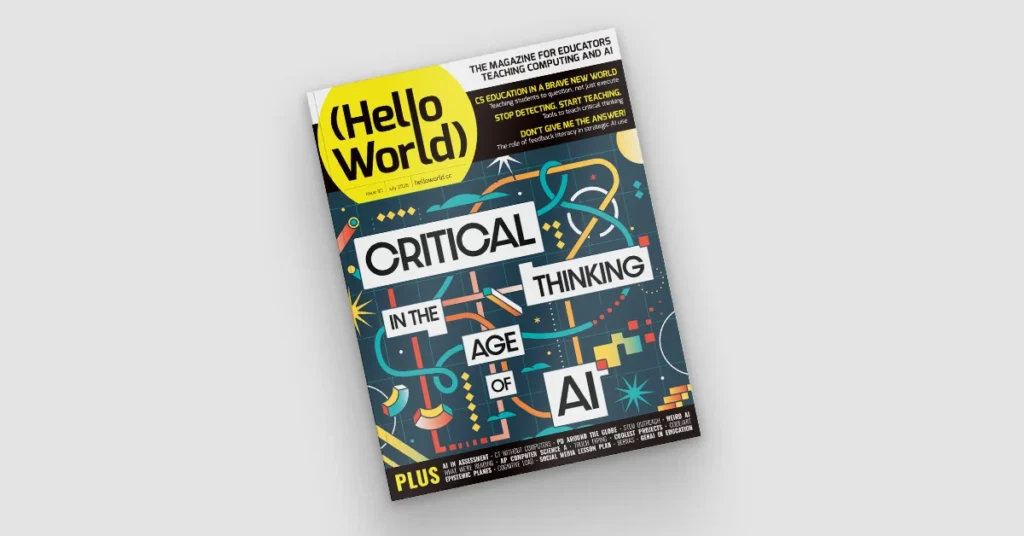
The rapid proliferation of data-driven tools and generative artificial intelligence has fundamentally altered the landscape of personal productivity, creative expression, and educational methodology. As these technologies become increasingly integrated into daily life, they offer significant time-saving benefits by automating routine decisions and providing instant answers to complex queries. However, this shift toward digital convenience has sparked a global dialogue among educators and technologists regarding the potential "outsourcing" of human thought. In response to these challenges, the Raspberry Pi Foundation has released the 30th issue of Hello World magazine, a publication dedicated to exploring the intersection of computing and education, with a specific focus on the necessity of critical thinking in the age of AI.
The release of this milestone issue comes at a pivotal moment for the global education sector. Since the public launch of advanced large language models (LLMs) in late 2022, schools and universities have grappled with the dual nature of AI: its ability to act as a powerful personalized tutor and its potential to undermine traditional learning processes. The new issue of Hello World, accompanied by a specialized podcast mini-series, seeks to provide a research-backed framework for teaching young people how to navigate this automated world without sacrificing their intellectual autonomy.
The Paradigm Shift: From Tool Usage to Critical Evaluation
For decades, digital literacy was defined by the ability to use software—learning how to navigate spreadsheets, word processors, and search engines. In the current era, the focus has shifted from functional competence to critical evaluation. Modern AI tools do more than just process data; they predict human intent. Features such as predictive text, algorithmic music recommendations, and AI chatbots offer a streamlined experience that often bypasses the need for active decision-making.
Educators contributing to the latest research suggest that while these tools enhance efficiency, they may inadvertently atrophy the "muscles" of critical thinking. The act of exploring a city without a GPS, for instance, requires spatial awareness and problem-solving skills that are rarely exercised when following a blue dot on a screen. Similarly, the process of synthesizing information from multiple sources to form an opinion is a cognitive exercise that is bypassed when an AI provides a single, confident summary. The core mission of the new educational resources is to ensure that students remain the "directors" of technology rather than its passive subjects.
Institutional Responses and the Update of Educational Standards
A significant component of the current discourse involves the modernization of educational frameworks to reflect the realities of the 2020s. The Computer Science Teachers Association (CSTA) in the United States has recently completed a comprehensive rewrite of the CSTA K–12 Computer Science Standards. This framework, which is highlighted in the new issue of Hello World, serves as a blueprint for preparing students for a future defined by rapid technological acceleration.
According to Amanda O’Mara, Smita Kolhatkar, and Tiffany Jones, who contributed to the research-backed framework, the arrival of AI necessitates a new balance in computer science education. Their findings suggest that while AI can generate answers instantly, the capacity to evaluate the accuracy, ethics, and relevance of those answers remains a uniquely human requirement. The updated CSTA standards emphasize that students must learn to interrogate the systems they use, understanding not just how to prompt an AI, but how to identify bias in its training data and limitations in its logic.
The Role of Professional Learning for Educators
The transition to AI-integrated classrooms requires more than just student-facing changes; it demands a fundamental shift in teacher training. Experts argue that professional development for educators should not merely focus on building confidence in using AI tools, but rather on fostering the critical thinking skills necessary to teach with them.
Issue 30 of Hello World features several articles from educators who have been investigating the pedagogical implications of digital technologies. One of the central questions addressed is the role of the teacher in an environment where information is ubiquitous. The research suggests that educators bring a vital "human element" to the table—contextualizing knowledge, facilitating ethical debates, and managing the cognitive load of their students. By focusing on professional learning that prioritizes critical inquiry, schools can ensure that AI is used to deepen thinking rather than replace it.
Managing Cognitive Load and Deep Thinking
A recurring theme in the latest educational research is the management of cognitive load. In educational psychology, cognitive load refers to the amount of working memory used by a student. While AI can reduce the "extraneous" cognitive load by handling formatting or basic data retrieval, there is a risk that it also reduces the "germane" cognitive load—the effort required to process and integrate new information into long-term memory.
The feature articles in the new publication explore how AI systems can be used in assessment without compromising the integrity of the learning process. For example, instead of banning AI, some educators are using it to generate "first drafts" that students must then critique, fact-check, and expand upon. This method promotes human decision-making and ensures that the student is performing the high-level cognitive work of evaluation and synthesis.
Data and Trends in AI Adoption within Education
The urgency of this educational shift is supported by recent data regarding AI adoption. According to various industry reports from 2023 and 2024, nearly 50% of students aged 12–18 have utilized generative AI for school-related tasks, often without formal guidance from their institutions. Conversely, a significant gap remains in teacher readiness; a survey of global educators indicated that while a majority believe AI will be transformative, fewer than 25% felt they had received adequate training on how to integrate it into their curriculum effectively.
Furthermore, the question of "whose knowledge is shaping AI" has become a central point of concern. AI models are trained on massive datasets that often reflect the biases and cultural perspectives of the regions where the technology is developed. Teaching students to think critically about AI involves helping them recognize these systemic biases. This ensures that the "outsourcing" of taste and thought does not result in a homogenization of culture and ideas.
Broader Impact and Long-term Implications
The implications of the current shift toward AI-assisted living extend far beyond the classroom. As the workforce evolves, the ability to think critically and make independent decisions is becoming a high-value skill. In a world where routine tasks—and even complex data analysis—can be performed by machines, the human capacity for judgment, ethics, and creative problem-solving becomes a primary differentiator in the labor market.
The Raspberry Pi Foundation’s initiative, supported by sponsors such as Oracle, reflects a broader movement to democratize computing education. By providing Issue 30 of Hello World as a free resource, the foundation aims to bridge the gap between those who have access to high-level AI literacy and those who do not. This is particularly important for subjects that intersect with technology, such as the "physics meets technology" projects highlighted in the issue, which demonstrate how AI can be a partner in scientific inquiry rather than a replacement for it.
Chronology of the AI Education Movement
To understand the context of this latest release, it is helpful to look at the timeline of AI’s integration into the educational sphere:
- Pre-2022: Focus on "Coding for All" and basic digital literacy. AI is largely seen as a niche topic within advanced computer science.
- Late 2022: The release of ChatGPT-3.5 triggers a global panic in education regarding plagiarism and the future of the essay.
- Early 2023: Schools begin to move from "ban" policies to "guidance" policies, recognizing that AI is a permanent fixture of the digital landscape.
- Late 2023: Organizations like CSTA and the Raspberry Pi Foundation begin synthesizing research on the long-term cognitive effects of AI usage in schools.
- 2024: The focus shifts to "AI Literacy" and "Critical Thinking," emphasizing the need for students to understand the mechanics and ethics of AI systems.
Conclusion
The release of Hello World issue 30 serves as a comprehensive guide for navigating the complexities of the modern technological era. By addressing the risks of "outsourcing" our personal and intellectual lives to data-driven tools, the publication reaffirms the value of the human mind. Whether through the exploration of "Flatgames," the analysis of predictive classroom systems, or the implementation of new K–12 standards, the goal remains the same: to cultivate a generation of thinkers who are equipped to lead in a world moving at "supersonic speed."
As the Raspberry Pi Foundation and its partners continue to offer resources for free, the responsibility now falls on the global community of educators and parents to implement these strategies. The objective is clear: to ensure that as AI becomes more capable, humans become more thoughtful, using technology as a lever to reach new heights of understanding rather than a crutch that limits our potential. Through critical thinking, the accidental delights of exploration and the satisfaction of deep understanding can be preserved in the age of automation.