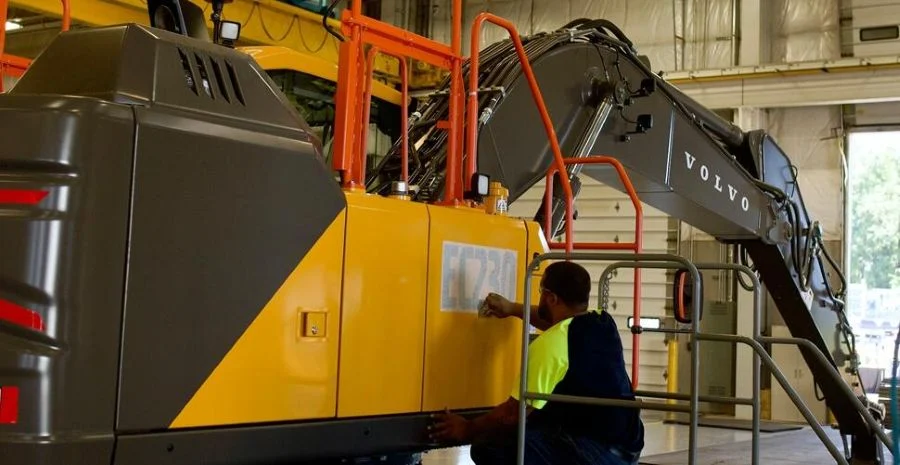
SHIPPENSBURG, PA — Volvo Construction Equipment (Volvo CE) has marked a pivotal moment in its North American operational strategy by commencing the assembly of excavators and large wheel loaders at its state-of-the-art manufacturing facility in Shippensburg, Pennsylvania. This strategic expansion means that more than 50 percent of the machines Volvo CE sells in North America are now manufactured domestically, a move projected to slash customer lead times by more than six weeks. The company has also announced plans to eventually produce 11 additional models at this re-engineered facility, underscoring a profound commitment to regional production and customer service.
The decision to expand local manufacturing capabilities comes amidst a global economic landscape increasingly shaped by supply chain volatility and the imperative for greater operational agility. Scott Young, head of Region North America at Volvo Construction Equipment, articulated the strategic significance of this development, stating, "This is manufacturing resilience in action: adapting with purpose and speed to increase capacity and build more machines closer to our customers. This achievement advances [our] long-term strategy to strengthen stability and flexibility across the North American market, while supporting our employees and the regional economy." Young’s comments highlight a broader industry trend towards de-risking global supply chains and fostering localized economic benefits.
Strategic Imperatives Behind Localized Production
The move to significantly increase North American production is not merely an operational adjustment but a strategic realignment in response to several key factors influencing the global construction equipment market. Firstly, geopolitical dynamics have introduced uncertainties that can disrupt international shipping and trade flows. By localizing production, Volvo CE is better insulated from these external pressures, ensuring a more consistent supply of critical machinery to its customers. Secondly, the cyclical nature of the construction equipment industry demands exceptional flexibility. Demand can fluctuate significantly based on economic conditions, infrastructure spending, and regional development projects. A more agile, regionally focused manufacturing base allows Volvo CE to respond more swiftly to these shifts, scaling production up or down without the extensive lead times associated with overseas logistics.
Beyond geopolitical and cyclical considerations, the drive for enhanced customer experience is paramount. Shorter lead times, estimated at over six weeks, directly translate into faster equipment delivery, enabling contractors and construction companies to commence or continue projects without undue delay. In a highly competitive market, this efficiency can be a significant differentiator, boosting customer satisfaction and loyalty. The ability to quickly deliver tailored solutions also positions Volvo CE as a more responsive partner in North America’s burgeoning infrastructure and construction sectors.
Operational Transformation and Capacity Expansion
The expansion at the Shippensburg plant was achieved through a comprehensive overhaul of existing operations, rather than simply building new structures. Volvo CE focused on maximizing efficiency and flexibility within its current footprint. This involved significant investments in automation, process improvements, and a more intelligent utilization of the existing factory space. The plant’s combined 436,000-square-foot assembly and fabrication area was meticulously reengineered to create three flexible production lines. These lines are now capable of building the full spectrum of excavator, wheel loader, and compactor models, representing a substantial increase in operational versatility. Crucially, the expansion also included the addition of new excavator welding capacity, a core component of heavy equipment manufacturing.
Gustavo Casagrandi, head of operations at Volvo CE Shippensburg, lauded the dedication of his teams. "Over the past 11 months, our teams have demonstrated exceptional commitment and execution to expand our production capabilities here," Casagrandi stated, underscoring the rapid and intensive nature of the transformation. He further emphasized the long-term benefits, noting, "Along the way, we’ve developed new technical capabilities within our workforce, making us more resilient and competitive as a manufacturing facility." This points to a dual benefit: increased production capacity coupled with an upskilled workforce, ready to tackle the complexities of modern manufacturing.
A History of Growth and Commitment in Shippensburg
The Shippensburg facility has a rich history as a cornerstone of Volvo CE’s North American operations. The company first acquired the site and its road development division from Ingersoll Rand in 2007, marking a significant entry into expanding its footprint in the region. By 2012, Volvo CE had further solidified its commitment by establishing its North American headquarters at the Shippensburg location. This strategic move consolidated leadership, sales, and administrative functions, fostering a more integrated approach to its regional market. Currently, the facility is a major employer in the region, providing livelihoods for more than 750 people. The recent expansion not only secures these existing jobs but also implies potential for future growth as production volumes increase and additional models are brought online. This long-standing presence underscores Volvo CE’s deep roots in the Pennsylvania community and its ongoing contribution to the local economy.

The decision to invest further in Shippensburg reflects a pattern of sustained growth and strategic development for Volvo CE in North America. Industry analysts often highlight the importance of established regional hubs for global manufacturers, enabling closer collaboration with local suppliers, better understanding of market demands, and enhanced responsiveness. The Shippensburg plant serves as a testament to this philosophy, evolving from an acquisition to a central manufacturing and administrative powerhouse for the company.
Innovations in Workforce Development and Manufacturing Processes
A key innovation implemented during this expansion is the pioneering "utility specialist" approach, specifically designed for the production of large wheel loaders. These machines are inherently complex, requiring approximately 30 percent more parts and intricate assembly processes compared to other models on the same line. To manage this complexity efficiently and maintain a consistent workflow, Volvo CE cross-trained employees in multiple zones. This multi-skilled workforce can provide additional support at workstations requiring extra labor, ensuring that bottlenecks are minimized and production remains steady. This flexible staffing model exemplifies a modern approach to manufacturing, where adaptability and continuous learning are prioritized.
Casagrandi highlighted the broader implications of this innovative approach: "Innovation around the way we work and insights from the pilot can be applied to the excavator line and shared across Volvo CE sites worldwide. This more integrated approach to manufacturing and engineering enables [us] to better support North American customers, while laying the foundation for a more resilient, responsive and sustainable future." This statement reveals that the Shippensburg facility is not just a production site but also a hub for process innovation, with best practices developed there potentially influencing Volvo CE’s global manufacturing network. Such an approach fosters a culture of continuous improvement and knowledge sharing across the organization.
Broader Economic and Industry Implications
The increased manufacturing capacity at Shippensburg carries significant economic implications for both Volvo CE and the broader North American market. For Volvo CE, it enhances its competitive posture by allowing it to respond more effectively to regional market demands, potentially increasing market share in key segments like excavators and large wheel loaders. The construction equipment market in North America is projected to see sustained growth, driven by investments in infrastructure, residential, and commercial construction. By producing closer to customers, Volvo CE is better positioned to capitalize on these opportunities, delivering equipment more quickly and with potentially lower transportation costs.
From a regional economic perspective, the expansion reinforces Shippensburg’s role as a vital manufacturing hub. The retention and potential growth of over 750 jobs provide stability and economic impetus to the local community. Furthermore, increased production often leads to greater demand for local suppliers, logistics services, and ancillary businesses, creating a multiplier effect throughout the regional economy. This localized economic benefit aligns with broader governmental initiatives aimed at strengthening domestic manufacturing and supply chains.
The move also reflects a wider trend in the manufacturing sector, often referred to as "reshoring" or "nearshoring." Following years of optimizing for lowest-cost production in distant geographies, many multinational corporations are now re-evaluating their strategies in light of recent global disruptions. The pandemic, geopolitical tensions, and escalating shipping costs have underscored the vulnerabilities of extended supply chains. Bringing production closer to the end-market mitigates these risks, offering greater control over quality, lead times, and inventory management. Volvo CE’s investment in Shippensburg is a clear demonstration of this strategic shift, prioritizing resilience and responsiveness alongside traditional cost efficiencies.
Towards a Sustainable and Responsive Future
The integration of advanced manufacturing techniques, automation, and a highly skilled, flexible workforce at the Shippensburg facility positions Volvo CE for a more sustainable and responsive future. The ability to quickly adapt production to market demands reduces waste and improves overall operational efficiency. Moreover, producing machines closer to their point of sale can contribute to a reduced carbon footprint by minimizing long-haul shipping. This aligns with Volvo Group’s broader commitment to sustainability and environmental stewardship.
As the construction industry continues to evolve, embracing digitalization, automation, and more sustainable practices, manufacturing facilities like Shippensburg will be critical enablers. The plant’s capacity to build a diverse range of models and its commitment to continuous innovation in production processes ensures that Volvo CE remains at the forefront of delivering cutting-edge, high-quality construction equipment to its North American customers. The planned addition of 11 more models to the Shippensburg production lines signals a long-term vision for this facility as a central pillar of Volvo CE’s regional and global strategy, promising continued growth and contribution to the construction landscape.