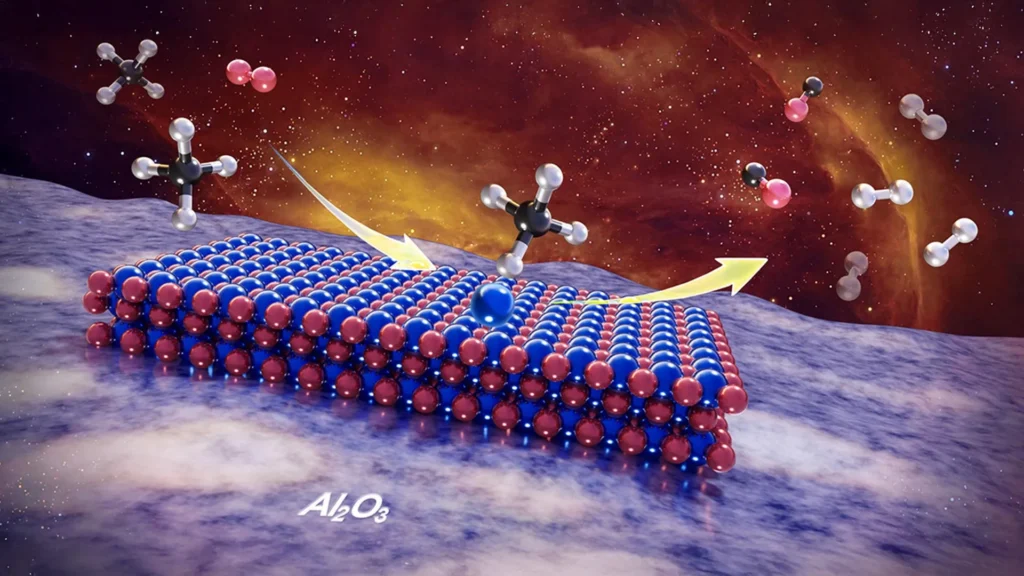
For decades, the scientific community has largely operated under the assumption that metallic nickel (Ni) nanoparticles served as the primary active centers driving the critical partial oxidation of methane (POM) reaction. This process, vital for generating syngas – a fundamental building block for numerous fuels and chemicals, including methanol, ammonia, and synthetic hydrocarbons via Fischer-Tropsch synthesis – has been a subject of intense research due to its potential as a more energy-efficient and environmentally favorable alternative to traditional syngas production methods. However, a significant unresolved question has long lingered within the catalysis field: the metallic nickel observed after a reaction could simply be a consequence of nickel oxide being reduced by the syngas at high temperatures, rather than representing the species that genuinely performs the catalysis under operando conditions. This ambiguity underscored a broader challenge in catalysis research: understanding the true nature of active sites, especially in dynamic reaction environments.
The Quest for Efficient Syngas Production
Syngas, primarily a mixture of hydrogen (H₂) and carbon monoxide (CO), is a cornerstone of the modern chemical industry. Its production traditionally relies on processes like steam methane reforming (SMR), autothermal reforming (ATR), and dry methane reforming (DMR). SMR, while mature, is highly endothermic, requiring significant energy input and operating at very high temperatures (700-1100°C), leading to substantial carbon dioxide emissions. ATR offers a more balanced approach, combining partial oxidation and steam reforming, resulting in a thermally neutral process, but still presents challenges in optimizing H₂/CO ratios and managing catalyst deactivation. DMR, which utilizes CO₂ as an oxidant, is attractive for its potential to consume greenhouse gases, but often suffers from severe coke formation and high energy demands.
Partial oxidation of methane (POM) distinguishes itself by offering a potentially less energy-intensive route, operating at moderate temperatures (typically 600-900°C) and producing an H₂/CO ratio closer to 2:1, which is ideal for many downstream synthesis processes, particularly for methanol production and Fischer-Tropsch synthesis. The direct conversion of methane to syngas via POM bypasses the need for steam, reducing energy costs and infrastructure complexity. However, the industrial implementation of POM has been hampered by challenges related to catalyst stability, selectivity towards syngas over complete combustion products, and resistance to carbon deposition. Nickel-based catalysts have emerged as economically attractive candidates due to nickel’s abundance and catalytic activity, but their exact mechanism and the identity of their true active sites have remained elusive.
The Elusive Nature of Nickel Catalysts Under Reaction Conditions
The difficulty in discerning the actual active species stems from nickel’s inherent reactivity. Under the high-temperature redox (reduction-oxidation) conditions characteristic of POM, nickel can undergo rapid changes in both its oxidation state and its atomic arrangement. For instance, metallic nickel (Ni⁰) can oxidize to nickel oxide (NiO) in the presence of oxygen, and NiO can be reduced back to Ni⁰ by reducing gases like hydrogen or carbon monoxide. These dynamic transformations make it exceedingly challenging to track the catalyst’s detailed structure in situ, meaning directly while the reaction is occurring. Traditional ex situ characterization methods, performed after a catalyst has been removed from the reactor and cooled, often capture a "snapshot" of the catalyst in a deactivated or post-reaction state, which may not accurately reflect its active structure under operating conditions. This discrepancy has led to persistent ambiguity regarding the true catalytic sites for POM.
A Groundbreaking Study Illuminates Dynamic Active Structures
A recent study, published in the esteemed journal Nature Catalysis, has provided critical insights into this long-standing puzzle. The research, spearheaded by Profs. Tao Zhang, Aiqin Wang, and Xiaoyan Liu from the Dalian Institute of Chemical Physics (DICP) of the Chinese Academy of Sciences (CAS), in collaboration with Prof. Wei Liu (also from DICP), Prof. Tao Yang from Xi’an Jiaotong University, and Prof. Graham J. Hutchings from Cardiff University, revealed that highly active structures can form in situ when the surface of nickel oxide (NiO) undergoes reconstruction during the partial oxidation of methane. This finding marks a pivotal moment in catalysis research, as it definitively identifies the atomic-scale source of the catalytic activity and underscores the paramount importance of observing catalysts while they are actively operating under realistic reaction conditions – a concept often referred to as "operando" characterization.
The research team’s meticulous approach allowed them to overcome the limitations of ex situ analysis, providing an unprecedented view of the catalyst’s dynamic behavior. This revelation challenges the conventional wisdom regarding metallic nickel as the sole active species and opens new avenues for rational catalyst design.
Methodology and Striking Performance
To investigate the process, the team embarked on synthesizing a unique Ni/Al₂O₃ catalyst. They employed a microemulsion method to create a catalyst containing an exceptionally low nickel content of just 0.8 wt%. The microemulsion technique, known for its ability to produce highly dispersed nanoparticles with controlled size and morphology, was crucial for generating a catalyst that could unveil the subtle atomic changes occurring during the reaction. Despite its relatively low nickel content, this catalyst exhibited remarkably strong performance during POM. It achieved an impressive 92% conversion of methane, while the selectivities for carbon monoxide (CO) and hydrogen (H₂) reached 87.0%. Crucially, the H₂/CO molar ratio remained stable at approximately 2.0, an optimal ratio for subsequent industrial syntheses.
This high performance with such a minimal amount of nickel immediately raised questions about the traditional understanding of nickel’s role. Conventional wisdom suggested that higher nickel loadings typically correlated with better performance, implying that the active sites were directly proportional to the total nickel content. The observed efficiency of the low-loading catalyst challenged this established paradigm.
The Paradox of Low-Loading, High-Performance Catalysis
One of the most striking findings from the post-reaction analysis was the almost complete absence of detectable metallic Ni in the catalyst. This observation directly contradicted the long-held assumption that metallic nickel nanoparticles were the primary active centers. Even without the presumed metallic nickel, the catalyst’s overall performance was comparable to that of an 8.0 wt% Ni/Al₂O₃ catalyst produced through the more conventional impregnation method – a catalyst containing ten times as much nickel. This dramatic difference in required nickel content for similar performance provided compelling evidence that the active site was not simply bulk metallic nickel.
Further comparative studies solidified this conclusion. The low-loading catalyst prepared via the microemulsion method also performed far better than another 0.8 wt% Ni/Al₂O₃ material prepared using the same impregnation method. Under identical reaction conditions, the impregnation-derived catalyst did not effectively carry out POM and instead showed only methane combustion activity, producing CO₂ and H₂O rather than syngas. This critical comparison highlighted that not only the nickel loading but also the synthesis method – which influences the catalyst’s initial morphology and dispersion – played a crucial role in enabling the formation of the true active sites.
The researchers also observed a dynamic transformation at the beginning of the reaction. Metallic Ni nanoparticles, initially present in the catalyst, were quickly oxidized into the NiO phase under the operating POM conditions. This indicated that if metallic Ni were indeed the active site, it would be transient at best. However, the study further demonstrated that NiO alone was insufficient for POM activity. A pre-formed pure-phase NiO catalyst showed no POM activity whatsoever, catalyzing only the complete oxidation of methane, similar to the poorly performing impregnation-derived catalyst. These cumulative experimental results pointed unequivocally away from both static metallic nickel and bulk nickel oxide as the primary active species for the partial oxidation of methane.
Atomic Reconstruction: Unveiling the True Active Site
The pivotal breakthrough came from a closer, in situ examination of the catalyst surface during the reaction. Utilizing advanced operando characterization techniques, the researchers were able to capture the dynamic formation of a reconstructed [Ni₁O₄Ni₄] structural unit on the NiO(100) surface. This specific atomic motif, which dynamically assembled under the reaction conditions, represented the previously hidden active structure responsible for the high catalytic performance.
To confirm the role of this newly identified structure, the team employed Density Functional Theory (DFT) calculations. These theoretical simulations provided atomic-level insights into the reaction mechanism. The DFT calculations indicated that this newly formed [Ni₁O₄Ni₄] motif significantly facilitated the breaking of C-H bonds in methane, which is widely recognized as one of the rate-determining steps in activating the methane molecule for subsequent reactions. The calculated activation barrier for C-H bond cleavage on this reconstructed surface was strikingly low, at only 12.5 kcal·mol⁻¹.
This activation barrier was dramatically lower than the value calculated for the intact NiO(100) surface, which stood at a high 38.5 kcal·mol⁻¹. Crucially, it was also significantly lower than the barrier calculated for the metallic Ni(111) surface, which was determined to be 15.7 kcal·mol⁻¹. This substantial kinetic advantage provided robust theoretical support for the experimental observations, strongly confirming the conclusion that the dynamically reconstructed [Ni₁O₄Ni₄] structural unit, rather than static metallic nickel or ordinary nickel oxide, is the true active center responsible for driving the partial oxidation of methane reaction.
A Paradigm Shift in Catalyst Design
Together, the compelling experimental observations and precise theoretical calculations delivered a clear message: the catalytic activity for POM does not originate simply from bulk metallic nickel or a static ordinary nickel oxide surface. Instead, it emerges from a specific, dynamically formed atomic structure that self-assembles and reconstructs while the reaction is actively taking place. This discovery highlights the transient and adaptive nature of active sites in heterogeneous catalysis, a concept that is gaining increasing recognition across various catalytic systems.
Prof. Liu articulated the profound implications of these findings, stating, "Our study highlights the critical role of in situ characterization in identifying dynamic active structures under reaction conditions. Dynamic reconstruction enables low-loading catalysts to achieve high performance, offering new opportunities for the rational design of efficient catalysts while reducing reliance on high metal loadings." This statement encapsulates the core message of the research: understanding the dynamic behavior of catalysts is not merely an academic exercise but a necessity for developing next-generation catalytic materials.
Broader Impact and Future Directions
The implications of this research extend far beyond the specific case of methane partial oxidation. This work represents a significant paradigm shift in the fundamental understanding of heterogeneous catalysis. For years, catalyst design has often focused on optimizing the initial state of a catalyst, assuming that this state largely persists throughout the reaction. This study, however, reinforces the growing understanding that catalysts are not static entities but dynamic systems that can adapt and reconstruct under reaction conditions, forming entirely new active sites.
Economic and Environmental Benefits:
The ability to achieve high performance with significantly reduced metal loadings, as demonstrated by the 0.8 wt% Ni catalyst, has profound economic implications. Nickel, while more abundant than precious metals, still contributes significantly to catalyst cost. Reducing the required nickel content by a factor of ten, while maintaining or even improving performance, offers substantial cost savings for industrial syngas production. Furthermore, more efficient catalysts can lead to lower energy consumption and potentially milder operating conditions, contributing to a reduced carbon footprint for syngas production and associated chemical processes. This aligns with global efforts towards sustainable chemistry and greener industrial practices.
Industrial Application and Scalability:
The microemulsion method, while effective for research, will need to be carefully evaluated for its scalability to industrial production levels. However, the fundamental insight that dynamic reconstruction creates the active site opens doors for exploring other synthesis methods that could also promote the formation of these structures. This knowledge allows for a more targeted approach to catalyst development, moving away from trial-and-error methods towards a more rational and predictive design strategy.
Future Research Avenues:
This study paves the way for several exciting avenues of future research:
- Exploring Other Systems: The principle of dynamic active site reconstruction is likely not unique to Ni/Al₂O₃ for POM. Researchers will now be motivated to investigate similar dynamic transformations in other catalytic systems, particularly those involving redox-active metals under harsh reaction conditions.
- Optimizing Dynamic Site Formation: Understanding the factors that promote or hinder the formation and stability of these reconstructed active sites will be crucial. This could involve manipulating catalyst support interactions, promoters, or even reactor operating parameters to maximize the concentration and longevity of these highly efficient structures.
- Advanced In Situ Characterization: The success of this study underscores the indispensable role of advanced in situ and operando characterization techniques. Continued development and application of methods like ambient pressure X-ray photoelectron spectroscopy (AP-XPS), environmental transmission electron microscopy (ETEM), and operando X-ray absorption spectroscopy (XAS) will be vital for unraveling the complexities of dynamic catalyst surfaces.
- Computational Catalysis: DFT calculations proved instrumental in validating the experimental findings. Further computational studies can help predict new dynamic structures, understand the electronic properties that confer their high activity, and screen potential catalyst materials more efficiently.
In conclusion, this landmark study has not only resolved a long-standing debate in methane partial oxidation catalysis but has also provided a powerful illustration of the dynamic nature of catalytic active sites. By meticulously observing catalysts under real reaction conditions, researchers can unlock new principles for designing more efficient, cost-effective, and sustainable catalytic processes, fundamentally reshaping our approach to industrial chemistry and energy production.