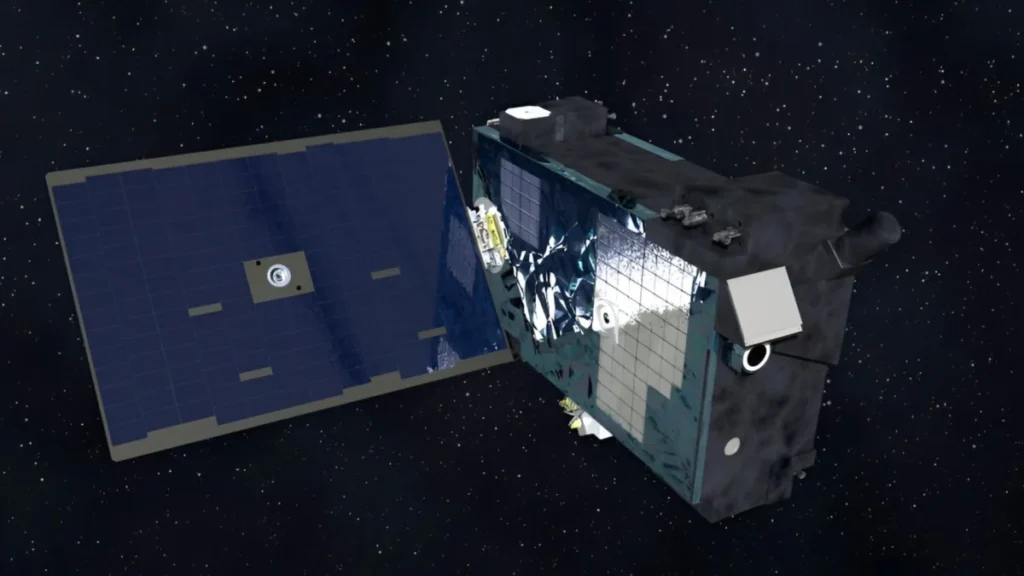
Northrop Grumman has been awarded a pivotal contract by the U.S. Space Force to develop a groundbreaking reconnaissance satellite prototype, specifically designed for deployment in the critical geosynchronous orbit (GEO). This initiative, part of the Defense Innovation Unit’s (DIU) GHOST-R program (Geosynchronous High-Altitude Operational Reconnaissance – R&D/Prototype), marks a significant step towards achieving faster and more cost-effective surveillance capabilities in one of Earth’s most strategically vital orbital regions. The project underscores a growing trend in national security space programs: leveraging commercial innovation and agile development methodologies to meet evolving threats.
The spacecraft, set to be a prototype for the GHOST-R program, aims to revolutionize how the U.S. monitors resident space objects (RSOs) and maintains comprehensive space domain awareness (SDA) in GEO. Northrop Grumman will utilize its well-established ESPASat-L spacecraft platform for this mission, a compact and modular design capable of carrying specialized mission hardware. Complementing Northrop Grumman’s platform, Irvine, California-based TRL-11 will provide the sophisticated optical payload, which will serve as the satellite’s primary observation capability. This collaborative approach between a major defense contractor and a specialized commercial vendor exemplifies the Space Force’s strategy to integrate diverse expertise and accelerate technological adoption.
The Strategic Imperative: Securing Geosynchronous Orbit
Geosynchronous orbit, situated approximately 35,786 kilometers (22,236 miles) above the Earth’s equator, is a uniquely valuable and increasingly contested domain. Satellites in GEO orbit at the same rate as the Earth’s rotation, allowing them to appear stationary relative to a point on the ground. This characteristic makes GEO an ideal location for critical national security assets, including military communication satellites, missile warning systems, and intelligence, surveillance, and reconnaissance (ISR) platforms, which require constant, unobstructed views of large swathes of the Earth.
-
The Criticality of GEO: The ability to maintain persistent presence and surveillance from GEO is paramount for U.S. national security. These high-value assets provide essential services ranging from global communications for military operations to early warning against ballistic missile launches. The stability and predictability of GEO allow for continuous coverage of specific geographic areas, making it indispensable for strategic oversight and response. Losing or being unable to monitor assets in this orbit would severely compromise defense capabilities and intelligence gathering. Historically, GEO has been the preserve of large, expensive, and bespoke satellites, often taking a decade or more from conception to deployment. The GHOST-R program signals a departure from this traditional model, seeking to inject agility and speed into GEO asset development.
-
A Domain Under Threat: As space becomes more accessible and technologically advanced, the GEO belt has become increasingly congested and contested. The number of active satellites, defunct spacecraft, and debris in GEO continues to grow, posing collision risks. More critically, adversarial nations are developing sophisticated counter-space capabilities, including anti-satellite (ASAT) weapons, co-orbital inspection satellites, and electronic warfare systems, all designed to disrupt, degrade, or destroy rivals’ space assets. These threats necessitate a robust and responsive SDA architecture to detect, track, identify, and characterize objects and activities in GEO. Without enhanced SDA, the U.S. risks being blind to potential threats, unable to protect its vital space infrastructure, or assess damage in the event of an attack.
GHOST-R: A New Paradigm for Space Domain Awareness
The GHOST-R program represents a strategic pivot towards a more agile and resilient approach to space surveillance. By leveraging commercially derived platforms and rapid prototyping, the Space Force aims to shorten the development cycle dramatically and reduce costs, while still deploying advanced capabilities. The prototype developed by Northrop Grumman and TRL-11 is a direct response to the urgent need for enhanced vigilance in GEO.
-
Leveraging Commercial Innovation: The ESPASat-L Platform: Northrop Grumman’s ESPASat-L platform is central to this rapid deployment strategy. Described as roughly the size of a small suitcase, ESPASat-L offers a compact and versatile platform for carrying specialized mission hardware into space. Its modular design is a key advantage, allowing for different payloads to support a variety of missions without requiring a complete redesign for each new endeavor. This modularity is also compatible with Northrop Grumman’s ESPAStar rideshare architecture, which facilitates more frequent and cost-effective access to space by allowing multiple payloads to share a single launch vehicle. The use of such a standardized, yet adaptable, platform is indicative of the military’s broader embrace of commercial space technologies to accelerate innovation and reduce procurement timelines. The ESPASat-L platform’s heritage in commercial space missions provides a proven foundation, mitigating some of the risks associated with entirely new designs for critical defense applications.
-
The Role of TRL-11 and Optical Payloads: For the GHOST-R mission, the optical equipment supplied by TRL-11 will be the satellite’s primary observation capability. This specialized payload will enable the prototype to perform high-resolution imaging and characterization of RSOs in GEO. The collaboration with a commercial optical payload specialist like TRL-11 highlights the Space Force’s intent to tap into the cutting-edge capabilities developed by the private sector, rather than relying solely on government-developed solutions. Once the optical payload is integrated, Northrop Grumman will undertake the assembly, integration, and testing (AI&T) of the complete spacecraft. These critical activities will occur at Northrop Grumman’s facilities in Dulles, Virginia, and Gilbert, Arizona, leveraging established infrastructure and expertise. Upon successful completion of AI&T, the finished spacecraft will be delivered to the U.S. Space Force for operational deployment, marking the transition from prototype to potential operational asset.
Accelerated Development and Agile Procurement
One of the most striking features of the GHOST-R program is its aggressive timeline. Northrop Grumman faces an accelerated 24-month schedule, which encompasses the entire lifecycle from spacecraft production and payload integration to extensive testing and final delivery. This rapid development pace is a stark contrast to the decades-long procurement cycles often associated with traditional defense satellite programs.
-
DIU’s Vision: Speed and Commercialization: This accelerated timeline is a direct reflection of the Defense Innovation Unit’s (DIU) mandate to bridge the gap between commercial technological advancements and military needs. The DIU actively seeks out and partners with commercial companies to rapidly prototype and field capabilities that address urgent national security challenges. The GHOST-R program, therefore, is not just about a new satellite but about validating a new acquisition model. By prioritizing speed, cost-effectiveness, and the integration of commercially derived solutions, the DIU aims to ensure that the U.S. military can maintain a technological edge in an increasingly dynamic global landscape. This model contrasts sharply with the bespoke, government-led design and manufacturing processes that have historically dominated defense space procurements, which often resulted in multi-billion dollar programs with extended development timelines.
-
Manufacturing Hubs and Rapid Deployment: The selection of Northrop Grumman’s facilities in Dulles, Virginia, and Gilbert, Arizona, for the assembly, integration, and testing (AI&T) phase is strategic. These locations are established hubs for satellite manufacturing and testing, equipped with the specialized cleanrooms, thermal vacuum chambers, and vibration tables necessary to prepare a spacecraft for the harsh environment of space. The ability to conduct these complex processes efficiently and concurrently is crucial for meeting the demanding 24-month deadline. The rapid deployment philosophy extends beyond manufacturing; it also implies an agile approach to launch and on-orbit operations, allowing the Space Force to quickly adapt to new intelligence requirements and evolving threats.
Beyond Reconnaissance: Comprehensive Space Domain Awareness
The GHOST-R prototype is designed to support multiple facets of space domain awareness, which is the foundational knowledge of all activities and entities in space. Its planned missions extend beyond simple observation to include detailed characterization and identification, contributing significantly to a clearer operational picture in GEO.
-
Augmenting Existing Capabilities: The Hybrid Architecture: GHOST-R will augment existing U.S. space surveillance systems, many of which rely on ground-based sensors or older generation space assets. The Space Force’s strategic vision involves a "hybrid architecture," where commercially owned and operated spacecraft work in conjunction with government-owned satellites. This approach leverages the strengths of both sectors: the agility and cost-efficiency of commercial providers combined with the assured access and unique capabilities of government systems. This hybrid model aims to create a more robust, resilient, and comprehensive surveillance network that is less susceptible to single points of failure. It represents a significant shift from the traditional reliance on a few large, exquisite, and therefore vulnerable, government-owned satellites.
-
Proliferation for Resilience: A key benefit of a proliferated approach, enabled by smaller, more numerous satellites like the GHOST-R prototype, is the distribution of surveillance functions across a larger number of spacecraft. In a contested environment, the loss of a single satellite would not necessarily remove an entire capability from orbit. Instead, other satellites in the constellation could compensate, ensuring continuous coverage and maintaining operational resilience. This "strength in numbers" strategy is particularly vital in GEO, where high-value assets are tempting targets for adversaries. The GHOST-R prototype, if successful and subsequently proliferated, would significantly enhance the Space Force’s ability to maintain eyes on critical activities in GEO, even under duress.
Northrop Grumman already possesses extensive experience in supporting U.S. surveillance operations in geosynchronous orbit through its Geosynchronous Space Situational Awareness Program (GSSAP) spacecraft. The GSSAP satellites are designed to monitor activity around other satellites operating in GEO, providing crucial insights into adversarial maneuvers and potential threats. GHOST-R, however, takes a different route towards adding surveillance capacity. It combines a compact spacecraft platform with commercially supplied optical hardware and an accelerated development schedule, aiming for rapid scalability and lower unit costs. The immediate goal is straightforward: deliver a working prototype within two years. If successful, the program could provide the Space Force with another highly effective means to expand its view of activity in geosynchronous orbit, thereby enhancing national security.
Connecting to the "Kill Web" and Future Space Architectures
The GHOST-R program also fits within the broader strategic framework of the DIU’s "Kill Web" portfolio. This ambitious initiative explores advanced space architectures that seamlessly combine sensing, artificial intelligence (AI), and targeting technologies. The "Kill Web" envisions a highly interconnected network of sensors and effectors that can rapidly detect, analyze, and respond to threats across multiple domains.
- The Synergy of Sensing, AI, and Targeting: For GHOST-R, its connection to the "Kill Web" could allow future systems to process orbital observations with unprecedented speed and autonomy. Data collected by the optical payload could be rapidly analyzed by AI algorithms on-orbit or via secure ground links, identifying anomalous behavior or potential threats in near real-time. This capability would drastically reduce the latency between detection and decision-making, a critical factor in a fast-paced, contested space environment. The integration of GHOST-R into this "Kill Web" framework aligns perfectly with the military’s broader push towards commercially sourced technologies that can reach operational use faster and integrate into a more distributed, resilient, and intelligent defense network. It represents a move away from siloed systems towards a unified, data-driven approach to national security.
Expert Perspectives and Industry Implications
The urgency and strategic importance of programs like GHOST-R are consistently highlighted by industry leaders and defense officials. Ryan Tintner, Northrop Grumman’s vice president and general manager for space superiority, articulated this pressing need, stating, "Space is becoming more congested and contested every day." He emphasized that "faster deployment can improve the military’s ability to understand activity around critical spacecraft."
-
Industry Voices on a Contested Domain: Tintner’s comments underscore the shared understanding within the defense and space industries regarding the evolving threat landscape. The ability to rapidly deploy advanced SDA assets is no longer a luxury but a necessity to maintain strategic advantage. This sentiment is echoed by Space Force leaders, who consistently advocate for agile procurement and the integration of commercial technologies to counter peer adversaries. The GHOST-R contract serves as a tangible example of this philosophy in action, demonstrating that commercial speed and innovation can directly serve critical national security objectives.
-
A Model for Future Space Acquisitions: The GHOST-R program is poised to become a significant case study for future U.S. Space Force acquisitions. Its success would not only deliver a vital surveillance capability but also validate the efficacy of a new procurement model. This model emphasizes modularity, rapid prototyping, commercial partnerships, and an accelerated timeline – all elements designed to keep pace with the rapid advancements in space technology and the dynamic nature of space threats. It suggests a future where defense contractors are incentivized to integrate commercial off-the-shelf (COTS) components and platforms, leading to more cost-effective and rapidly deployable solutions across the spectrum of military space operations.
The Path Forward: From Prototype to Operational Capability
The immediate goal of the GHOST-R program is clear and focused: deliver a fully functional prototype satellite within the ambitious two-year timeframe. This prototype will then undergo rigorous testing and evaluation by the Space Force, potentially paving the way for further production and operational deployment.
- The Promise of Enhanced Vigilance: If successful, the GHOST-R program could provide the U.S. Space Force with a new, highly effective, and potentially scalable means to expand its view of activity in geosynchronous orbit. This enhanced vigilance would translate into improved situational awareness, better threat assessment, and a stronger deterrent posture in space. It would allow the U.S. to more effectively protect its own high-value GEO assets and to understand the intentions and capabilities of potential adversaries, thereby contributing to global stability and national security. The development of such capabilities is crucial for ensuring the continued free and safe use of space, a domain increasingly vital to both military operations and everyday civilian life.
In conclusion, Northrop Grumman’s contract for the GHOST-R prototype is more than just a satellite development project; it is a testament to the U.S. Space Force’s commitment to innovation, agility, and strategic partnerships. By embracing commercially derived solutions and an accelerated development timeline, the program aims to deliver critical space domain awareness capabilities in geosynchronous orbit, reinforcing U.S. leadership in space and ensuring the security of its vital assets in an increasingly complex and contested environment. The success of GHOST-R could well define the future trajectory of military space acquisitions, ushering in an era of more responsive, resilient, and cost-effective space defense.