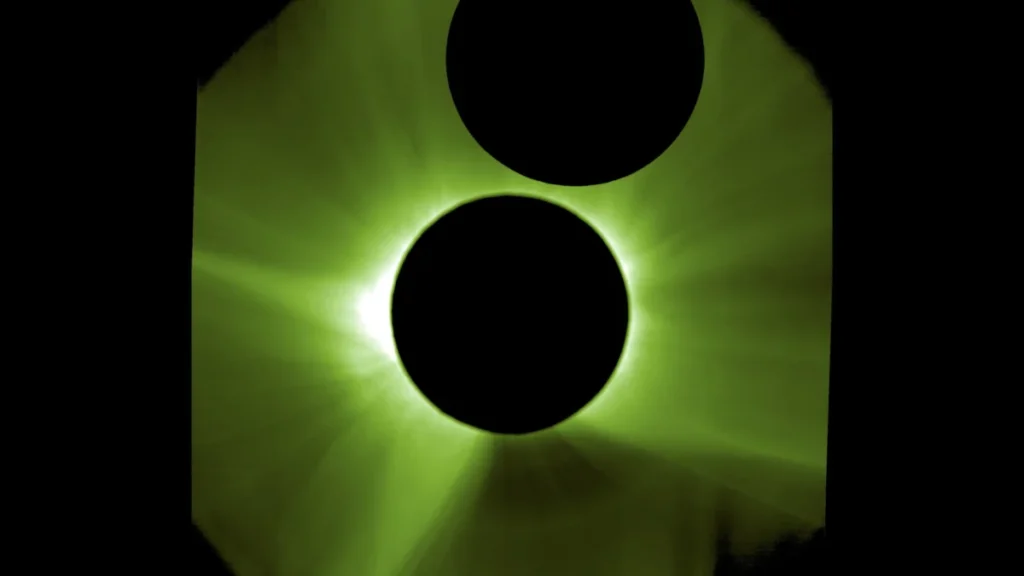
On August 12, 2026, as a breathtaking total solar eclipse traced its path across parts of Europe, a unique cosmic ballet unfolded tens of thousands of kilometers above Earth. The European Space Agency’s (ESA) Proba-3 mission, a pioneering project designed to study the Sun’s corona, found itself in an extraordinary position, observing not one, but two eclipses in a matter of hours. The natural eclipse witnessed by millions on the ground was preceded by an artificial one, meticulously orchestrated by Proba-3’s twin spacecraft, offering scientists an unprecedented opportunity for calibration and observation.
The Proba-3 mission, comprising two satellites – the Occulter and the Coronagraph – operates by creating its own solar eclipses. Flying in precise formation at an altitude of 60,000 kilometers, the Occulter spacecraft positions itself to block the Sun’s blinding disc, effectively acting as an artificial Moon. This allows the Coronagraph spacecraft to capture uninterrupted views of the Sun’s ethereal outer atmosphere, the corona, for extended periods. This capability is crucial for understanding solar phenomena like coronal mass ejections (CMEs) and solar flares, which can impact technological infrastructure and even human spaceflight.
However, on August 12, 2026, nature decided to join ESA’s meticulously planned experiment. Hours before the Moon’s shadow touched down on Earth, it also serendipitously swept across Proba-3’s observational field of view. This celestial alignment resulted in a rare "double eclipse," where the Moon’s passage further obscured the Sun, even as Proba-3’s Occulter was already performing its duty.
A Celestial Coincidence: The Moon Joins the Experiment
The remarkable event was captured by the ASPIICS (Association of Spacecraft for the Investigation of the Corona and Interplanetary Space) coronagraph instrument aboard the Coronagraph spacecraft. Over a three-hour period on the morning of August 12, the Moon, our closest celestial neighbor, made a prominent appearance, crossing the Proba-3 spacecraft’s vantage point.
The Moon’s apparent size in the sky, from Proba-3’s perspective, was slightly larger than the occulting disc of the Occulter spacecraft. This meant that for a duration of 8 minutes and 40 seconds, the Moon completely covered the solar disc. During this entire time, the Proba-3 mission continued to maintain its artificial eclipse, creating a unique scenario of a double solar eclipse.
This prolonged celestial event for Proba-3 had significant scientific implications. The natural eclipse, amplified by the artificial one, provided an extended period of darkness, far exceeding the duration of totality experienced on Earth. While the maximum duration of totality for the ground-based eclipse was approximately 2 minutes and 18 seconds, occurring just off the coast of Iceland, the Proba-3 mission experienced a near-nine-minute double eclipse.
Unprecedented Calibration and Observation Opportunities
The primary benefit of this extended period of darkness was the significant reduction of parasitic light. Parasitic light, often caused by the diffraction of sunlight around the edges of the Occulter spacecraft, can interfere with the delicate observations of the faint corona. With the Moon further obscuring the Sun and minimizing diffracted light, the ASPIICS coronagraph was essentially free from this usual source of noise.
This pristine viewing condition allowed scientists to meticulously calibrate the optical performance of the ASPIICS coronagraph. Calibration is a critical step in ensuring the accuracy and reliability of scientific instruments. By observing the corona under such ideal circumstances, researchers could fine-tune the instrument’s sensitivity and spectral response. Furthermore, it provided an invaluable opportunity for scientists to observe the solar corona in its most unadulterated form, potentially revealing subtle details and structures that might otherwise be masked.
A Once-in-a-Lifetime Opportunity for Proba-3
For the Proba-3 mission, experiencing a natural total solar eclipse while in its operational configuration is an exceptionally rare event. The mission’s design is centered around its ability to create its own eclipses, but the chance alignment with a natural one, and at such close proximity, is a fortunate coincidence that enhances its scientific potential.
ESA’s Proba-3 mission is scheduled to operate for a defined period, and the likelihood of its operational window coinciding with a total solar eclipse visible from its orbital path is statistically low. This particular double eclipse is considered a "once-in-a-lifetime event" for the mission. While Proba-3 will have the opportunity to witness partial eclipses during future ground-based total solar eclipses in August 2027 and July 2028, these events will not involve the Moon fully obscuring the solar disc as it did on August 12, 2026. These future events will still allow for the Moon to pass through the ASPIICS field of view, offering further calibration opportunities, but the unique totality achieved on August 12th provided an unparalleled scientific boon.
Background: The Proba-3 Mission and Its Objectives
The Proba-3 mission, launched on November 15, 2023, is part of ESA’s Technology Demonstrator program. Its primary objective is to demonstrate the capability of flying two spacecraft in close formation to create a large, stable coronagraphic instrument in space. This innovative approach allows for continuous observation of the solar corona, a region of the Sun’s atmosphere that is typically obscured by the Sun’s bright disc.
The Sun’s corona is a region of extremely hot plasma, reaching temperatures of millions of degrees Celsius. It is the source of the solar wind, a stream of charged particles that flows outwards from the Sun and influences space weather. Understanding the dynamics of the corona is crucial for predicting and mitigating the effects of space weather events, such as geomagnetic storms, which can disrupt satellite operations, power grids, and communication systems on Earth.
The Proba-3 mission’s unique formation flying capability addresses a long-standing challenge in solar physics: how to observe the faint structures of the corona without being blinded by the Sun’s intense glare. By creating an artificial eclipse, Proba-3 overcomes the limitations of traditional coronagraphs, which often suffer from stray light.
Chronology of the Double Eclipse Event
- August 12, 2026, Morning (UTC): The Proba-3 mission’s Coronagraph spacecraft, equipped with the ASPIICS instrument, begins its observation period.
- Hours Before Ground Totality: The Moon, as it moves in its orbit, begins to transit across Proba-3’s field of view.
- Coincidental Alignment: The Moon’s path causes it to pass directly in front of the Sun, creating a natural solar eclipse from Proba-3’s perspective. This occurs while the Occulter spacecraft is already actively eclipsing the Sun.
- Double Eclipse Period: For approximately 8 minutes and 40 seconds, both the Moon and the Occulter spacecraft are obscuring the Sun, resulting in a profound reduction of light. This period is significantly longer than the totality experienced on Earth.
- Scientific Observation and Calibration: During the double eclipse, the ASPIICS coronagraph operates in near-perfect conditions, free from parasitic light, allowing for detailed calibration and observation of the solar corona.
- Post-Eclipse Observations: After the Moon moves out of the field of view, Proba-3 continues its artificial eclipses, allowing for further study of the corona.
- Ground-Based Total Solar Eclipse: Later in the day, millions of people across Europe witness the natural total solar eclipse.
Supporting Data and Scientific Context
The duration of totality for the 2026 total solar eclipse varied geographically. The path of totality began in North America, crossed the Atlantic Ocean, and made landfall in Spain, France, and Italy, before moving across the Mediterranean Sea and ending in Egypt. The longest duration of totality, approximately 2 minutes and 18 seconds, was observed near the Faroe Islands.
The distance of Proba-3 from Earth, at approximately 60,000 km, provided a unique perspective. At this altitude, the Moon’s apparent size in the sky is similar to its appearance from Earth, but the spacecraft’s ability to maintain a stable occulting position allowed for a prolonged period of darkness. The relative size of the Moon compared to the Sun as seen from Proba-3, coupled with the Occulter’s precise positioning, created the extended double eclipse.
The ASPIICS instrument on Proba-3 is designed to observe the solar corona in visible light, specifically focusing on emission lines that reveal the composition, temperature, and velocity of the plasma. These observations are vital for understanding fundamental solar physics and the processes that drive space weather.
Broader Impact and Implications
The scientific data gathered during this double eclipse is expected to contribute significantly to our understanding of the solar corona and its influence on the heliosphere. The ability to calibrate instruments under such ideal conditions validates and enhances the reliability of future solar observations.
Furthermore, the success of the Proba-3 mission, particularly in demonstrating its formation flying capabilities and its ability to create artificial eclipses, has significant implications for future space-based solar observatories. The techniques developed and tested by Proba-3 could pave the way for more sophisticated and capable instruments designed to study the Sun in unprecedented detail.
The mission also serves as a testament to international collaboration in space exploration, with contributions from various ESA member states and partner organizations. The data collected will be made available to the global scientific community, fostering further research and discovery.
The 2026 total solar eclipse was a widely anticipated event, with numerous astronomical organizations and space agencies preparing to observe and document it. ESA’s own compilation of images and observations from the natural eclipse highlights the widespread interest and the collective effort to capture this celestial phenomenon. The Proba-3 mission’s unique experience, however, adds a scientific dimension that extends far beyond the visual spectacle, offering valuable insights into the Sun and the cosmos.