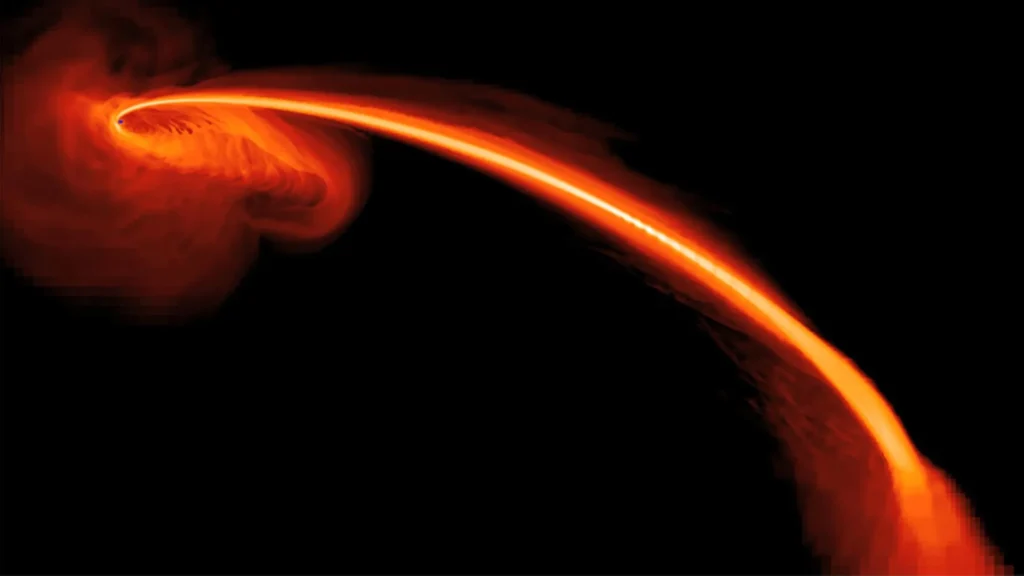
Most galaxies are thought to harbor a supermassive black hole at their center, colossal entities weighing millions or even billions of times the mass of our Sun, generating some of the most intense gravitational environments in the cosmos. When a star ventures too close to these cosmic behemoths, its demise isn’t always a swift, singular event. Some stars manage to survive the initial encounter, only to return for subsequent close passes, each interaction igniting a fresh burst of electromagnetic radiation. These phenomena, known as repeating partial tidal disruption events (rpTDEs), offer astronomers a rare opportunity to witness the same stellar system repeatedly interacting with the same black hole. The advent of wide-field time-domain surveys, which meticulously scan vast swathes of the night sky and meticulously track celestial objects exhibiting variability in brightness, has made these observations increasingly feasible.
However, a subset of these rpTDE systems has presented a persistent enigma for the astronomical community. Instead of exhibiting similar flare intensities with each successive orbit, these events have been observed to become progressively fainter. For years, theoretical models struggled to adequately account for this peculiar dimming trend, leaving scientists searching for a missing piece of the puzzle.
Now, groundbreaking research emerging from astrophysicists at Syracuse University offers a compelling explanation, pinpointing a previously underappreciated stellar property: the star’s rotational speed prior to its initial close encounter with the supermassive black hole.
Unraveling the Mechanics of Tidal Disruption
A standard tidal disruption event (TDE) occurs when the immense gravitational gradient of a black hole exerts a differential pull across a star. This tidal force, vastly stronger on the side of the star closer to the black hole than on the farther side, tears the star apart. The resulting stellar debris, a stream of gas and plasma, then begins to spiral inward, or "accrete," onto the black hole. As this material loses orbital energy and falls into the black hole’s abyss, it heats up and emits light, producing a luminous flare that can persist for periods ranging from days to months.
While black holes themselves are inherently invisible due to their light-trapping nature, TDEs temporarily supply an incandescent cloak of matter, illuminating the otherwise dark vicinity of these enigmatic objects. This luminous signature provides astronomers with an indirect, yet invaluable, method for probing and studying these celestial enigmas.
Not every stellar encounter with a black hole culminates in complete obliteration. If a star’s trajectory brings it close to a black hole but without crossing the critical threshold for total disintegration, it can shed only a fraction of its mass, resulting in a partial TDE. In the context of a repeating partial TDE, the star’s surviving core remains bound in orbit around the black hole. It then embarks on a series of recurring close passages, each time ejecting additional material. These orbital returns can occur on timescales ranging from months to several years, offering astronomers multiple observational windows into the same dynamic process.
The Enigma of Fading Galactic Flares
The quantity of stellar material stripped away during these repeated tidal encounters is intrinsically linked to the star’s internal structure. Dr. Ananya Bandopadhyay, a doctoral student at Syracuse University and lead author of the new study, likens a low-mass star to a delicate meringue. Such a star, with its loosely bound outer layers, can become increasingly vulnerable to the black hole’s powerful tidal forces.
In contrast, a higher-mass star possesses a more concentrated internal structure, akin to an onion with its material tightly packed towards the core. This configuration allows it to shed its outer envelopes while its dense, central core remains relatively intact, leading to a progressively decreasing amount of mass lost with each successive encounter. This structural variation offers a partial explanation for why not all rpTDEs evolve identically.
However, one particular observational outcome has proven particularly vexing: the steady dimming of flares from a significant portion of the approximately 10 repeating systems identified to date. While it might intuitively seem that less stripped material would naturally result in weaker flares, previous hydrodynamic simulations presented a confounding paradox. Even when models indicated a reduction in the mass of material lost during each passage, they consistently predicted flares with roughly comparable peak brightness.
"We were puzzled by this for two years," Bandopadhyay stated in an interview.
A New Ingredient: Stellar Spin
The Syracuse University research team’s breakthrough stems from a deeper understanding of the complex interplay between the star and the black hole’s tidal forces. Their prior work had uncovered a crucial consequence beyond mere mass stripping: the tidal forces also exert a significant torque on the star, inducing a faster rotation rate after each close encounter.
This accelerated spin fundamentally alters the dynamics of the returning stellar debris. While the quantity of material might be less, its inflow towards the black hole becomes concentrated over a shorter temporal period. This more focused stream helps maintain a similar peak fallback rate, and consequently, a roughly consistent predicted flare brightness in the simulations.
To reconcile their models with the observed dimming flares, the researchers introduced a critical "new ingredient," as Bandopadhyay described it: a star that was already spinning rapidly before its initial close encounter with the supermassive black hole.
The new simulations suggest that a pre-rotating star experiences a significantly reduced increase in its spin rate during subsequent tidal encounters. Without this substantial spin-up after each passage, the time it takes for the stripped stellar material to fall back towards the black hole remains relatively constant.
This recalibrated understanding dramatically alters the outcome. As progressively less material is stripped from the star over time, the peak fallback rate consequently diminishes. The predicted flare luminosity then naturally decreases with each subsequent encounter, aligning precisely with the dimming trend observed by astronomers.
The Hills Mechanism: A Potential Capture Scenario
The finding that pre-existing rapid stellar rotation is key to explaining fading rpTDE flares naturally leads to another pertinent question: what mechanism could imbue a star with such high rotational velocity before it even approaches a supermassive black hole?
Professor Eric Coughlin, an associate professor at Syracuse University and a key collaborator on the study, commented on the challenge: "It is also extremely difficult to ‘bind’ a star to a supermassive black hole so tightly that it orbits the black hole in a matter of months, and yet they seem to do so in rpTDEs."
The Hills mechanism, a theoretical astrophysical process, offers a compelling explanation for both the rapid pre-encounter rotation and the star’s unusually tight orbit observed in rpTDEs. This scenario posits that the supermassive black hole encounters a binary star system where two stars are orbiting each other in very close proximity. The black hole’s immense gravity then tears this binary system apart. In this gravitational tug-of-war, one star is violently ejected from the vicinity of the black hole, while the other is captured into a stable orbit around it.
Stars locked in a very close binary system can become tidally locked. This means each star rotates on its axis at precisely the same rate that the pair orbits around their common center of mass. The tighter the binary system, the shorter its orbital period, and consequently, the faster a tidally locked star within that system must rotate.
For a captured star to end up on the short, months-long orbit characteristic of rpTDEs, the original binary system must have been exceptionally compact. This same tight configuration would naturally result in a rapidly spinning, tidally locked star before the black hole captured it.
"Ananya’s work demonstrates that each of these peculiarities can be explained by the same underlying phenomenon: the tidal destruction of a binary system and the capture of one of the stars," Coughlin emphasized. "From a theoretical standpoint, this is a major step forward in our understanding of the physics at play in these systems."
Implications for Our Own Galactic Backyard
The implications of this research extend beyond the distant, repeating flare systems observed in other galaxies. Professor Coughlin notes that the Hills capture mechanism could also be responsible for the origin of some of the stars currently orbiting Sagittarius A*, the supermassive black hole residing at the heart of our own Milky Way galaxy.
If this mechanism is indeed at play in our galactic center, then the same physical process that may explain the fading rpTDE flares could also shed light on some of the peculiar stellar populations observed around Sagittarius A*. This could provide astronomers with a deeper understanding of the dynamics and history of the stars in what Coughlin aptly describes as "our own cosmological backyard." The potential connection between these distant phenomena and the enigmatic environment of our own galactic nucleus underscores the far-reaching impact of this new research.